Imagine having a team of tireless digital assistants working around the clock, handling repetitive tasks, analyzing data, and making intelligent decisions without human intervention. This isn’t science fiction—it’s the reality that an AI agents platform brings to modern businesses.
In today’s fast-paced digital landscape, organizations are drowning in routine tasks that consume valuable time and resources. From customer service inquiries to data entry, content generation to workflow management, these repetitive activities prevent teams from focusing on strategic initiatives that drive growth.
AI agent platforms have emerged as the solution to this productivity crisis. These sophisticated systems deploy autonomous software agents that can perceive their environment, make decisions, and take actions to achieve specific goals. Unlike traditional automation tools that follow rigid scripts, AI agents learn, adapt, and improve over time.
In this comprehensive guide, we’ll explore the 10 best AI agent platforms available today, examining their unique features, use cases, and how they can revolutionize your workflow. Whether you’re a small business owner or an enterprise leader, you’ll discover the perfect solution to supercharge your operations.
Understanding AI Agent Platforms: What They Are and Why They Matter
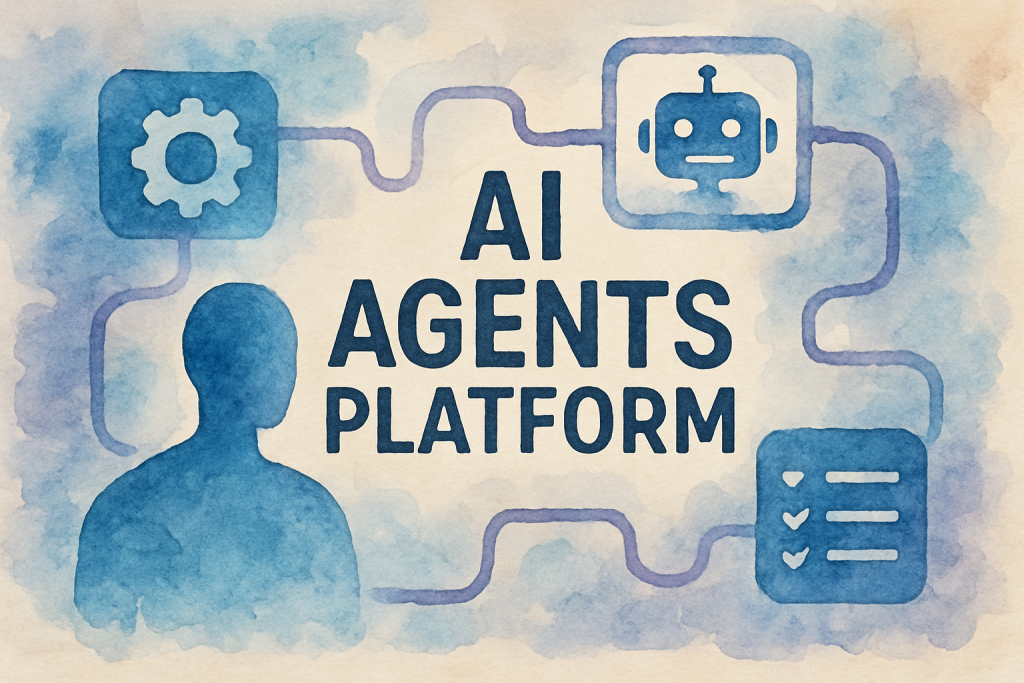
An AI agents platform is a comprehensive software ecosystem that enables the creation, deployment, and management of autonomous AI agents. These platforms provide the infrastructure, tools, and frameworks necessary to build intelligent systems that can perform complex tasks with minimal human oversight.
The Core Components of AI Agent Platforms
Modern AI agent platforms typically include several essential components that work together seamlessly. The foundation consists of natural language processing capabilities that allow agents to understand and generate human language. Machine learning algorithms enable continuous improvement through experience and data analysis.
Integration capabilities form another crucial element, allowing agents to connect with existing business systems, databases, and third-party applications. This interoperability ensures that AI agents can access the information they need and execute actions across your entire technology stack.
The orchestration layer manages multiple agents working in concert, coordinating their activities and ensuring they don’t conflict with each other. This is particularly important in complex workflows where different agents handle various aspects of a single process.
Why Businesses Are Adopting AI Agent Technology
The adoption of AI agent platforms has accelerated dramatically, with the global AI market projected to reach $1.8 trillion by 2030 according to Grand View Research. This explosive growth reflects the tangible benefits organizations are experiencing.
Companies implementing AI agents report productivity increases of 30-40% in automated departments. Customer service teams using AI agent platforms have reduced response times by up to 80% while maintaining or improving satisfaction scores. These aren’t marginal improvements—they’re transformative changes that directly impact the bottom line.
Beyond efficiency gains, AI agents platform solutions provide scalability that human teams simply cannot match. An AI agent can handle thousands of simultaneous conversations, process millions of data points, or monitor countless systems without fatigue or error.
Current Trends Shaping the AI Agent Landscape
The AI agent ecosystem is evolving rapidly with several key trends emerging. Multi-agent systems are becoming more sophisticated, with specialized agents collaborating to solve complex problems. Autonomous decision-making capabilities are advancing, allowing agents to handle increasingly nuanced scenarios without human intervention.
Low-code and no-code platforms are democratizing AI agent development, enabling business users without programming expertise to create and deploy their own agents. This shift is accelerating adoption across organizations of all sizes and technical capabilities.
The 10 Best AI Agent Platforms for 2025
1. AutoGPT: The Pioneer of Autonomous AI Agents
AutoGPT revolutionized the AI agents platform space by demonstrating how large language models could be chained together to accomplish complex goals autonomously. This open-source platform allows users to set objectives and watch as the AI breaks them down into subtasks, executes them, and learns from the results.
Key features include autonomous goal decomposition, internet browsing capabilities, and memory management for long-term context retention. AutoGPT excels in research tasks, content creation workflows, and data analysis projects where exploration and iteration are essential.
2. LangChain: Building Sophisticated Agent Workflows
LangChain has become the go-to framework for developers building production-ready AI agent applications. Its modular architecture allows for the creation of complex agent chains that combine multiple AI models, tools, and data sources.
The platform offers extensive integration options with vector databases, APIs, and external tools. LangChain’s agent executors can reason about which tools to use and in what order, making it ideal for building custom AI solutions tailored to specific business needs.
3. Microsoft Copilot Studio: Enterprise-Grade Agent Development
Microsoft’s Copilot Studio brings enterprise security and scalability to AI agent development. Built on Azure’s robust infrastructure, this platform enables organizations to create custom copilots that integrate seamlessly with Microsoft 365 and other business applications.
The visual development environment makes it accessible to citizen developers while providing the power and flexibility that professional developers require. Copilot Studio includes pre-built connectors to hundreds of data sources and services, accelerating time-to-value.
4. CrewAI: Orchestrating Multi-Agent Collaboration
CrewAI specializes in coordinating multiple AI agents working together as a team. Each agent has defined roles, goals, and backstories, allowing for sophisticated collaboration patterns that mirror human team dynamics.
This AI agents platform shines in scenarios requiring diverse expertise, such as content production workflows where research agents, writing agents, and editing agents collaborate to produce high-quality output. The platform handles task delegation, communication between agents, and result aggregation automatically.
5. Zapier Central: No-Code AI Agent Automation
Zapier Central extends the popular automation platform into the AI agent realm, offering a no-code interface for creating intelligent automation workflows. Users can build agents that monitor triggers, make decisions based on context, and execute actions across thousands of integrated applications.
The platform’s strength lies in its accessibility and extensive app ecosystem. Business users can create sophisticated AI-powered workflows without writing a single line of code, democratizing AI agent technology across organizations.
6. Relevance AI: Purpose-Built for Business Operations
Relevance AI focuses on practical business applications, offering pre-built agent templates for common use cases like lead qualification, customer support, and data enrichment. The platform combines AI agents with workflow automation and data analysis capabilities.
Teams can deploy agents that automatically categorize support tickets, enrich CRM data, or qualify leads based on complex criteria. The visual workflow builder makes it easy to customize agent behavior without technical expertise.
7. Fixie.ai: Conversational AI Agents at Scale
Fixie.ai specializes in building conversational AI agents that can engage in natural, context-aware dialogues. The platform provides tools for creating agents that remember conversation history, access external data sources, and take actions based on user requests.
This AI agents platform excels in customer service applications, virtual assistant development, and any scenario where natural language interaction is paramount. The platform’s memory management ensures agents maintain context across long conversations and multiple sessions.
8. Superagent: Open-Source Agent Infrastructure
Superagent offers an open-source alternative for organizations that want full control over their AI agent infrastructure. The platform provides APIs and SDKs for building, deploying, and managing agents across various environments.
Developers appreciate Superagent’s flexibility and extensibility. The platform supports multiple LLM providers, custom tool integration, and deployment options ranging from cloud to on-premises. This makes it ideal for organizations with specific security or compliance requirements.
9. Dust: AI Agents for Knowledge Work
Dust focuses on augmenting knowledge workers with AI agents that can access company data, answer questions, and assist with research and analysis tasks. The platform emphasizes data security and privacy, making it suitable for handling sensitive business information.
Agents built on Dust can search across multiple data sources, synthesize information, and provide contextual answers to complex questions. The platform integrates with popular productivity tools and knowledge bases, becoming a central hub for organizational intelligence.
10. Adala: Specialized Agents for Data Processing
Adala specializes in AI agents for data labeling, classification, and processing tasks. The platform enables the creation of agents that can autonomously label datasets, identify patterns, and improve data quality at scale.
For organizations dealing with large volumes of unstructured data, Adala provides agents that learn from examples and continuously improve their accuracy. This is particularly valuable in machine learning projects where high-quality training data is essential.
Implementing AI Agents: A Strategic Approach
Step 1: Identify High-Impact Use Cases
Successful AI agent implementation begins with identifying processes that will benefit most from automation. Look for tasks that are repetitive, time-consuming, and rule-based but require some level of decision-making or adaptation.
Customer service inquiries, data entry and validation, content moderation, and lead qualification are excellent starting points. These use cases typically deliver quick wins that build momentum for broader adoption.
Conduct a workflow audit to map current processes and identify bottlenecks. Calculate the time spent on each task and estimate potential savings. This data-driven approach helps prioritize implementation efforts and demonstrates ROI to stakeholders.
Step 2: Choose the Right AI Agents Platform
Selecting the appropriate platform depends on several factors including technical expertise, integration requirements, scalability needs, and budget constraints. Organizations with strong development teams might prefer flexible frameworks like LangChain or Superagent that offer maximum customization.
Business users without coding experience should consider no-code platforms like Zapier Central or Relevance AI. These solutions provide pre-built templates and visual interfaces that accelerate deployment without sacrificing capability.
Evaluate platforms based on their integration ecosystem, ensuring they connect with your existing tools and data sources. Security and compliance features are critical for enterprises handling sensitive information.
Step 3: Start Small and Iterate
Begin with a pilot project that addresses a specific pain point rather than attempting to transform your entire operation at once. This approach allows you to learn, adjust, and demonstrate value before scaling.
Define clear success metrics for your pilot, such as time saved, error reduction, or customer satisfaction improvements. Monitor these metrics closely and gather feedback from users interacting with the AI agents.
Use insights from the pilot to refine your approach. AI agents improve with feedback and training data, so establish processes for continuous improvement. Document lessons learned and best practices to inform future implementations.
Step 4: Scale Strategically Across the Organization
Once you’ve validated the approach with a successful pilot, develop a roadmap for broader deployment. Prioritize use cases based on impact, feasibility, and strategic alignment with business objectives.
Invest in training and change management to ensure teams understand how to work effectively with AI agents. Address concerns about job displacement by emphasizing how agents augment human capabilities rather than replace them.
Establish governance frameworks that define how AI agents should be developed, deployed, and monitored. This includes guidelines for data usage, decision-making authority, and escalation procedures when agents encounter situations beyond their capabilities.
Best Practices for AI Agent Success
Design agents with clear, specific objectives rather than trying to create general-purpose solutions. Specialized agents typically perform better and are easier to maintain than those attempting to handle too many diverse tasks.
Implement robust monitoring and logging to track agent performance and identify issues quickly. Set up alerts for anomalies or errors that require human intervention.
Maintain human oversight, especially in critical processes. AI agents should augment human decision-making, not replace it entirely. Design workflows that allow humans to review and approve important actions.
Regularly update and retrain agents as business processes evolve. An AI agents platform should be treated as a living system that requires ongoing maintenance and improvement.
Overcoming Common AI Agent Implementation Challenges
Challenge 1: Integration Complexity
Connecting AI agents to existing systems often proves more difficult than anticipated. Legacy systems may lack APIs, data formats might be inconsistent, and security protocols can complicate access.
Solution: Start by creating a comprehensive integration map that documents all systems the agent needs to access. Use middleware or integration platforms to bridge gaps between modern AI agents platform solutions and legacy systems. Consider API wrappers or custom connectors for systems without native integration options.
Challenge 2: Data Quality and Availability
AI agents are only as good as the data they access. Incomplete, outdated, or inconsistent data leads to poor agent performance and unreliable outputs.
Solution: Implement data governance practices before deploying agents. Clean and standardize data sources, establish data quality metrics, and create processes for ongoing data maintenance. Consider starting with use cases that rely on high-quality data sources while working to improve others.
Challenge 3: Managing User Expectations
Unrealistic expectations about AI agent capabilities can lead to disappointment and resistance. Users may expect human-level understanding and flexibility that current technology cannot deliver.
Solution: Communicate clearly about what agents can and cannot do. Provide training that demonstrates both capabilities and limitations. Set appropriate expectations by framing agents as assistants that handle specific tasks rather than general-purpose problem solvers.
Challenge 4: Ensuring Reliability and Consistency
AI agents can sometimes produce inconsistent results or make unexpected decisions, particularly when encountering edge cases or unusual inputs.
Solution: Implement comprehensive testing that covers normal operations and edge cases. Use techniques like prompt engineering and few-shot learning to improve consistency. Establish fallback mechanisms that route complex or ambiguous situations to human operators. Monitor agent outputs regularly and refine based on real-world performance.
Challenge 5: Scaling Costs
As AI agent usage grows, costs associated with API calls, compute resources, and data storage can escalate quickly, potentially eroding ROI.
Solution: Implement cost monitoring and optimization strategies from the start. Use caching to reduce redundant API calls, optimize prompts to minimize token usage, and consider self-hosted models for high-volume use cases. Regularly review usage patterns and adjust agent behavior to balance performance with cost efficiency.
Conclusion: Embracing the AI Agent Revolution
The emergence of sophisticated AI agents platform solutions represents a fundamental shift in how work gets done. These intelligent systems are no longer experimental technology—they’re practical tools delivering measurable results across industries and use cases.
From AutoGPT’s autonomous problem-solving to Microsoft Copilot Studio’s enterprise-grade capabilities, the platforms we’ve explored offer diverse approaches to AI agent implementation. Whether you’re a developer seeking maximum flexibility or a business user wanting no-code simplicity, there’s a solution that fits your needs.
The key to success lies not in the technology itself but in thoughtful implementation. Start with clear objectives, choose the right platform for your requirements, and iterate based on real-world results. Remember that AI agents augment human capabilities rather than replace them—the most effective implementations combine artificial intelligence with human judgment.
As these platforms continue to evolve, early adopters will gain significant competitive advantages. Organizations that master AI agent technology today will be better positioned to adapt to tomorrow’s challenges and opportunities.
The question isn’t whether to adopt an AI agents platform, but when and how. The tools are ready, the use cases are proven, and the benefits are clear. The time to supercharge your workflow with AI agents is now.
Ready to transform your business with AI agents? The experts at The Crunch can help you navigate the AI agent landscape, select the right platform, and implement solutions that deliver real results. Schedule your free consultation today and discover how AI agents can revolutionize your workflow.
Frequently Asked Questions (FAQ)
1. What is an AI agents platform?
2. How do AI agents platforms work?
3. What are the main benefits of using an AI agents platform?
4. How do I get started with an AI agents platform?
5. How does an AI agents platform differ from traditional automation tools?
6. What are common use cases for AI agents platforms?
7. Are AI agents platforms secure?
8. How much do AI agents platforms cost?
9. Can I integrate AI agents platforms with my existing tools?
10. What skills are needed to use an AI agents platform?
11. What are some challenges or limitations of AI agents platforms?
12. How do I choose the right AI agents platform for my business?