AI Agent Workflow Builder: 5 Steps to Automate Your Workflow Like a Pro
Introduction: The Future of Work is Automated
Imagine cutting your repetitive tasks by 80% while your team focuses on strategic initiatives that actually move the needle. That’s not a distant dream—it’s the reality businesses are creating today with intelligent automation.
In today’s fast-paced digital landscape, manual workflows are becoming obsolete. Companies that cling to outdated processes find themselves drowning in administrative tasks while competitors race ahead. The solution? An AI agent workflow builder that transforms how your team operates.
Whether you’re a startup founder juggling multiple roles or a business leader seeking operational efficiency, AI agents can revolutionize your daily operations. These intelligent systems handle everything from customer inquiries to data processing, freeing your team to focus on innovation and growth.
In this comprehensive guide, you’ll discover exactly how to build AI agents that work for you 24/7. We’ll walk through five actionable steps that take you from concept to implementation, explore real-world benefits, and address common challenges you might face along the way.
Ready to transform your workflow? Let’s go.
Understanding AI Agent Workflow Builders: Your Digital Workforce
What is an AI Agent Workflow Builder?
An AI agent workflow builder is a sophisticated platform that enables you to create, deploy, and manage intelligent automation systems without extensive coding knowledge. Think of it as your command center for building digital employees that handle specific tasks with precision and consistency.
These platforms combine artificial intelligence, machine learning, and workflow automation into a unified system. Unlike traditional automation tools that follow rigid if-then rules, AI agents learn from interactions, adapt to new scenarios, and make intelligent decisions based on context.
The technology has evolved dramatically. According to recent industry research, 67% of businesses now use some form of AI automation, with that number expected to reach 85% by 2025. This isn’t just a trend—it’s a fundamental shift in how work gets done.
Why Your Business Needs AI Workflow Automation Now
The competitive landscape has changed. Companies leveraging AI agents report average productivity gains of 40% and cost reductions of up to 30%. These aren’t marginal improvements—they’re game-changing advantages.
Traditional workflows create bottlenecks. Every manual handoff introduces delays, errors, and frustration. AI agents eliminate these friction points by seamlessly connecting systems, processing information instantly, and executing tasks without human intervention.
Consider customer service. While your team sleeps, AI agents handle inquiries, resolve common issues, and escalate complex problems to the right person. Your customers get instant responses, and your team tackles only the challenges that require human expertise.
The Evolution of Intelligent Automation
This evolution means your AI agents become more valuable over time. They identify patterns in your workflows, suggest optimizations, and adapt to changing business needs without constant reprogramming.
5 Powerful Benefits of Using an AI Agent Workflow Builder
1. Dramatic Time Savings and Productivity Gains
Time is your most valuable resource, and AI agents are master time-savers. Tasks that once consumed hours now complete in minutes. Data entry, report generation, email sorting, appointment scheduling—these routine activities happen automatically while your team focuses on strategic work.
Real-world example: A mid-sized marketing agency implemented an AI agent workflow builder for client onboarding. What previously took 3 hours of manual work now completes in 15 minutes, allowing them to onboard 10x more clients with the same team size.
2. Consistent Quality and Error Reduction
Human error is inevitable when handling repetitive tasks. Fatigue sets in, attention wanders, and mistakes happen. AI agents maintain perfect consistency, executing workflows exactly as designed every single time.
This reliability is particularly crucial for compliance-heavy industries. Financial services firms use AI agents to ensure every transaction follows regulatory requirements, reducing compliance violations by up to 95%.
3. Scalability Without Proportional Cost Increases
Traditional scaling means hiring more people, which increases costs linearly. AI agents break this model. Once built, they handle 10 requests or 10,000 requests with minimal additional cost.
Your business can grow rapidly without the typical growing pains. Seasonal spikes? No problem. New market expansion? Your AI agents scale instantly to meet demand.
4. 24/7 Operations and Global Reach
AI agents never sleep, take vacations, or call in sick. They provide round-the-clock service across all time zones, ensuring your business never misses opportunities.
For companies with international customers, this means providing consistent service quality regardless of when or where requests come in. Your Tokyo customers get the same excellent experience as your New York clients.
5. Data-Driven Insights and Continuous Improvement
Every interaction your AI agents handle generates valuable data. These insights reveal bottlenecks, customer preferences, and optimization opportunities you might never discover manually.
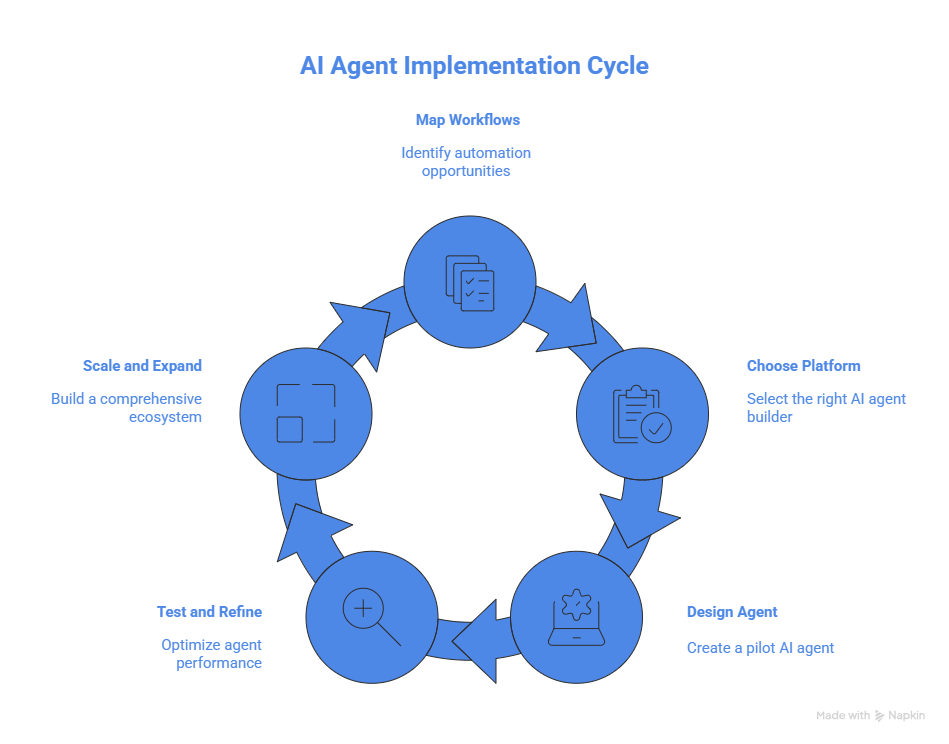
How to Build AI Agents: Your 5-Step Implementation Guide
Step 1: Map Your Current Workflows and Identify Automation Opportunities
Start by documenting your existing processes. Which tasks consume the most time? Where do errors frequently occur? What activities frustrate your team?
Create a workflow inventory listing every repetitive process in your organization. Prioritize based on three criteria: frequency, time consumption, and business impact. The sweet spot for initial automation is high-frequency, time-intensive tasks that don’t require complex human judgment.
Pro tip: Involve your team in this discovery phase. They know the pain points better than anyone and will be more invested in the solution when they’ve contributed to its design.
Step 2: Choose the Right AI Agent Workflow Builder Platform
Not all platforms are created equal. Evaluate options based on your technical capabilities, integration needs, and scalability requirements.
Key features to look for include:
- Intuitive visual workflow designer with drag-and-drop functionality
- Pre-built templates for common use cases
- Robust integration capabilities with your existing tools
- Natural language processing for conversational AI agents
- Security features and compliance certifications
Consider starting with a platform that offers a free trial or sandbox environment. This allows you to test functionality before committing resources.
Step 3: Design and Build Your First AI Agent
Begin with a pilot project—something valuable but not mission-critical. This approach minimizes risk while demonstrating value quickly.
Define your agent’s purpose clearly. What specific problem does it solve? What triggers its actions? What outcomes should it produce? Clear objectives guide effective design.
Use your AI agent workflow builder’s visual interface to map the workflow. Connect trigger events to actions, add decision points, and configure integrations with your existing systems. Most modern platforms make this process surprisingly intuitive, even for non-technical users.
Best practice: Build in small increments. Create a basic version, test it thoroughly, then add complexity gradually. This iterative approach prevents overwhelming complexity and makes troubleshooting easier.
Step 4: Test, Refine, and Optimize Performance
Testing isn’t optional—it’s essential. Run your AI agent through various scenarios, including edge cases and potential failure points. What happens when data is missing? How does it handle unexpected inputs?
Gather feedback from actual users. Their real-world experience reveals issues you might miss in controlled testing. Create feedback loops that capture both quantitative metrics and qualitative insights.
Monitor performance continuously. Track key metrics like completion rates, error frequencies, and processing times. Use this data to identify optimization opportunities and refine your workflows.
Step 5: Scale and Expand Your AI Agent Ecosystem
Once your pilot succeeds, expand strategically. Apply lessons learned to new workflows, building a comprehensive automation ecosystem.
Create standardized templates for common workflow patterns. This accelerates future development and ensures consistency across your AI agent fleet.
Consider advanced capabilities like multi-agent collaboration, where different AI agents work together to handle complex processes. For example, one agent qualifies leads, another schedules meetings, and a third prepares personalized proposals—all working in concert without human intervention.
Document everything. Create playbooks that explain how each agent works, what it automates, and how to modify it. This documentation becomes invaluable as your automation program grows.
Overcoming Common AI Agent Workflow Builder Challenges
Challenge 1: Integration Complexity with Legacy Systems
Many businesses struggle connecting modern AI agents with older systems that weren’t designed for automation. APIs might be limited or non-existent, creating integration headaches.
Solution: Start with systems that offer robust APIs and modern integration capabilities. Use middleware platforms that bridge legacy systems and modern automation tools. In some cases, screen scraping or RPA (Robotic Process Automation) can provide workarounds until proper integrations are available.
Challenge 2: Team Resistance and Change Management
Employees sometimes fear AI agents will replace their jobs, creating resistance to adoption. This anxiety can derail even the best automation initiatives.
Solution: Frame AI agents as tools that eliminate tedious work, not replace people. Involve team members in the design process, showing how automation frees them for more meaningful work. Celebrate early wins publicly and share success stories that demonstrate positive impact.
Challenge 3: Maintaining AI Agents as Business Needs Evolve
Workflows change. New tools get adopted. Business processes evolve. Without proper maintenance, AI agents become outdated and ineffective.
Solution: Establish governance processes for your AI agent workflow builder program. Assign ownership for each agent, schedule regular reviews, and create clear procedures for requesting modifications. Treat your AI agents like any other business asset that requires ongoing management.
Challenge 4: Balancing Automation with Human Touch
Not everything should be automated. Some interactions benefit from human empathy, creativity, and judgment. Finding the right balance is crucial.
Solution: Design hybrid workflows where AI agents handle routine aspects while seamlessly escalating to humans when needed. Use AI to augment human capabilities rather than replace them entirely. The goal is human-AI collaboration, not complete automation.
Conclusion: Your Journey to Workflow Automation Starts Now
Building AI agents isn’t just about technology—it’s about transforming how your business operates. The five steps we’ve covered provide a proven roadmap from concept to implementation, helping you automate workflows that drive real business value.
Remember, successful automation is a journey, not a destination. Start small with high-impact workflows, learn from each implementation, and scale strategically. The businesses winning today aren’t those with the most AI agents—they’re the ones using an AI agent workflow builder to solve real problems and create genuine competitive advantages.
The benefits are clear: dramatic time savings, consistent quality, unlimited scalability, and continuous improvement. The challenges are manageable with proper planning and the right approach. What matters most is taking that first step.
Your competitors are already exploring these capabilities. The question isn’t whether to automate—it’s how quickly you can implement AI agents that transform your operations.
Ready to build AI agents that revolutionize your workflow? The team at The Crunch specializes in helping businesses design, implement, and optimize AI automation strategies tailored to your unique needs.
Don’t navigate this transformation alone. Contact The Crunch today to schedule your free consultation and discover how an AI agent workflow builder can unlock unprecedented efficiency in your organization. Let’s build your automated future together.
Frequently Asked Questions (FAQ)
1. What is an AI agent workflow builder?
2. How does an AI agent workflow builder work?
3. What are the main benefits of using an AI agent workflow builder?
4. How do I get started with an AI agent workflow builder?
5. What features should I look for in an AI agent workflow builder?
6. How does an AI agent workflow builder compare to traditional automation tools?
7. Are AI agent workflow builders expensive?
8. Can I use an AI agent workflow builder without coding experience?
9. What are common concerns when using AI agent workflow builders?
10. Can AI agent workflow builders integrate with my existing tools?
11. What types of tasks can I automate with an AI agent workflow builder?
12. Is my data safe when using an AI agent workflow builder?