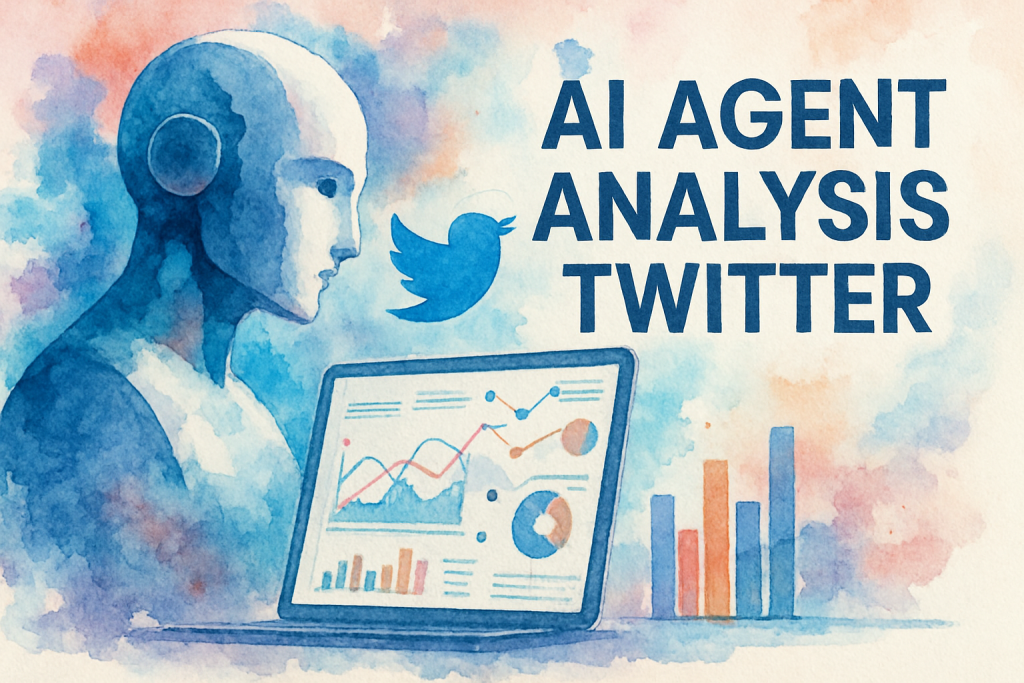
Twitter has evolved into a goldmine of real-time data, consumer insights, and brand intelligence. Yet, sifting through millions of tweets manually is like finding a needle in a haystack whilst blindfolded. Enter AI agent for Twitter Analysis is a smart solution that came in time—sophisticated tools that transform chaotic social media noise into actionable business intelligence. These intelligent systems don’t just count likes and retweets; they analyse sentiment, predict trends, and uncover opportunities that human analysts might miss.
Quick Answer
Brandwatch, Sprinklr, Talkwalker, Synthesio, and Crimson Hexagon—offer enterprise-grade capabilities that process millions of tweets daily, delivering insights that drive strategic decision-making. These tools reduce analysis time by up to 85% whilst improving accuracy and uncovering patterns invisible to traditional methods.
Understanding AI Agent Analysis for Twitter in 2025
These intelligent systems employ sophisticated algorithms that go far beyond simple keyword matching. They understand linguistic nuances, cultural context, and even visual content within tweets. Modern AI agents can identify whether a tweet mentioning your brand is genuinely positive or dripping with sarcasm—a distinction that traditional sentiment analysis often misses.
What makes 2025’s AI agents revolutionary is their ability to learn and adapt. These systems improve their accuracy over time, understanding your specific industry terminology, brand voice, and competitive landscape. They don’t just tell you what happened; they predict what’s likely to happen next and recommend specific actions.
Key Technologies Powering Modern AI Agents
Several technological breakthroughs enable today’s sophisticated AI agent analysis Twitter platforms:
-
- Natural Language Processing (NLP): Advanced NLP models understand context, idioms, and multilingual content with near-human accuracy
- Computer Vision: AI agents analyse images and videos within tweets, extracting brand logos, products, and visual sentiment
- Machine Learning: Continuous learning algorithms improve classification accuracy and reduce false positives
Network analysis reveals influence patterns and identifies key opinion leaders within conversations
- Predictive Modelling: Statistical models forecast trend trajectories and potential viral content
The market offers numerous solutions, but five platforms stand distinctly above the rest in terms of capability, accuracy, and business impact. Each brings unique strengths to AI agent analysis Twitter workflows.
1. Brandwatch Consumer Intelligence
Brandwatch has established itself as the gold standard for enterprise social listening. Its AI agent capabilities process over 1.4 trillion historical conversations and add 500 million new posts daily from across the social web, with Twitter being a primary focus.
The platform’s Iris AI technology automatically categorises conversations into topics, themes, and sentiment without requiring manual rule creation. This autonomous classification saves analysts countless hours whilst maintaining accuracy rates exceeding 90%. Brandwatch’s image recognition capabilities identify brand logos and products in tweets, even when not explicitly mentioned in text.
2. Sprinklr Insights
Sprinklr takes a unified approach to social media management, combining AI agent analysis Twitter capabilities with response management and content publishing. This integration proves particularly valuable for large organisations managing multiple brands and accounts.
The platform’s AI Studio allows businesses to train custom machine learning models specific to their industry and use cases. A pharmaceutical company, for instance, can teach the system to identify adverse event reports in tweets, whilst a retail brand might focus on product defect mentions. This customisation delivers precision that generic models cannot match.
Sprinklr’s real-time alerting system monitors Twitter for crisis indicators, automatically escalating potential issues to appropriate team members. The platform claims to reduce crisis response time by an average of 67%, a critical advantage when brand reputation hangs in the balance.
Talkwalker’s Blue Silk AI technology excels at detecting emerging trends and viral content. The system analyses engagement velocity, influencer participation, and cross-platform amplification to predict which Twitter conversations will gain momentum. Brands using this capability report 43% improvement in trend capitalisation success rates.
4. Synthesio Social Intelligence
Synthesio, now part of the Ipsos group, brings market research rigour to AI agent analysis Twitter workflows. The platform excels at audience segmentation and persona development, using AI to cluster Twitter users into meaningful demographic and psychographic groups.
The Synthesio Beam feature automatically generates executive-ready reports and presentations, transforming raw data into compelling narratives. This automation reduces reporting time by up to 80%, freeing analysts to focus on strategic interpretation rather than data compilation.
Particularly impressive is Synthesio’s competitive benchmarking capabilities. The AI agents continuously monitor competitor Twitter activity, measuring share of voice, sentiment comparison, and campaign effectiveness. This intelligence proves invaluable for strategic planning and identifying market gaps.
5. Quid Social (formerly Crimson Hexagon)
Quid Social approaches AI agent analysis Twitter from a data science perspective, offering sophisticated statistical analysis and visualisation tools. The platform’s ForSight architecture processes Twitter data through multiple AI models simultaneously, cross-validating results for maximum accuracy.
The system’s network analysis capabilities map conversation ecosystems, revealing how information flows through Twitter communities. This proves particularly valuable for influencer identification and understanding how messages spread organically versus through paid amplification.
Quid Social’s historical analysis extends back over a decade, allowing brands to identify long-term trends and seasonal patterns. This longitudinal perspective helps distinguish genuine shifts in consumer sentiment from temporary fluctuations.
Implementing AI Agent Analysis for Maximum Impact
Selecting the right platform represents just the first step. Successful implementation of AI agent analysis Twitter solutions requires strategic planning, proper configuration, and organisational alignment.
Step 1: Define Clear Objectives and Use Cases
Begin by identifying specific business questions you need answered. Are you primarily concerned with brand reputation management? Competitive intelligence? Campaign measurement? Customer service escalation? Different objectives may favour different platforms or require distinct configuration approaches.
Document 3-5 priority use cases with measurable success criteria. For example: “Reduce average crisis detection time from 4 hours to 30 minutes” or “Increase campaign engagement rates by 25% through better trend capitalisation.” These concrete goals guide platform selection and implementation decisions.
Step 2: Configure AI Models for Your Context
Generic AI models deliver generic results. Invest time training your chosen platform to understand your specific context. This includes:
- Creating custom categories relevant to your business (product lines, customer concerns, competitor activities)
- Building industry-specific lexicons that capture terminology unique to your sector
- Training sentiment models on examples from your actual Twitter mentions
- Defining your competitive set and key influencers for ongoing monitoring
- Establishing baseline metrics for comparison and trend identification
Most platforms offer professional services to assist with initial configuration. Whilst this represents additional investment, it dramatically accelerates time-to-value and improves long-term accuracy.
Step 3: Integrate with Existing Workflows
- Customer relationship management (CRM) systems to enrich customer profiles with social insights
- Marketing automation platforms to trigger campaigns based on trending topics
- Customer service tools to route urgent mentions to appropriate teams
- Business intelligence dashboards for executive visibility
- Collaboration platforms like Slack or Microsoft Teams for real-time alerts
These integrations transform insights into action, ensuring that valuable intelligence doesn’t languish in reports but drives tangible business outcomes.
Step 4: Establish Governance and Response Protocols
AI agents will identify issues and opportunities, but humans must decide how to respond. Develop clear protocols specifying:
- Who receives alerts for different types of mentions or trends
- Response time expectations for various scenarios
- Approval workflows for engaging with sensitive topics
- Escalation paths when situations exceed normal parameters
- Documentation requirements for regulatory compliance
Regular training ensures team members understand how to interpret AI-generated insights and take appropriate action. Consider appointing a social intelligence champion who maintains expertise and drives continuous improvement.
Step 5: Measure, Learn, and Optimise
Treat your AI agent analysis Twitter implementation as an evolving capability rather than a one-time project. Establish monthly review sessions examining:
- Accuracy of sentiment classification and topic categorisation
- False positive and false negative rates for critical alerts
- Time savings compared to manual analysis methods
- Business outcomes attributable to social intelligence
- User adoption and satisfaction across teams
Use these insights to refine configurations, adjust alert thresholds, and expand use cases. The most successful organisations view AI agents as collaborative partners that improve through feedback and iteration.
Overcoming Common Challenges in AI Agent Analysis Twitter
Despite their sophistication, AI agent analysis Twitter platforms present implementation challenges. Understanding these obstacles and their solutions prevents frustration and accelerates success.
Challenge 1: Data Overload and Alert Fatigue
AI agents can identify thousands of relevant tweets daily, overwhelming analysts with information. The solution lies in intelligent filtering and prioritisation. Configure your platform to focus on high-impact signals rather than comprehensive coverage. Use scoring algorithms that weight mentions by author influence, sentiment intensity, and potential reach. Establish clear thresholds for alerts, ensuring only genuinely significant developments trigger notifications.
Many organisations find success with a tiered approach: automated responses for routine mentions, analyst review for moderate-priority items, and immediate escalation for crisis indicators. This stratification ensures appropriate attention without burning out your team.
Challenge 2: Context Misinterpretation
Even advanced AI occasionally misreads context, particularly with sarcasm, cultural references, or industry jargon. Combat this through continuous model training using examples from your actual Twitter mentions. Create feedback loops where analysts flag misclassifications, allowing the system to learn from mistakes.
Consider implementing human-in-the-loop workflows for high-stakes decisions. AI agents can identify and categorise mentions, but human experts make final judgements on sensitive issues like crisis response or legal concerns. This hybrid approach balances efficiency with accuracy.
Challenge 3: Integration Complexity
Connecting AI agent analysis Twitter platforms with existing technology stacks often proves more complex than anticipated. APIs may have limitations, data formats might not align, and real-time synchronisation can strain systems.
Zapier or MuleSoft to bridge gaps between systems.
Challenge 4: Demonstrating ROI
Quantifying the value of social intelligence proves difficult, particularly when benefits include avoided crises or improved decision quality. Establish baseline metrics before implementation, measuring factors like crisis response time, campaign performance, and analyst productivity. Track these metrics consistently post-implementation to demonstrate improvement.
Document specific examples where AI agent insights drove measurable outcomes: a product issue identified before escalation, a trend capitalised for viral engagement, or a competitor weakness exploited for market share gain. These case studies provide tangible evidence of value beyond abstract metrics.
Challenge 5: Keeping Pace with Platform Evolution
Twitter itself evolves constantly, introducing new features, changing algorithms, and adjusting data access policies. AI agent analysis Twitter platforms must adapt accordingly, but these changes can disrupt established workflows.
Maintain close relationships with your vendor, participating in user communities and beta programmes. Schedule quarterly reviews of new platform capabilities, identifying features that could enhance your use cases. Budget for ongoing training to ensure your team leverages the latest capabilities rather than relying on outdated approaches.
The Future of AI Agent Analysis Twitter
Looking ahead, AI agent analysis Twitter capabilities will become increasingly sophisticated and autonomous. Emerging developments include:
Multimodal Analysis: Future AI agents will seamlessly analyse text, images, videos, and audio within tweets, providing holistic understanding of content regardless of format.
Predictive Engagement: Systems will not only identify trends but automatically generate and test response strategies, recommending optimal engagement approaches based on predicted outcomes.
Autonomous Action: With appropriate guardrails, AI agents will move beyond analysis to execution—automatically responding to routine mentions, adjusting ad targeting based on sentiment shifts, or triggering internal workflows without human intervention.
Cross-Platform Intelligence: As social media fragments across platforms, AI agents will provide unified intelligence across Twitter, emerging alternatives, and traditional channels, identifying patterns invisible when examining platforms in isolation.
The organisations that master AI agent analysis Twitter today position themselves to capitalise on these advances tomorrow, building capabilities and expertise that compound over time.
Transform Your Twitter Intelligence Strategy
AI agent analysis Twitter represents more than technological advancement—it’s a fundamental reimagining of how organisations understand and engage with social media. The five platforms explored in this article demonstrate that we’ve moved beyond simple monitoring to genuine intelligence: systems that learn, predict, and guide strategic decisions.
The competitive advantage flows not from access to these tools—most are commercially available—but from how effectively you implement and leverage them. Organisations that invest in proper configuration, integrate insights into business processes, and continuously refine their approach will extract exponentially more value than those treating AI agents as glorified dashboards.
Twitter’s real-time nature means opportunities and threats emerge rapidly. Manual analysis simply cannot keep pace. AI agent analysis Twitter solutions provide the speed, scale, and sophistication required to compete effectively in today’s social media landscape. The question isn’t whether to adopt these capabilities, but how quickly you can implement them effectively.
Start by clearly defining your objectives, selecting a platform aligned with your needs, and committing to proper implementation. The investment—both financial and organisational—will be repaid many times over through improved decision-making, faster response times, and deeper customer understanding.
Schedule a free consultation to discover how AI agent analysis Twitter can transform your social media intelligence capabilities.
Frequently Asked Questions (FAQ)
1. What is AI agent analysis on Twitter?
2. How do AI agents analyze Twitter data?
3. What are the benefits of using AI agent analysis for Twitter?
5. Is AI agent analysis on Twitter expensive?
6. What are common concerns about using AI agents for Twitter analysis?
7. How can I get started with AI agent analysis on Twitter?
8. Can AI agent analysis help identify fake accounts or bots on Twitter?
9. What features should I look for in an AI agent analysis tool for Twitter?
10. Do I need technical skills to use AI agent analysis tools for Twitter?
11. How accurate are AI agent analyses of Twitter data?
12. Can AI agent analysis be customized for specific industries or topics on Twitter?