AI Career Guide: Master the Future of Work for the New Generation
Stop worrying about robots taking your job. Start thinking about what comes next.
If you’re entering the workforce in 2025 or beyond, you’ve probably heard the panic: ChatGPT is going to automate white-collar work. AI will replace lawyers, accountants, writers, and analysts. The middle class is doomed. Maybe you should learn to code. Or maybe coding is dying too?
Take a breath. This anxiety isn’t new, and history suggests the narrative is more complicated than the headlines.
Why Historical Lessons Matter: 200 Years of Automation Anxiety
Economist Benedict Evans recently provided fascinating perspective on this exact question by examining 200 years of automation. The pattern is clear and reassuring: every major technological shift—from typewriters to spreadsheets to the internet—has destroyed specific job categories while creating entirely new ones.
Historical Context: According to the U.S. Bureau of Labour Statistics, when spreadsheet software was introduced in the 1980s, accounting employment didn’t decline—it grew by 17% between 1985 and 2000. Similarly, despite word processors replacing typewriters, McKinsey research found that administrative and clerical roles evolved rather than disappeared entirely.
Clerks copying documents by hand were automated away by typewriters, yet clerical employment actually grew. Excel made accountants more productive, but accounting employment increased for decades. The pattern repeats.
This isn’t coincidence. It’s economics. When something becomes cheaper and more efficient, demand increases. When a tool makes you ten times more productive, you don’t necessarily lose your job—you tackle ten times more complex problems, or your organisation does ten times more business.
The Jevons Paradox: Why Efficiency Creates Demand
The mechanism behind this is called the Jevons Paradox, named after 19th-century economist William Jevons. He observed that more efficient steam engines didn’t reduce coal consumption; instead, they became cheaper to run, so factories used more of them for new purposes. Coal consumption actually increased.
Today, the same principle applies to intellectual work. Make analysis cheaper, and companies do more analysis. Make writing faster, and organisations produce more content. According to Gartner’s 2023 survey, 55% of organisations are already piloting or deploying AI, not to reduce headcount, but to increase output and tackle previously unsolvable problems.
Stop Optimising for the Wrong Thing
The biggest mistake young professionals make is trying to compete directly with AI on speed and efficiency. You cannot outcompute a computer.
- A lawyer cannot write legal briefs faster than ChatGPT
- An analyst cannot process data faster than machine learning
- A content writer cannot produce volume faster than AI writing tools
If your value proposition is “I do this task quickly and cheaply,” you’re doomed—not because AI is unstoppable, but because you’ve chosen the wrong battlefield.
Real-World Warning: In 2023, a New York lawyer was sanctioned for submitting legal briefs containing fake case citations generated by ChatGPT. This illustrates the critical importance of human judgement and verification—skills that remain irreplaceable.
This is the critical insight: AI isn’t replacing people. It’s replacing a specific type of work—the kind that can be fully automated. The pattern of the last 200 years suggests something different is happening: tools are becoming more powerful, and humans are moving upstream to use them.
The Accountant’s Evolution: A Case Study
Consider the evolution of accountants. In the 1980s, accounting software like early spreadsheets seemed like a threat. A single accountant with a computer could do the work of ten manual accountants. Yet the profession didn’t shrink. Instead, according to Journal of Accountancy, accountants stopped doing arithmetic and started doing analysis, strategy, and advising. They moved up the value chain.
The tools freed them from drudgery and made them more valuable. That’s what’s happening now with AI.
What Matters: Judgement, Not Efficiency
The skills that will matter in an AI-augmented world are not the skills machines can replicate. They’re the skills machines can’t replicate—at least not yet, and probably not for a long time.
1. Judgement is the Core Skill
Judgement encompasses:
- Knowing which problems to solve
- Understanding why a client needs something, not just how to build it
- Recognising when an AI output is wrong (which happens constantly)
- Deciding whether a proposed solution actually serves the client’s interests or just looks good on a spreadsheet
According to the World Economic Forum’s Future of Jobs Report 2023, analytical thinking and creative thinking top the list of core skills for 2025, with 73% of companies ranking these as most important—ahead of technical AI skills.
Why Specificity Matters: Despite spreadsheets being “general-purpose” tools, the average enterprise now uses 473 different software applications. A spreadsheet can theoretically do many things, but a law firm needs different tools configured differently than an insurance company. The specificity matters. The judgement matters.
2. Taste and Creativity
Not the kind of creativity AI demonstrates—pattern-matching and interpolation—but the kind that requires genuine judgement about what’s valuable:
- Which product ideas are worth pursuing?
- Which marketing message actually resonates?
- Which business model is sustainable?
- Which research questions are worth investigating?
These require intuition, taste, and understanding of human nature—capabilities that remain distinctly human.
3. Domain Expertise
The more you understand the actual problem being solved—not the technical solution, but the business reality—the more valuable you become. A consultant who deeply understands how law firms or insurance companies actually work can ask AI assistants like Claude the right questions and evaluate the answers.
A consultant who doesn’t understand the domain will take whatever output the AI provides and wonder why it doesn’t work.
4. Relationship Skills
If AI can draft a brief or analyse a dataset, what becomes truly rare is the ability to:
- Understand what a client actually needs
- Build trust
- Communicate complex ideas clearly
- Manage people and lead teams
- Make decisions under uncertainty
According to LinkedIn’s 2024 Most In-Demand Skills report, communication ranked as the #1 most sought-after soft skill, with 92% of talent professionals agreeing that soft skills matter as much or more than hard skills.
Practical AI Career Guide: Your Action Plan
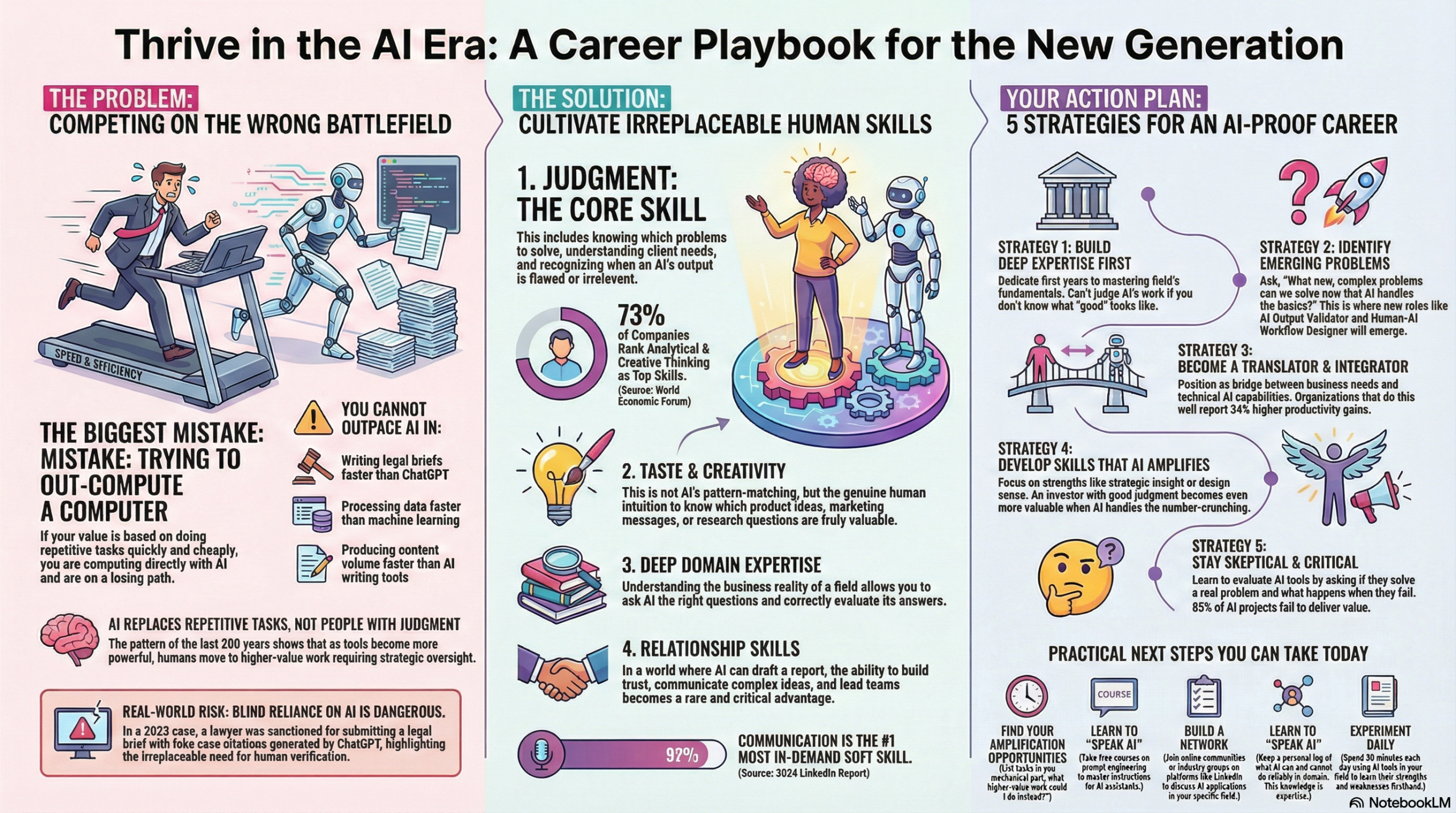
Strategy 1: Build Deep Expertise Before Optimisation
Actionable Tip: Dedicate your first 2-3 years to mastering the fundamentals of your field without heavy reliance on AI tools. You can’t effectively use AI to amplify your work if you don’t understand the work well enough to judge whether the AI is doing it correctly.
Implementation Steps:
- Choose one domain area and commit to 10,000 hours of deliberate practice (as outlined in Malcolm Gladwell’s research)
- Seek mentorship from experienced professionals in your field
- Learn the “why” behind processes, not just the “how”
- Only after achieving competency, introduce AI as a productivity multiplier
Strategy 2: Identify Emerging Problems
Think about what problems will emerge once AI is widely deployed. The Jevons Paradox tells us this: as white-collar work becomes cheaper and easier, organisations will do more of it. They’ll tackle problems they couldn’t afford to solve before.
Actionable Tip: Ask yourself: “What new problems become solvable once I can instantly generate first drafts, analyses, or code?” Those are the opportunities.
Examples of Emerging Roles:
- AI Trainers & Prompt Engineers: CNBC reports these roles command salaries up to $335,000
- AI Ethics Officers: Ensuring responsible AI deployment
- Human-AI Workflow Designers: Optimising the collaboration between humans and AI systems
- AI Output Validators: Specialists who verify AI-generated work for accuracy and compliance
Strategy 3: Become a Translator and Integrator
The future doesn’t belong to specialists who resist tools or to tool experts who don’t understand domains. It belongs to people who understand both.
Actionable Tip: Position yourself as a bridge between technical and business teams:
- Learn to translate business problems into effective AI prompts
- Understand why AI output is or isn’t useful in specific contexts
- Integrate AI capabilities into real workflows, real products, and real organisations
According to IBM’s Institute for Business Value, organisations that successfully integrate AI report 34% higher productivity gains than those that simply deploy AI tools without strategic integration.
Strategy 4: Develop Skills That AI Amplifies
Examples of amplification:
- A litigator who becomes better at understanding opposing counsel’s strategy becomes more valuable with AI doing document review
- An investor with better judgement about market trends becomes more valuable with AI handling financial analysis
- A designer with stronger aesthetic sensibility becomes more valuable with AI generating variations
The tool amplifies what you’re good at. Focus on developing the strategic, creative, and interpersonal skills that sit atop the automation stack.
ROI Data: McKinsey’s State of AI 2023 found that organisations using generative AI for tasks requiring creativity and judgement (such as marketing content creation combined with human strategic oversight) saw 40% better performance than those using AI for purely mechanical tasks.
Strategy 5: Stay Sceptical of Technological Solutionism
Not everything new is an improvement. Not every application of AI makes sense. There’s enormous friction in deploying new tools in large organisations:
- Enterprise software takes years to adopt
- Integration is hard
- Security and compliance matter
- Legal and ethical questions are real
Actionable Tip: Develop critical evaluation skills. Before adopting any AI tool, ask:
- Does this actually solve a real problem, or is it a solution looking for a problem?
- What are the security and compliance implications?
- What’s the total cost of ownership, including training and integration?
- What happens when the AI makes a mistake?
According to Gartner research, 85% of AI projects fail to deliver expected business value, often because organisations underestimate implementation complexity.
The Honest Truth: What We Know and Don’t Know
Here’s what we actually know:
What We Know
- AI will change work. Some tasks will be automated. Some jobs will be eliminated or transformed.
- There will be real friction. Some people will face real hardship, and that matters—those are real people in real communities.
- History provides a pattern. Research from MIT economists shows that 60% of jobs in 2018 didn’t exist in 1940. Technology creates more jobs than it destroys over time.
- The mechanism is proven. Efficiency improvements create new demand, which creates new problems to solve, which creates new opportunities.
Employment Data: The OECD’s Employment Outlook shows that whilst 14% of jobs are at high risk of automation, 32% of jobs will experience significant changes in how they’re performed—meaning transformation, not elimination. Additionally, historical data shows that major technological shifts have consistently created 20-30% more jobs than they’ve destroyed within a 15-year timeframe.
What We Don’t Know
We don’t know what those new opportunities will look like. No one in 1900 predicted that a million Americans would work in “railways,” and no one in 1950 predicted “video post-production” or “software engineer.” The new categories don’t exist yet.
According to the World Economic Forum, 69 million new jobs will be created by 2027 due to technological change, whilst 83 million will be displaced—a net displacement of 14 million jobs globally. However, these figures don’t capture the entirely new job categories that will emerge, just as “social media manager” or “data scientist” didn’t exist 20 years ago.
Your Path Forward: Building an AI-Resilient Career
So yes, the next few years will be disorienting. Some existing roles will become obsolete faster than expected. There will be winners and losers based on geography, industry, and access to retraining. That’s real.
But if you focus on these principles, you’ll be positioned to thrive:
Your AI-Era Career Checklist
- ☑ Build genuine expertise in a domain before relying heavily on AI tools
- ☑ Develop judgement skills that allow you to evaluate AI outputs critically
- ☑ Stay curious about new tools whilst maintaining scepticism about their limitations
- ☑ Think strategically about what problems become solvable when old problems get easier
- ☑ Cultivate uniquely human skills: empathy, creativity, complex communication, ethical reasoning
- ☑ Position yourself as a bridge between technical capabilities and business needs
- ☑ Embrace continuous learning as the pace of change accelerates
Practical Next Steps You Can Take Today
- Experiment with AI tools in your field: Spend 30 minutes daily using tools like Claude, ChatGPT, or industry-specific AI applications. Document what works, what doesn’t, and why.
- Develop your “AI prompt literacy”: Learn to craft effective prompts by taking free courses like DeepLearning.AI’s offerings or Anthropic’s prompt engineering guide.
- Identify your amplification opportunities: List five tasks in your current role. For each, ask: “If AI could do the mechanical part, what higher-value work could I focus on instead?”
- Build a learning network: Join communities discussing AI in your industry. Examples include r/MachineLearning, LinkedIn AI groups, or industry-specific forums.
- Document your AI experiments: Create a personal knowledge base of what AI can and cannot do reliably in your field. This becomes invaluable expertise.
Conclusion: Opportunity, Not Obsolescence
The new generation doesn’t need to fear AI. It needs to get good at working with it.
The path forward isn’t about competing with machines on their terms. It’s about understanding what makes you irreplaceably human—judgement, creativity, empathy, strategic thinking—and using AI to amplify those strengths.
As Benedict Evans writes, “The question is not ‘will AI take my job?’ but ‘what will I do with AI?'” That mindset shift—from passive victim to active participant—makes all the difference.
Need Help Navigating AI for Your Career or Business?
At The Crunch, we specialise in helping Malaysian businesses and professionals leverage AI automation strategically—not as a replacement for human expertise, but as a powerful amplifier. Whether you’re looking to upskill your team, implement AI solutions that actually deliver ROI, or future-proof your career, we can help.