7 Proven Steps to Master AI Chatbot Training in 2026
Imagine launching a chatbot that understands your customers perfectly, responds with human-like accuracy, and continuously improves with every interaction. This isn’t science fiction—it’s the reality of properly executed AI chatbot training in 2025.
As businesses increasingly rely on conversational AI to handle customer interactions, the quality of your chatbot’s training directly impacts customer satisfaction, operational efficiency, and your bottom line. Yet, many organizations struggle with creating chatbots that truly understand context, handle complex queries, and deliver meaningful conversations.
The challenge isn’t just about deploying a chatbot—it’s about training it effectively to represent your brand, understand your customers’ needs, and provide accurate responses consistently. Poor training leads to frustrated users, increased support tickets, and ultimately, abandoned conversations.
In this comprehensive guide, you’ll discover seven proven steps to master AI chatbot training, from data preparation to continuous optimization. Whether you’re building your first chatbot or refining an existing one, these strategies will help you create an intelligent assistant that delivers real value to your business and customers.
Understanding AI Chatbot Training Fundamentals
AI chatbot training is the systematic process of teaching conversational AI systems to understand user intent, process natural language, and generate appropriate responses. Think of it as teaching a new employee—except this employee can handle thousands of conversations simultaneously and never needs a coffee break.
The foundation of effective chatbot training lies in three core components: quality training data, robust natural language processing (NLP) models, and continuous learning mechanisms. According to recent industry research, businesses that invest in comprehensive chatbot training see up to 67% improvement in first-contact resolution rates.
The Evolution of Conversational AI Training
Modern AI chatbot training has evolved dramatically from simple rule-based systems to sophisticated machine learning models. Today’s chatbots leverage transformer architectures, contextual understanding, and multi-turn conversation capabilities that were impossible just a few years ago.
The shift toward large language models (LLMs) has revolutionized how we approach training. Instead of manually programming every possible conversation path, we now focus on fine-tuning pre-trained models with domain-specific data, significantly reducing development time while improving accuracy.
Why Proper Training Makes or Breaks Your Chatbot
A well-trained chatbot becomes a strategic asset, handling routine inquiries, qualifying leads, and providing 24/7 support. Conversely, a poorly trained chatbot frustrates users, damages brand reputation, and creates more work for your human team.
Statistics reveal that 73% of customers expect companies to understand their unique needs and expectations. Your chatbot’s training directly determines whether you meet or miss these expectations. The difference between a helpful assistant and a digital nuisance often comes down to the quality and depth of training invested upfront.
Seven Essential Steps for Effective AI Chatbot Training
Mastering AI chatbot training requires a structured approach that balances technical precision with user-centric design. These seven steps provide a roadmap for creating chatbots that truly understand and serve your audience.
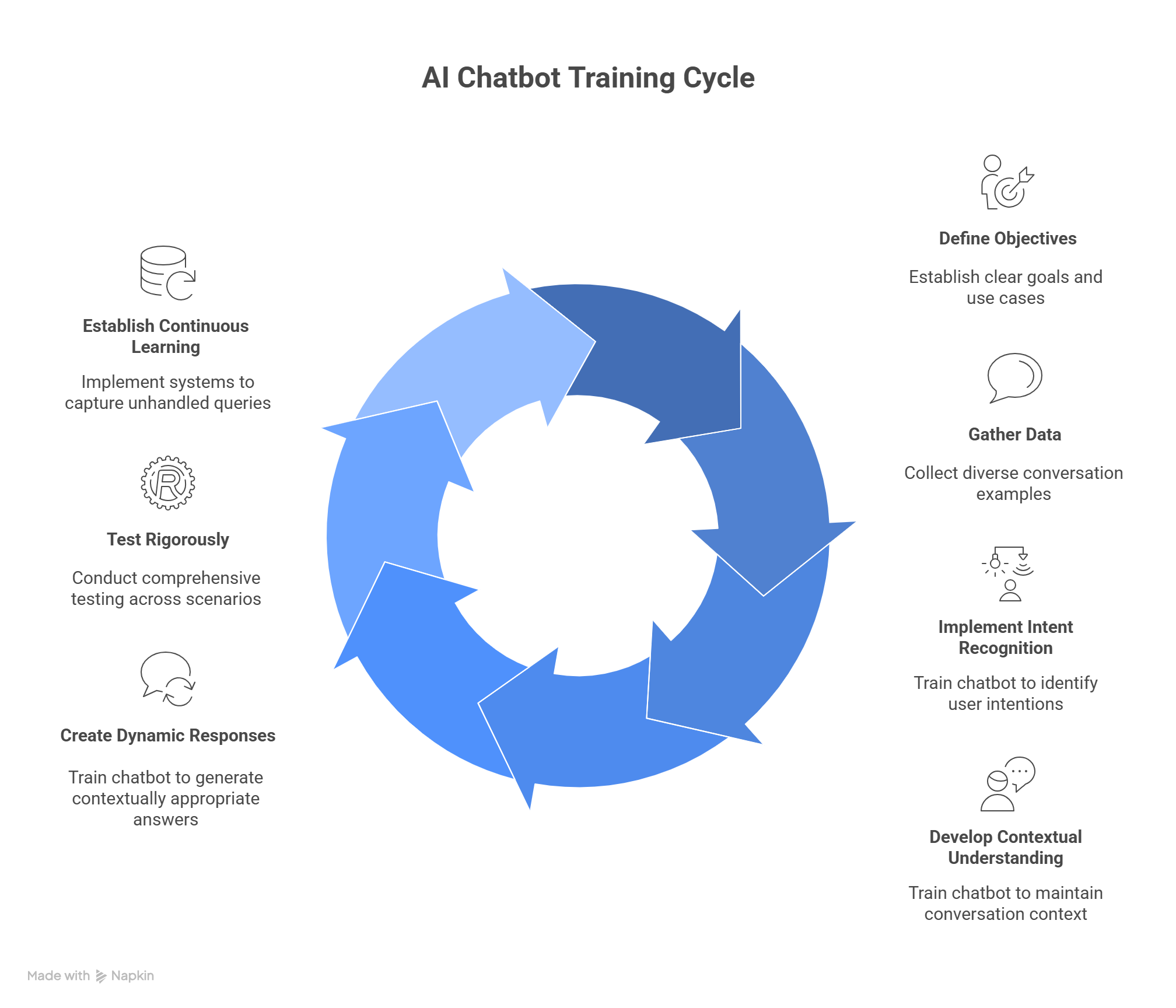
Step 1: Define Clear Objectives and Use Cases
Before collecting a single data point, identify exactly what you want your chatbot to accomplish. Are you focusing on customer support, lead generation, appointment scheduling, or product recommendations? Each use case requires different training approaches and data sets.
Document specific success metrics such as resolution rate, average handling time, customer satisfaction scores, and conversation completion rates. These benchmarks will guide your training priorities and help measure improvement over time.
Step 2: Gather and Prepare High-Quality Training Data
Your chatbot’s intelligence is only as good as the data it learns from. Collect diverse conversation examples, including customer service transcripts, FAQ documents, product information, and real user queries. Aim for at least 1,000-2,000 quality conversation examples for basic functionality, with more complex use cases requiring significantly larger datasets.
Clean and structure your data meticulously. Remove personally identifiable information, correct spelling errors, standardize formatting, and categorize conversations by intent. This preprocessing phase directly impacts your chatbot’s ability to understand and respond accurately.
Step 3: Implement Intent Recognition and Entity Extraction
Train your chatbot to identify user intentions behind messages. For example, “I need to return my order” and “How do I send back this product?” express the same intent despite different wording. Create comprehensive intent libraries covering all possible user goals within your defined use cases.
Entity extraction enables your chatbot to identify specific information within user messages—names, dates, product numbers, locations, and other relevant details. This capability transforms generic responses into personalized, actionable conversations.
Step 4: Develop Contextual Understanding
Modern users expect chatbots to remember previous messages and maintain conversation context. Train your system to track conversation history, reference earlier statements, and understand how current messages relate to the broader dialogue.
Implement slot-filling techniques where your chatbot systematically gathers required information through natural conversation. Instead of demanding all details upfront, a well-trained chatbot asks follow-up questions based on what’s already been shared.
Step 5: Create Dynamic Response Generation
Move beyond static, scripted responses by training your chatbot to generate contextually appropriate answers. This involves fine-tuning language models on your specific domain, brand voice, and communication style.
Develop response templates with variable elements that adapt based on user input, conversation context, and available data. Include fallback responses for situations where confidence is low, gracefully transferring to human agents when necessary.
Step 6: Test Rigorously Across Scenarios
Comprehensive testing reveals gaps in your AI chatbot training before users encounter them. Create test scenarios covering common paths, edge cases, and potential misunderstandings. Include intentionally ambiguous queries, misspellings, slang, and multi-intent messages.
Conduct A/B testing with different response strategies to identify what resonates best with your audience. Monitor key performance indicators and user feedback to pinpoint areas needing additional training.
Step 7: Establish Continuous Learning Mechanisms
The most successful chatbots never stop learning. Implement systems to capture unhandled queries, low-confidence responses, and user corrections. Review these regularly to identify training gaps and emerging conversation patterns.
Schedule periodic retraining cycles incorporating new data, updated product information, and refined understanding of user needs. Set up automated alerts for significant drops in performance metrics, enabling quick intervention when issues arise.
Implementing Your AI Chatbot Training Strategy
Theory becomes valuable only when translated into action. Here’s how to implement these training principles effectively within your organization.
Choosing the Right Training Platform and Tools
Select platforms that align with your technical capabilities and business requirements. Options range from no-code solutions like Dialogflow and Microsoft Bot Framework to custom implementations using TensorFlow or PyTorch for maximum flexibility.
Building Your Training Dataset Strategically
Start with existing resources—customer service logs, email inquiries, chat transcripts, and support tickets. Augment these with synthetic data generation for underrepresented scenarios, ensuring balanced coverage across all intents.
Involve subject matter experts in reviewing and validating training data. Their domain knowledge ensures accuracy and helps identify nuances that automated processes might miss. Create annotation guidelines to maintain consistency when multiple team members contribute to dataset development.
Establishing Training Workflows and Governance
Define clear roles and responsibilities for chatbot training. Assign data collection, annotation, model training, testing, and deployment tasks to specific team members. Establish review processes ensuring quality standards before updates go live.
Document your training methodology, including data sources, preprocessing steps, model configurations, and evaluation criteria. This documentation becomes invaluable for onboarding new team members and maintaining consistency as your chatbot evolves.
Measuring Training Effectiveness
Track metrics that directly reflect training quality: intent recognition accuracy, entity extraction precision, conversation completion rates, and user satisfaction scores. Compare these against your baseline measurements to quantify improvement.
Analyze conversation logs to identify patterns in successful versus unsuccessful interactions. Look for common phrases where the chatbot struggles, topics requiring additional training data, and opportunities to expand functionality based on user needs.
Overcoming Common AI Chatbot Training Challenges
Even with careful planning, you’ll encounter obstacles during AI chatbot training. Recognizing these challenges early and implementing proven solutions keeps your project on track.
Challenge 1: Insufficient or Imbalanced Training Data
Many organizations struggle with limited conversation examples, particularly for new products or services. This scarcity leads to chatbots that handle common queries well but fail with less frequent but equally important requests.
Solution: Supplement real data with carefully crafted synthetic examples. Use data augmentation techniques like paraphrasing, synonym replacement, and back-translation to expand your dataset. Prioritize quality over quantity—100 well-annotated examples often outperform 1,000 poorly labeled ones.
Challenge 2: Handling Ambiguous or Multi-Intent Queries
Users rarely communicate with the precision chatbots prefer. Messages like “I want to change my order and check delivery status” contain multiple intents requiring different actions.
Solution: Train your chatbot to recognize and decompose complex queries. Implement clarification dialogues that confirm understanding before proceeding. Teach your system to prioritize intents based on context and ask follow-up questions to resolve ambiguity.
Challenge 3: Maintaining Consistency Across Updates
As you continuously train and update your chatbot, new capabilities sometimes interfere with existing functionality. A change improving one conversation type might inadvertently degrade performance elsewhere.
Solution: Maintain comprehensive test suites covering all supported scenarios. Run regression testing before deploying updates, ensuring new training doesn’t compromise established capabilities. Version control your training data and models, enabling quick rollback if issues emerge.
Challenge 4: Balancing Automation with Human Escalation
Determining when your chatbot should handle conversations versus transferring to human agents requires careful calibration. Too aggressive automation frustrates users, while excessive escalation wastes the chatbot’s potential.
Solution: Implement confidence thresholds that trigger human handoff when the chatbot’s certainty falls below acceptable levels. Train your system to recognize emotional cues indicating user frustration. Create seamless transition protocols that provide human agents with full conversation context.
Conclusion: Your Path to AI Chatbot Training Excellence
Mastering AI chatbot training in 2025 isn’t about deploying the most advanced technology—it’s about systematically teaching your chatbot to understand, engage, and serve your users effectively. The seven steps outlined in this guide provide a proven framework for creating conversational AI that delivers measurable business value.
Remember that effective AI chatbot training is an ongoing journey, not a one-time project. Start with clear objectives, invest in quality training data, implement robust testing processes, and commit to continuous improvement. Each conversation your chatbot handles generates insights that make the next interaction even better.
The businesses that excel with conversational AI aren’t necessarily those with the largest budgets or most sophisticated technology. They’re the ones that approach chatbot training strategically, prioritize user experience, and remain committed to iterative refinement.
As you implement these strategies, you’ll transform your chatbot from a simple question-answering tool into an intelligent assistant that enhances customer experience, reduces operational costs, and scales your support capabilities exponentially.
Ready to take your AI chatbot training to the next level? The Crunch specializes in developing and optimizing conversational AI solutions that drive real business results. Our team of experts can help you implement these proven strategies, avoid common pitfalls, and create chatbots that truly understand your customers.
Contact The Crunch today to schedule your free consultation and discover how professional AI chatbot training can transform your customer engagement strategy. Visit https://thecrunch.io/get-a-proposal/ to get started.
Frequently Asked Questions (FAQ)
1. What is AI chatbot training?
2. How do you train an AI chatbot?
3. What data is needed to train a chatbot?
4. How does AI chatbot training differ from rule-based chatbot training?
5. What are the benefits of training an AI chatbot?
6. How much does it cost to train an AI chatbot?
7. How long does it take to train an AI chatbot?
8. Can I train a chatbot without coding experience?
9. What are common challenges in AI chatbot training?
10. How do I get started with AI chatbot training?
11. How often should I retrain my AI chatbot?
12. Are there privacy concerns with AI chatbot training?