7 Ways AI CRM Boosts Sales Revenue & Closes More Deals
Introduction: The Sales Revolution Powered by Artificial Intelligence
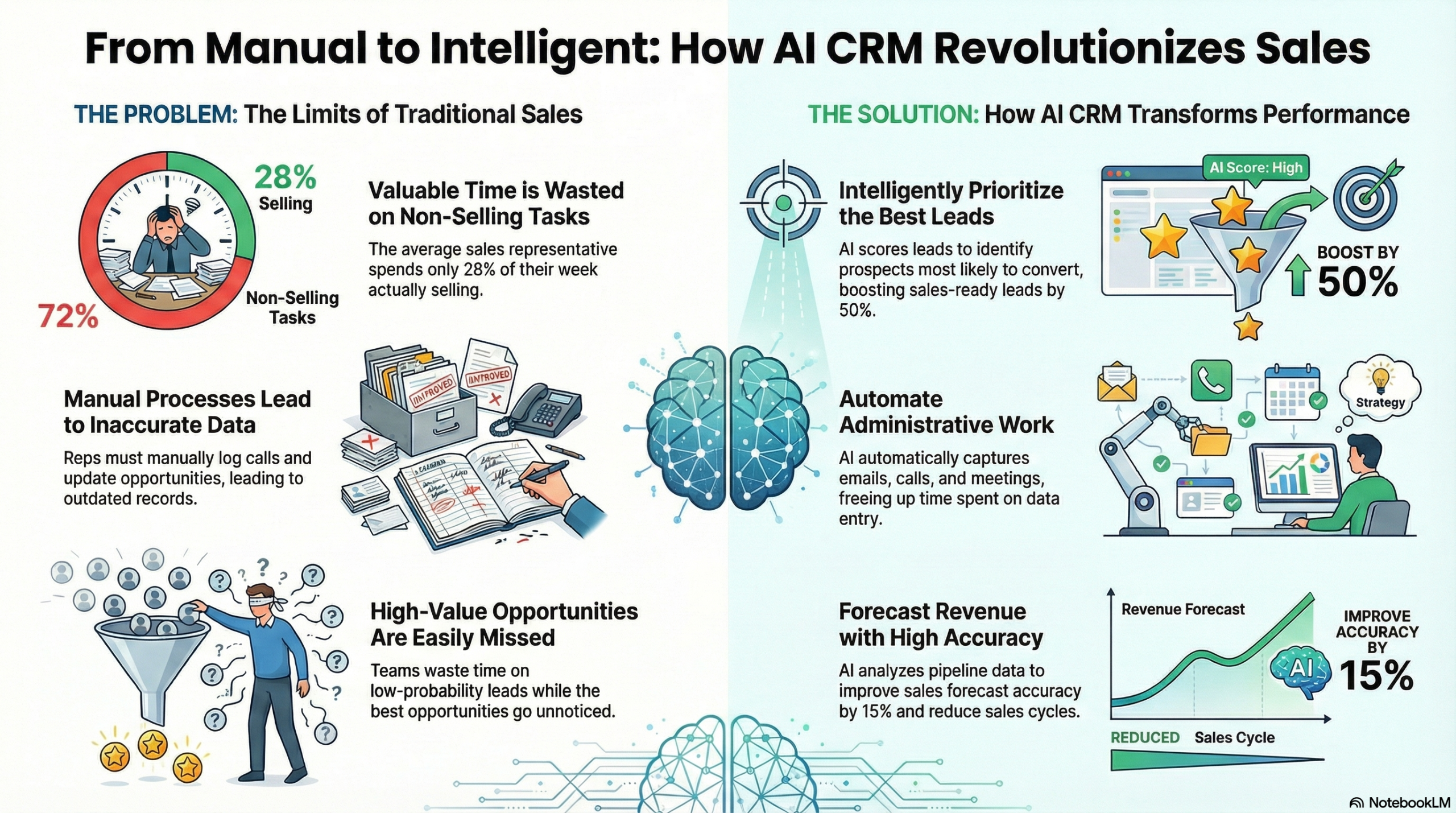
Sales teams are drowning in data but starving for insights. Every day, valuable leads slip through the cracks, follow-ups get forgotten, and deals stall in the pipeline. The average sales rep spends only 28% of their week actually selling, with the rest consumed by administrative tasks and manual data entry.
Enter AI CRM for sales—a game-changing technology that’s transforming how businesses identify prospects, nurture relationships, and close deals. By combining artificial intelligence with customer relationship management, modern sales teams are achieving unprecedented levels of efficiency and revenue growth.
Understanding AI CRM for Sales: The Foundation of Modern Revenue Growth
An AI CRM for sales goes far beyond traditional customer relationship management systems. While conventional CRMs serve as digital filing cabinets for customer information, AI-powered platforms act as intelligent assistants that actively help sales teams work smarter and faster.
The Current State of AI in Sales Technology
The adoption of artificial intelligence in sales has accelerated dramatically. Gartner predicts that by 2025, 75% of B2B sales organizations will augment traditional sales playbooks with AI-guided selling solutions. This shift isn’t just about keeping up with technology trends—it’s about survival in an increasingly competitive marketplace.
Modern AI CRM platforms can analyze millions of data points in seconds, identifying patterns that would take human analysts months to discover. They can predict which leads are most likely to convert, recommend the best time to reach out to prospects, and even suggest personalized messaging that resonates with specific buyer personas.
Why Traditional CRM Falls Short
Traditional CRM systems require constant manual input and offer limited intelligence. Sales reps must remember to log every call, update every opportunity, and manually segment their contacts. This creates several critical problems:
Data becomes outdated quickly because reps forget to update records. Valuable insights remain hidden in spreadsheets and disconnected systems. Sales managers lack real-time visibility into pipeline health. Teams waste hours on low-probability leads while high-value opportunities go unnoticed.
AI CRM solutions eliminate these bottlenecks by automatically capturing interactions, continuously updating customer profiles, and proactively alerting teams to opportunities and risks.
Seven Powerful Ways AI CRM Transforms Sales Performance
1. Intelligent Lead Scoring and Prioritization
Not all leads are created equal, but identifying the best opportunities has traditionally relied on gut instinct and limited data. AI CRM for sales changes this equation entirely by analyzing hundreds of variables to predict which prospects are most likely to convert.
Machine learning algorithms examine historical data from closed deals, identifying common characteristics among your best customers. The system then scores new leads based on these patterns, considering factors like company size, industry, engagement level, website behavior, and demographic information.
Sales teams using AI-powered lead scoring report 50% more sales-ready leads and a 30% increase in conversion rates. Instead of wasting time on cold prospects, reps can focus their energy on opportunities with the highest probability of closing.
2. Automated Data Entry and Activity Capture
Sales professionals spend an average of 17% of their day on data entry—time that could be spent building relationships and closing deals. AI CRM systems automatically capture emails, calls, meetings, and other interactions without requiring manual input.
Natural language processing technology can read email conversations and automatically update opportunity stages, log next steps, and extract key information like budget discussions or decision-maker involvement. Voice recognition can transcribe sales calls and identify important commitments or concerns raised by prospects.
This automation doesn’t just save time—it ensures data accuracy and completeness. When every interaction is automatically logged, sales managers gain complete visibility into pipeline activity and can provide more effective coaching.
Accurate sales forecasting has always been more art than science, but AI brings unprecedented precision to revenue predictions. By analyzing historical patterns, current pipeline data, and external market factors, AI CRM platforms can forecast deal closure probability with remarkable accuracy.
These systems identify warning signs that deals might be at risk—like decreased engagement, longer-than-average sales cycles, or missing key stakeholders. They also highlight opportunities that are progressing faster than expected, allowing managers to allocate resources strategically.
Companies using AI-powered forecasting report 15% improvement in forecast accuracy and 20% reduction in sales cycle length. This precision enables better resource planning, more accurate revenue projections, and proactive intervention on at-risk deals.
4. Personalized Customer Engagement at Scale
Today’s buyers expect personalized experiences, but delivering customization to hundreds or thousands of prospects seems impossible. AI CRM technology makes personalization scalable by analyzing customer data and automatically generating tailored recommendations.
The system can suggest the best content to share with specific prospects based on their industry, role, and stage in the buying journey. It can recommend optimal outreach timing based on when similar customers have been most responsive. It can even draft personalized email templates that incorporate relevant case studies and address specific pain points.
This level of personalization drives engagement. Research shows that personalized emails deliver 6x higher transaction rates, and AI makes it possible to deliver this personalization to every prospect in your pipeline.
5. Intelligent Next-Best-Action Recommendations
Even experienced sales professionals can feel overwhelmed by the number of opportunities in their pipeline. Which deal should they focus on today? Who needs a follow-up? What’s the best approach for moving a stalled opportunity forward?
AI CRM for sales acts as a virtual sales coach, providing real-time recommendations on the next best action for every opportunity. The system might suggest scheduling a demo with a highly engaged prospect, recommend involving a technical specialist in a complex deal, or alert the rep that a key decision-maker hasn’t been contacted.
These recommendations are based on analysis of thousands of successful deals, identifying the actions that historically lead to positive outcomes. Sales teams using AI-guided selling report 30% higher win rates and significantly shorter sales cycles.
6. Automated Follow-Up and Nurture Sequences
Following up consistently is crucial for sales success, yet 44% of salespeople give up after just one follow-up attempt. AI CRM systems ensure no opportunity falls through the cracks by automating intelligent follow-up sequences.
Unlike simple email automation, AI-powered nurture campaigns adapt based on prospect behavior. If a lead opens an email but doesn’t respond, the system might automatically send a different message with alternative content. If a prospect visits your pricing page, the AI can trigger an immediate notification to the sales rep and suggest a timely follow-up call.
This intelligent automation keeps prospects engaged throughout the buying journey while freeing sales reps to focus on high-value conversations rather than routine follow-ups.
7. Real-Time Competitive Intelligence and Market Insights
Understanding your competitive landscape and market dynamics is essential for effective selling. AI CRM platforms continuously monitor news, social media, and public data sources to provide real-time intelligence about prospects and competitors.
The system can alert your team when a prospect company announces funding, leadership changes, or expansion plans—perfect triggers for timely outreach. It can identify when competitors are mentioned in conversations and suggest effective counter-positioning strategies. It can even analyze win/loss patterns to reveal why you’re winning or losing against specific competitors.
This intelligence empowers sales teams to have more relevant conversations, address objections proactively, and position their solutions more effectively against alternatives.
Implementing AI CRM: Your Step-by-Step Success Blueprint
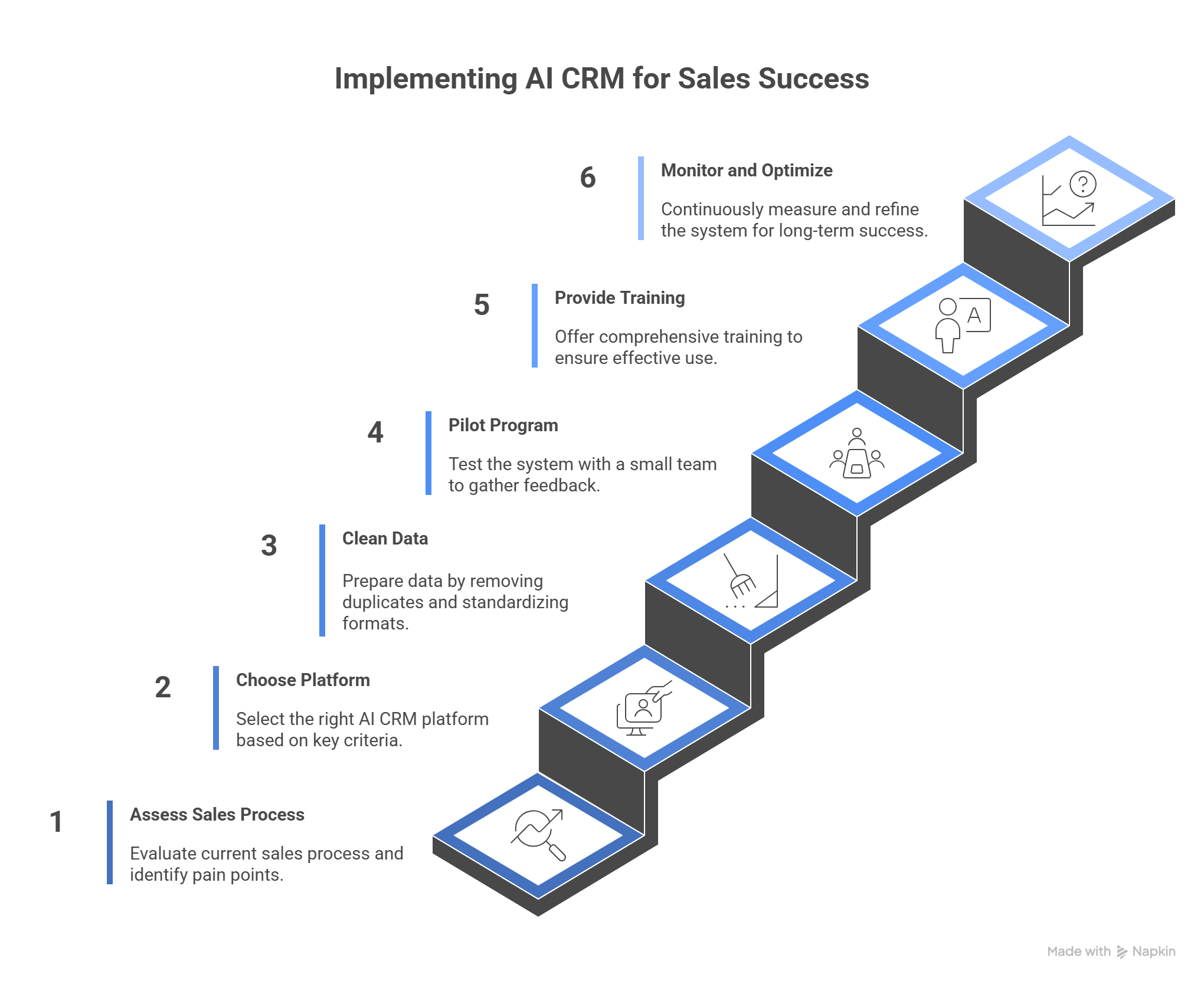
Step 1: Assess Your Current Sales Process and Pain Points
Before implementing any AI CRM solution, conduct a thorough audit of your existing sales process. Identify specific bottlenecks where deals get stuck, tasks that consume excessive time, and areas where data quality is poor.
Interview your sales team to understand their daily challenges. Are they spending too much time on administrative work? Do they struggle to prioritize opportunities? Are they missing important follow-ups? These insights will help you select an AI CRM platform that addresses your most critical needs.
Step 2: Choose the Right AI CRM Platform
Not all AI CRM solutions are created equal. Evaluate platforms based on several key criteria: integration capabilities with your existing tech stack, ease of use for your sales team, quality of AI features and accuracy of predictions, scalability to grow with your business, and vendor support and training resources.
Request demos from multiple vendors and involve your sales team in the evaluation process. The best technology in the world won’t deliver results if your team doesn’t adopt it.
Step 3: Clean and Prepare Your Data
AI systems are only as good as the data they’re trained on. Before implementation, invest time in cleaning your existing customer database. Remove duplicates, standardize formatting, fill in missing information, and archive outdated records.
This data preparation phase is crucial for ensuring your AI CRM delivers accurate predictions and valuable insights from day one.
Step 4: Start with a Pilot Program
Rather than rolling out AI CRM across your entire organization immediately, begin with a pilot program involving a small team or specific sales segment. This approach allows you to test the system, identify issues, gather feedback, and refine processes before full deployment.
Monitor key metrics during the pilot phase, including adoption rates, time savings, lead conversion improvements, and user satisfaction. Use these insights to optimize your implementation strategy.
Step 5: Provide Comprehensive Training and Support
Technology adoption fails when users don’t understand how to leverage new tools effectively. Invest in thorough training that goes beyond basic system navigation to teach strategic use of AI features.
Create role-specific training programs that show sales reps, managers, and executives how AI CRM benefits their specific responsibilities. Provide ongoing support through documentation, video tutorials, and accessible help resources.
Step 6: Monitor, Measure, and Optimize
Implementation isn’t a one-time event—it’s an ongoing process of refinement. Establish clear KPIs to measure the impact of your AI CRM for sales, such as sales cycle length, win rates, forecast accuracy, time spent on administrative tasks, and revenue per sales rep.
Review these metrics regularly and gather continuous feedback from users. AI systems improve over time as they process more data, so be patient and committed to the long-term transformation.
Overcoming Common AI CRM Implementation Challenges
Challenge 1: Resistance to Change from Sales Teams
Sales professionals often resist new technology, fearing it will complicate their workflow or replace their jobs. Address this concern head-on by emphasizing how AI CRM augments rather than replaces human selling.
Involve sales team members in the selection and implementation process. Highlight quick wins and time savings that directly benefit individual reps. Share success stories from early adopters to build momentum and enthusiasm.
Challenge 2: Data Quality and Integration Issues
Poor data quality undermines AI effectiveness, while integration challenges can create information silos. Establish data governance policies that define standards for data entry and maintenance. Invest in integration tools that connect your AI CRM with marketing automation, customer support, and other critical systems.
Consider working with implementation specialists who can navigate technical complexities and ensure seamless data flow across your technology ecosystem.
Challenge 3: Unrealistic Expectations About AI Capabilities
AI is powerful but not magical. Some organizations expect immediate transformation without recognizing that AI systems require time to learn and improve. Set realistic expectations about implementation timelines and results.
Communicate that AI CRM is a tool that enhances human decision-making rather than a complete autopilot solution. The most successful implementations combine AI insights with human judgment and relationship-building skills.
Challenge 4: Privacy and Security Concerns
As AI systems process sensitive customer data, privacy and security become paramount concerns. Choose vendors with robust security certifications and compliance with regulations like GDPR and CCPA.
Implement clear policies about data usage and ensure your team understands privacy requirements. Transparency about how AI uses customer information builds trust with both employees and customers.
Conclusion: Transform Your Sales Performance with AI CRM
The seven strategies outlined in this guide provide a comprehensive roadmap for transforming your sales operations. From intelligent lead prioritization that focuses your team on the highest-value opportunities to automated data capture that eliminates administrative burden, each capability delivers measurable impact on your bottom line.
Success with AI CRM requires more than just technology adoption—it demands strategic implementation, comprehensive training, and ongoing optimization. Organizations that approach AI CRM as a transformational initiative rather than a simple software upgrade consistently achieve the best results.
The sales landscape is evolving rapidly, and teams that embrace AI-powered tools are pulling ahead of competitors still relying on manual processes and gut instinct. The question isn’t whether to adopt AI CRM for sales, but how quickly you can implement it to start capturing the benefits.
Ready to revolutionize your sales performance with AI CRM? The Crunch specializes in helping businesses implement and optimize AI-powered sales solutions that drive real revenue growth. Our team of experts will assess your current processes, recommend the right technology stack, and guide you through every step of implementation.
Don’t let your competition gain the AI advantage. Contact The Crunch today to schedule your free consultation and discover how AI CRM can transform your sales results. Let’s build a customized strategy that closes more deals and accelerates your revenue growth.
Frequently Asked Questions (FAQ)
1. What is an AI CRM for sales?
2. How does an AI CRM improve sales performance?
3. What features should I look for in an AI CRM for sales?
4. How do I get started with an AI CRM for my sales team?
5. How does an AI CRM compare to a traditional CRM?
6. What are the main benefits of using an AI CRM for sales?
7. How much does an AI CRM for sales cost?
8. Is my sales data secure in an AI CRM?
9. Can an AI CRM integrate with my existing sales tools?
10. What are common challenges when adopting an AI CRM for sales?
11. Do I need technical expertise to use an AI CRM?
12. How can I measure the ROI of an AI CRM for sales?