AI Productivity Tips: Why 90% Get It Wrong
Picture this: Winston Churchill, sitting in his bathtub, dictating a national address to his assistant in the next room.
“Distinguished ladies and gentlemen—”
“Don’t call them distinguished! They’re not!”
The assistant adjusts, understanding Churchill’s intent, his voice, his context intimately enough to craft speeches whilst he soaks.
For decades, I’ve envied that relationship. The luxury of having someone who knows you so well they can translate your rough thoughts into polished prose. Someone available whenever inspiration strikes—in the bath, on a walk, during those crucial 3am moments when solutions suddenly crystallise.
Here’s what changed everything for me: What was once available only to prime ministers is now accessible to every business owner reading this article.
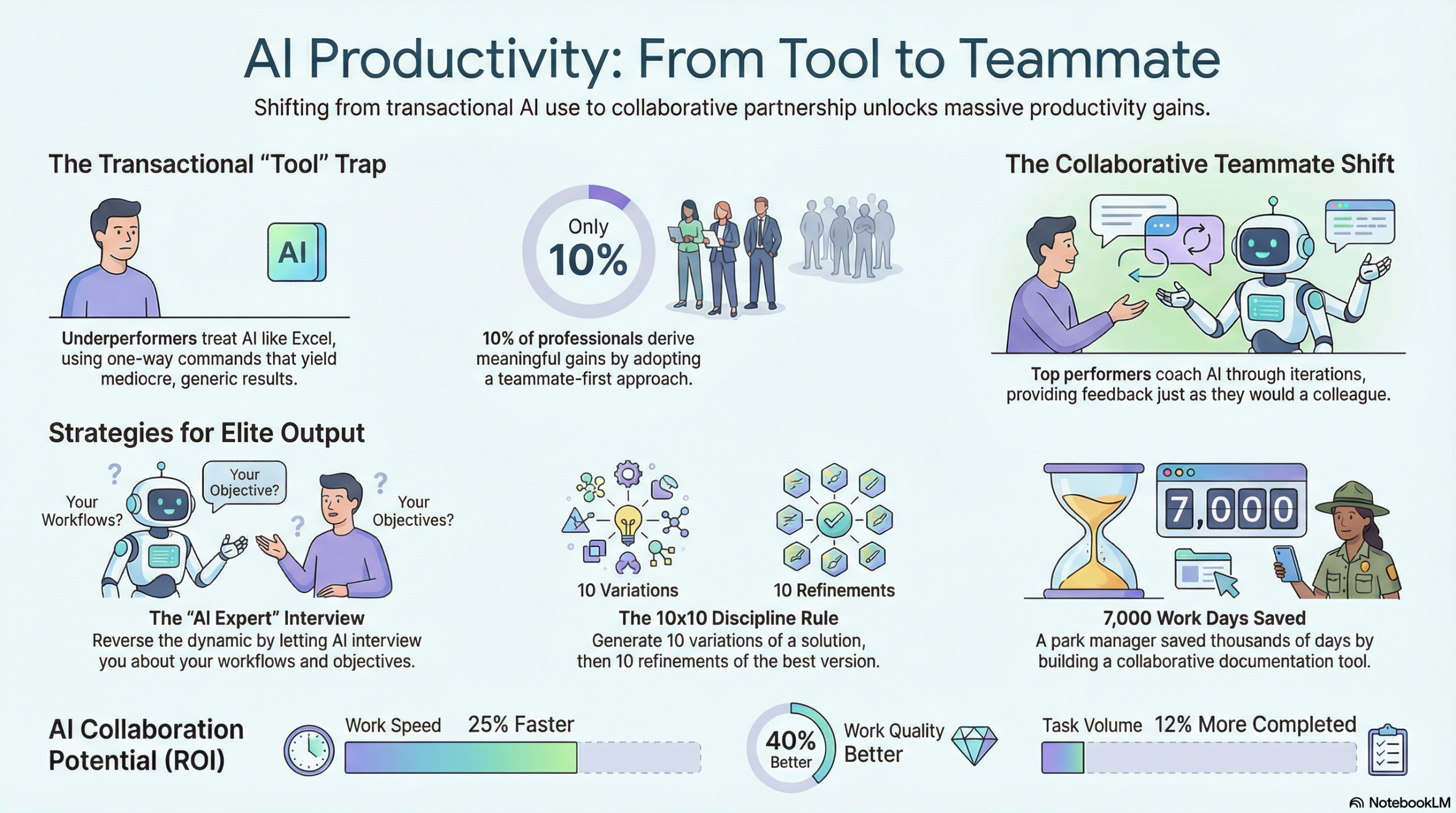
And yet, fewer than 10% of working professionals are deriving meaningful productivity gains from AI.
How is that possible? If AI can make us 25% faster, produce 40% better quality work, and complete 12% more tasks, why are 90% of professionals seeing no real benefit?
The answer surprised me—and it will probably surprise you too.
This blog is Inspired by : How Stanford Teaches AI-Powered Creativity in Just 13 MinutesㅣJeremy Utley
The Research That Changed My Perspective
I spent the past two years studying how professionals collaborate with AI. Not just reading about it, but conducting actual research with teams across Europe and the United States, watching them work, measuring their outputs, tracking their creative processes.
What we discovered was counterintuitive: AI didn’t make most people more creative. In many cases, it made them less creative.
This baffled us initially. How could a tool designed to augment human creativity actually diminish it?
The answer emerged when we compared the top performers with the underperformers. The difference wasn’t technical skill. It wasn’t prompt engineering prowess. It wasn’t even time spent with the tools.
The outperformers treated AI like a teammate. The underperformers treated AI like a tool.
That distinction—teammate versus tool—changes everything.
What Happens When You Treat AI Like a Tool
When you treat AI like a tool, here’s what typically happens:
You type in a prompt. AI generates a response. If it’s mediocre, you either manually fix it yourself, try a slightly different prompt, or decide “AI isn’t good at this” and move on.
You’re the question-asker. AI is the answer-giver. The relationship is transactional and one-directional.
It’s like using Excel or PowerPoint—you input commands, it executes. The tool doesn’t learn about you, doesn’t understand your context, doesn’t push back or ask clarifying questions.
Here’s the problem: ChatGPT isn’t Excel. Claude isn’t PowerPoint. These aren’t traditional tools.
What Changes When You Treat AI Like a Teammate
Think about the last time a colleague delivered mediocre work. What did you do?
You didn’t abandon them or conclude they were useless. You gave them feedback. You asked questions. You helped them understand what you actually needed. You coached them through revisions.
Now imagine your newest team member just produced a first draft of a client proposal. It’s not quite right—too generic, missing key details about the client’s specific challenges.
Do you:
- A) Rewrite it entirely yourself
- B) Give up and conclude this person can’t write proposals
- C) Provide specific feedback and coach them through improvements
Obviously C, right?
So why do we default to A or B with AI?
When you shift to treating AI as a teammate:
- You coach it through iterations rather than expecting perfection immediately
- You let it ask you questions to understand context before diving into answers
- You roleplay difficult scenarios together (like that challenging client conversation you’re dreading)
- You give it feedback on its work and explain what needs improvement
- You build on its ideas rather than just accepting or rejecting them wholesale
This isn’t theoretical. Let me show you what’s possible.
The Park Ranger Who Saved 7,000 Work Days
Adam Rymer works at Glen Canyon National Park. His job includes facilities management, and replacing carpet tiles requires extensive paperwork—typically 2-3 days of forms, approvals, and documentation.
After a basic AI training session, Adam had a thought: “Could AI help me write that paperwork?”
In 45 minutes, using nothing but natural language (no coding, no technical expertise), he built a custom AI tool that generates the required documentation.
That tool spread across the National Park Service’s 430 parks.
The result? An estimated 7,000 days of human labour saved this year. From one person’s 45-minute experiment.
Adam isn’t a software engineer. He’s a facilities manager who approached AI as a collaborative partner rather than a command-line tool.
The Question You Should Ask Before You Ask AI Anything
Here’s a technique I teach that transforms how people work with AI:
Before you ask AI to solve your problem, try this prompt:
“You’re an AI expert. I would love your help and a consultation with you to help me figure out where I can best leverage AI in my life. As an AI expert, would you please ask me questions—one question at a time—until you have enough context about my workflows, responsibilities, KPIs, and objectives that you could make two obvious recommendations and two non-obvious recommendations for how I could leverage AI in my work?”
Then let it interview you.
This reverses the typical dynamic. Instead of you trying to guess what context AI needs, it asks you directly. Instead of you determining what’s possible, it suggests applications based on deep understanding of both your situation and its own capabilities.
I’ve watched this single conversation change people’s entire relationship with AI.
Why Creativity Is More Important Than Ever (And What It Actually Means)
I once taught a class with Lecrae, a multi-time Grammy-winning hip-hop artist. We asked students to go gather inspiration from the world.
The business school students looked lost. “Inspiration? How do we… find that?”
Lecrae dropped one of those bars that sticks with you: “Inspiration is a discipline.”
The most creative people I know—artists, entrepreneurs, innovators—don’t wait for inspiration to strike. They systematically cultivate diverse inputs because they know it affects their outputs.
My favourite definition of creativity comes from a seventh-grader in Ohio: “Creativity is doing more than the first thing you think of.”
Think about that. In the age of AI, getting to “good enough” is easier than ever. Type a prompt, get a decent answer, move on.
But if everyone has access to the same ChatGPT, the same Claude, the same AI tools, how do you get different—better—results?
You bring different inputs. You push past good enough. You do more than the first thing you think of.
That’s why I push people to develop what I call the 10×10 rule:
- Generate 10 variations of your first solution
- Then develop 10 refinements of the most promising variation
Never settle for your first acceptable answer.
The AI makes generating variations easy. The hard part—the human part—is having the discipline not to stop at good enough.
What This Means for Your Business
If you’re running an agency, consulting firm, or any professional services business, this shift has profound implications:
1. Your competitive advantage won’t come from AI access
Every one of your competitors can sign up for ChatGPT Plus or Claude Pro. Access to tools isn’t differentiation.
Your advantage comes from:
- The unique inspiration and perspective you bring to the model
- Your discipline in pushing past good enough
- The custom tools you build for recurring workflows
- How well you coach AI through iterations
- Your willingness to let AI interview you and reveal non-obvious applications
2. Junior team members can now deliver senior-level quality
When Adam Rymer built that tool in 45 minutes, he created something that performs at the level of someone with years of regulatory paperwork experience.
This isn’t about replacing senior people. It’s about enabling your entire team to punch above their weight class.
Imagine your newest hire being able to draft client proposals that match your best work because they’re collaborating with an AI that has learned your voice, your approach, your standards.
3. The tasks you dread become your biggest opportunities
I tell people to focus on the work they dread. The repetitive paperwork. The difficult conversations. The tedious documentation.
These aren’t just productivity wins—they’re emotional energy wins. Every hour you spend on work you hate is an hour you’re not spending on work that energises you.
What if you could reclaim those hours? What becomes possible then?
A Simple Practice to leverage on AI Productivity Tips is to Start Tomorrow
Here’s what I recommend:
Schedule 90 minutes this week for AI experimentation. Not for completing urgent tasks. For exploration.
Choose one workflow you repeat regularly in your business:
- Client onboarding
- Project scoping
- Proposal writing
- Research and competitive analysis
- Documentation
- Quality assurance
Approach AI as a collaborative partner and see if you can build a custom tool that streamlines that workflow.
Don’t worry about making it perfect. Adam’s tool took 45 minutes. Yours might take 90. That’s fine.
The goal isn’t the tool itself—it’s developing the muscle of thinking “How could AI help with this?” and then actually building something rather than just thinking about it.
The Mindset Shift That Changes Everything
Here’s the truth I keep coming back to:
AI doesn’t need to be used. AI needs to be worked with.
When you’re stuck on a problem, you don’t “use” a trusted colleague. You grab coffee with them. You talk through the challenge. You ask their opinion. They ask clarifying questions. Together, you arrive somewhere neither of you could have reached alone.
That’s the relationship available to you with AI. Right now. Today.
But only if you’re willing to shift from:
- Commanding → Collaborating
- Extracting → Exploring
- Using → Working with
The poorest person in Palo Alto can now access what only Winston Churchill once had: an assistant who understands their context, voice, and intent well enough to help them think, create, and communicate at their highest level.
The question isn’t whether the technology is ready.
The question is whether you’re ready to treat it like the teammate it can be.
If you wish to explore how to use AI effectively, you can contact our team to schedule an appointment to learn more.