Introduction: Best AI Software for Customer Service is Here
Customer expectations have skyrocketed. Today’s consumers demand instant responses, personalized interactions, and 24/7 availability. Traditional support teams struggle to keep pace, leading to frustrated customers and overwhelmed agents.
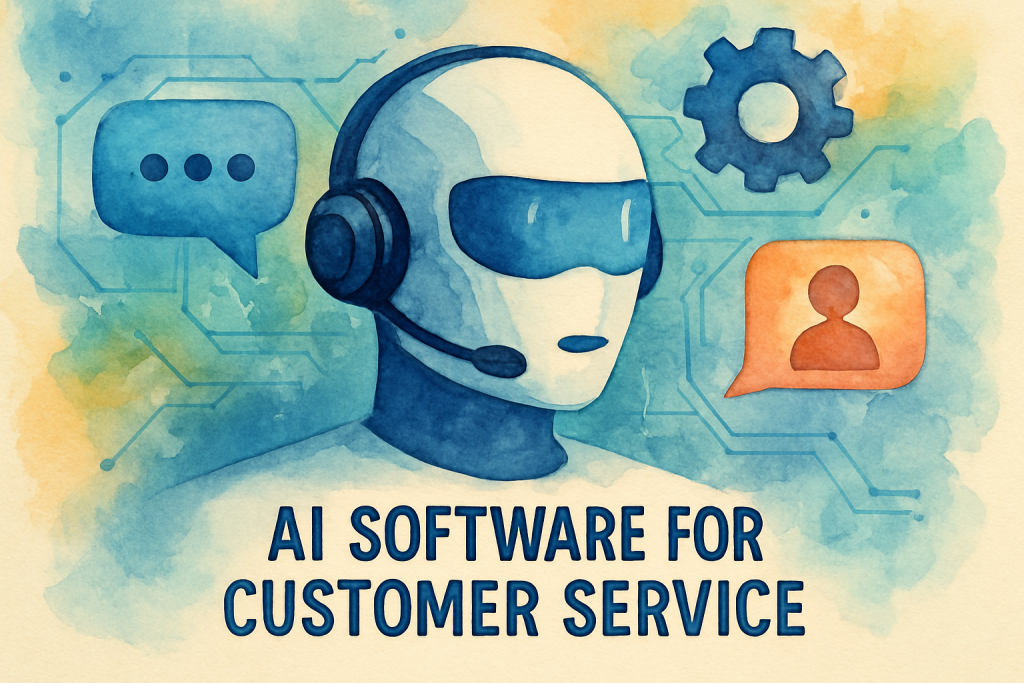
Enter AI software for customer service—a game-changing solution that’s transforming how businesses interact with their customers. These intelligent tools don’t just automate responses; they learn, adapt, and deliver experiences that rival human interaction while dramatically reducing operational costs.
The numbers speak for themselves: companies implementing AI-powered customer service solutions report up to 70% reduction in response times and 30% cost savings on support operations. But with dozens of platforms flooding the market, choosing the right one feels overwhelming.
This comprehensive guide cuts through the noise. We’ll explore the seven best AI customer service tools available today, examine their unique capabilities, and show you exactly how to implement them for maximum ROI. Whether you’re a startup or an enterprise, you’ll discover actionable strategies to revolutionise your support operations.
Understanding AI Software for Customer Service
AI software for customer service represents a sophisticated blend of machine learning, natural language processing, and automation technologies designed to handle customer interactions intelligently. Unlike basic chatbots that follow rigid scripts, modern AI solutions understand context, sentiment, and intent.
These platforms analyse thousands of customer conversations to identify patterns, predict needs, and deliver personalised responses. They integrate seamlessly with existing CRM systems, help desks, and communication channels to create a unified support ecosystem.
Why AI Customer Service Matters Now
The shift toward AI-powered support isn’t just a trend—it’s a business imperative. According to Gartner, by 2027, chatbots will become the primary customer service channel for roughly a quarter of organisations. Companies that delay adoption risk falling behind competitors who are already reaping the benefits.
Customer service AI tools excel at handling repetitive queries, freeing human agents to focus on complex issues requiring empathy and creative problem-solving. This hybrid approach maximises efficiency while maintaining the human touch customers value.
Key Technologies Powering AI Support Solutions
Modern AI customer service platforms leverage several cutting-edge technologies:
-
- Natural Language Processing (NLP): Enables systems to understand and respond to customer queries in conversational language
- Machine Learning: Allows platforms to improve accuracy over time by learning from past interactions
- Sentiment Analysis: Detects customer emotions to route urgent or frustrated customers to human agents
Anticipates customer needs based on behaviour patterns and historical data
The 7 Best AI Customer Service Tools
After extensive research and analysis, we’ve identified seven exceptional platforms that deliver measurable results across different business needs and budgets.
1. Zendesk AI
Zendesk‘s AI-powered suite combines intelligent automation with robust ticketing capabilities. Its Answer Bot resolves common questions instantly by pulling from your knowledge base, while Advanced AI suggests responses to agents, reducing handle times by up to 40%.
Best for: Mid-sized to enterprise companies seeking comprehensive support automation
2. Intercom Resolution Bot
Intercom‘s Resolution Bot uses conversational AI to engage customers proactively. It doesn’t just answer questions—it guides users through complex processes, qualifies leads, and seamlessly hands off to human agents when needed.
Best for: SaaS companies prioritising customer engagement and product adoption
Key Features: Custom bot workflows, behavioural targeting, A/B testing, real-time collaboration
3. Freshdesk Freddy AI
Freddy AI brings intelligent automation to Freshdesk‘s intuitive platform. It predicts ticket fields, suggests solutions to agents, and identifies trending issues before they escalate. The platform’s affordability makes enterprise-grade AI accessible to growing businesses.
Best for: Small to mid-sized businesses seeking cost-effective AI implementation
Key Features: Smart ticket assignment, agent assist, customer sentiment analysis, chatbot builder
4. Salesforce Einstein
Einstein integrates AI capabilities directly into Salesforce Service Cloud, providing a unified view of customer interactions. Its predictive intelligence helps agents resolve issues faster whilst identifying upsell opportunities.
Best for: Enterprises already using Salesforce ecosystem
Key Features: Case classification, next-best-action recommendations, voice-to-text transcription, Einstein Bots
5. Ada
Ada specialises in automated customer service that feels remarkably human. Its no-code platform allows non-technical teams to build sophisticated conversation flows that resolve over 70% of inquiries without human intervention.
Best for: Companies wanting powerful automation without technical complexity
6. Drift Conversational AI
Drift focuses on conversational marketing and sales, but its AI capabilities extend to customer support. The platform excels at qualifying leads, booking meetings, and providing instant answers whilst maintaining a conversational tone.
Best for: B2B companies integrating sales and support functions
Key Features: Conversational landing pages, account-based marketing, video chat, custom playbooks
7. Kustomer
Kustomer‘s AI-powered CRM platform provides a holistic view of customer relationships. Its intelligent routing ensures inquiries reach the right agent, whilst automation handles routine tasks, allowing teams to focus on building relationships.
Best for: Retail and e-commerce businesses managing high volumes
Key Features: Omnichannel inbox, customer timeline view, intelligent workflows, business intelligence
Implementing AI Software for Customer Service: A Step-by-Step Guide
Successfully deploying AI customer service tools requires strategic planning and thoughtful execution. Follow this proven framework to maximise your investment.
Step 1: Assess Your Current Support Operations
Begin by auditing your existing customer service processes. Identify bottlenecks, measure key metrics like first response time and resolution rate, and analyse the types of inquiries your team handles most frequently.
Document which questions are repetitive and easily automated versus those requiring human expertise. This analysis reveals where AI will deliver the greatest impact.
Step 2: Define Clear Objectives and KPIs
Establish specific, measurable goals for your AI implementation. Common objectives include:
- Reducing average response time by 50%
- Automating 60% of tier-1 support inquiries
- Decreasing support costs by 30%
- Improving customer satisfaction scores by 20%
- Increasing agent productivity by 40%
These benchmarks provide a framework for evaluating platform options and measuring success post-implementation.
Step 3: Choose the Right Platform
Select AI software for customer service that aligns with your technical capabilities, budget, and business requirements. Consider factors like:
- Integration capabilities with existing tools
- Scalability to accommodate growth
- Customisation options for your brand voice
- Training and support resources
- Pricing structure and total cost of ownership
Request demos and trial periods to test platforms with real customer scenarios before committing.
Step 4: Build Your Knowledge Base
AI systems are only as effective as the information they access. Develop a comprehensive knowledge base covering common questions, troubleshooting guides, and product documentation.
Organise content logically, use clear language, and update regularly based on new inquiries and product changes. Quality content directly impacts AI accuracy and customer satisfaction.
Step 5: Train Your AI and Your Team
Most platforms require initial training to understand your business context and terminology. Feed historical conversation data, refine responses, and test extensively before going live.
Simultaneously, prepare your support team for the transition. Explain how AI will augment their work, provide training on new workflows, and address concerns about job security. Emphasise that AI handles routine tasks so they can focus on meaningful customer relationships.
Step 6: Launch Gradually and Iterate
Start with a limited rollout—perhaps one channel or customer segment—to identify issues before full deployment. Monitor performance closely, gather feedback from both customers and agents, and make adjustments.
AI systems improve through continuous learning. Regularly review conversations, identify gaps in knowledge, and refine responses to enhance accuracy over time.
Overcoming Common AI Customer Service Challenges
Whilst AI software for customer service delivers impressive benefits, implementation isn’t without obstacles. Understanding these challenges and their solutions ensures smoother adoption.
Challenge 1: Maintaining Brand Voice and Personality
Many businesses worry that AI responses feel robotic or impersonal, diluting their brand identity.
Solution: Invest time in customising your AI’s tone and language. Most platforms allow you to define personality traits, preferred phrases, and communication style. Review and refine responses regularly to ensure they reflect your brand values. Consider having your marketing team collaborate on response templates.
Challenge 2: Handling Complex or Emotional Situations
AI excels at straightforward queries but can struggle with nuanced problems or upset customers requiring empathy.
Solution: Implement intelligent escalation rules that detect frustration, confusion, or complexity and route these conversations to human agents. Use sentiment analysis to identify emotional cues early. Train your AI to acknowledge limitations and transition smoothly to human support when appropriate.
Challenge 3: Integration with Legacy Systems
Organisations with older technology infrastructure may face technical hurdles connecting AI platforms to existing systems.
Solution: Prioritise platforms offering robust API capabilities and pre-built integrations with common business tools. Consider middleware solutions that bridge gaps between systems. If necessary, phase your implementation, starting with standalone AI capabilities before pursuing deeper integrations.
Challenge 4: Data Privacy and Security Concerns
Customer service interactions often involve sensitive information, raising questions about data protection and compliance.
Solution: Select vendors with strong security credentials, including SOC 2 compliance, GDPR adherence, and encryption standards. Establish clear data governance policies, limit AI access to necessary information only, and regularly audit security practices. Transparency with customers about AI usage builds trust.
Challenge 5: Measuring True ROI
Quantifying the financial impact of AI customer service tools can be challenging beyond obvious metrics like reduced headcount.
Solution: Track comprehensive metrics including customer lifetime value, retention rates, upsell conversion, and brand sentiment alongside operational efficiency measures. Calculate the cost of customer churn prevented and revenue generated through improved experiences. These holistic measurements reveal AI’s full business impact.
Maximising Your AI Customer Service Investment
Implementing AI software for customer service is just the beginning. These advanced strategies help you extract maximum value from your investment.
Use AI-generated insights to anticipate customer needs before they reach out. Identify patterns indicating potential issues and proactively address them through targeted communications or product improvements.
Personalise at Scale
Modern AI platforms access customer history, preferences, and behaviour to deliver personalised experiences. Configure your system to reference past purchases, acknowledge loyalty, and tailor recommendations based on individual profiles.
Continuously Optimise Through A/B Testing
Test different response variations, conversation flows, and escalation triggers to identify what resonates best with your audience. Small improvements compound over time, significantly enhancing performance.
Expand Across Channels
Once your AI performs well on one channel, extend it to others—email, social media, SMS, voice. Omnichannel consistency improves customer experience whilst maximising your technology investment.
Conclusion: Transform Your Customer Service with AI
AI software for customer service has evolved from experimental technology to essential business infrastructure. The seven platforms highlighted in this guide represent the best options available, each offering unique strengths for different organisational needs.
The benefits are undeniable: faster response times, reduced operational costs, improved customer satisfaction, and freed-up human agents to handle complex, high-value interactions. Companies that embrace these tools gain competitive advantages that compound over time.
Success requires more than selecting the right platform—it demands strategic implementation, continuous optimisation, and commitment to balancing automation with human touch. Start by assessing your current operations, defining clear objectives, and choosing a solution that aligns with your business goals.
Remember that AI customer service tools work best when they augment human capabilities rather than replace them entirely. The future of customer support is collaborative, combining AI efficiency with human empathy to deliver exceptional experiences at scale.
Ready to revolutionise your customer service operations? The Crunch specialises in helping businesses select, implement, and optimise AI customer service solutions tailored to their unique needs. Our team of experts will guide you through every step of the journey, from initial assessment to full deployment and beyond.
Don’t let your competitors gain the AI advantage. Contact The Crunch today to schedule your free consultation and discover how AI software for customer service can transform your support operations and boost ROI. Visit our proposal page to get started on your customer service transformation journey.
Frequently Asked Questions (FAQ)
1. What is AI software for customer service?
2. How does AI improve customer service?
3. What are the main benefits of using AI in customer service?
4. How do I get started with AI customer service software?
5. How does AI customer service software compare to traditional customer support?
6. Is AI customer service software expensive?
7. Can AI software handle complex customer inquiries?
8. What are common concerns about using AI in customer service?
9. How do I integrate AI customer service software with my existing systems?
10. Can AI customer service software be customised for my business?
11. What types of businesses benefit most from AI customer service software?
12. Is AI customer service software secure?