The technology landscape is evolving at breakneck speed, and one question keeps surfacing in boardrooms and development teams worldwide: what’s the real difference between AI and traditional software? While many people use these terms interchangeably, understanding the distinction between AI vs software is crucial for making informed business decisions in 2026.
In this comprehensive guide, we’ll explore five key differences that distinguish AI from traditional software, examine their unique capabilities, and help you determine which approach best serves your business needs. Whether you’re a business owner evaluating technology investments or a developer planning your next project, understanding these distinctions will empower you to leverage the right tools for maximum impact.
What Makes AI Different from Traditional Software?
Defining Traditional Software
Traditional software operates on explicit instructions written by programmers. Every action, decision, and output is predetermined through lines of code that follow logical pathways. Think of it as a detailed recipe: if you follow the steps exactly, you’ll get the same result every time.
Conventional software applications like word processors, accounting systems, and inventory management tools execute predefined rules. When you click “save,” the software follows a specific sequence of commands to store your file. These programs are deterministic, meaning they produce consistent, predictable outcomes based on their programming.
Understanding Artificial Intelligence
Artificial intelligence, in contrast, learns from data and experience rather than following rigid instructions. AI systems use algorithms that identify patterns, make predictions, and improve their performance over time without explicit programming for every scenario.
Machine learning, a subset of AI, enables systems to analyze vast datasets and draw conclusions that weren’t explicitly coded. According to recent industry reports, the global AI market is projected to reach $1.8 trillion by 2030, reflecting the transformative impact of this technology across industries.
The Fundamental Distinction
The core difference in the AI vs software comparison lies in adaptability. Traditional software requires human intervention to change its behavior—a developer must modify the code. AI systems, however, can adjust their responses based on new information, essentially “learning” from experience much like humans do.
Five Critical Differences Between AI and Software
1. Decision-Making Approach
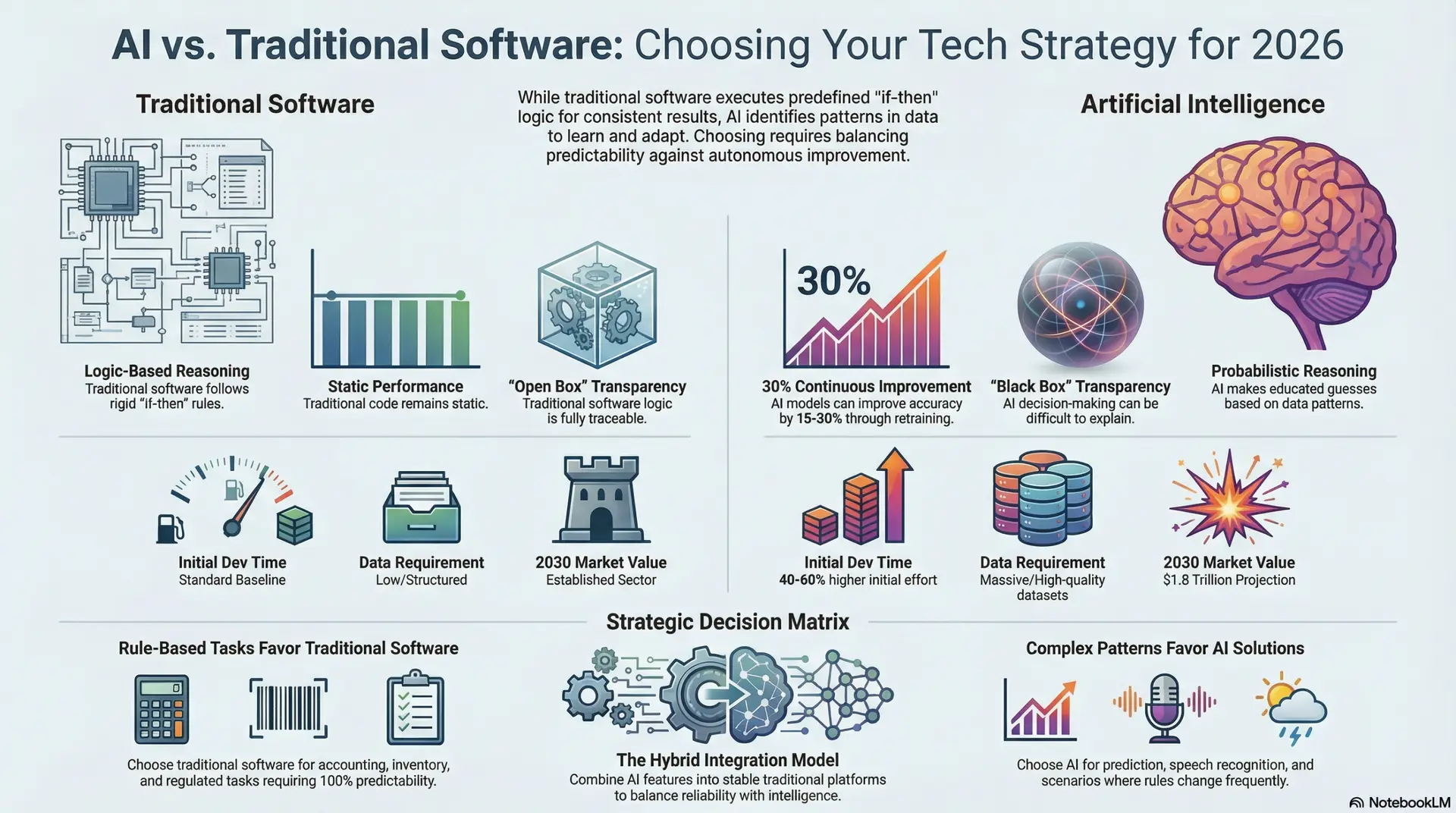
Traditional software makes decisions based on if-then logic programmed by developers. Every possible scenario must be anticipated and coded. If a situation arises that wasn’t programmed, the software either fails or produces an error message.
AI systems employ probabilistic reasoning, weighing multiple factors to determine the most likely correct response. They can handle ambiguous situations and make educated guesses based on patterns learned from training data. This capability makes AI particularly valuable for complex, unpredictable environments where rule-based programming falls short.
2. Learning and Adaptation Capabilities
One of the most significant advantages in the AI vs software debate is the learning capacity. Traditional software remains static until a developer updates it. If your accounting software needs a new feature, someone must write and deploy new code.
AI systems continuously improve through exposure to new data. A customer service chatbot becomes more accurate at understanding queries over time. Recommendation engines refine their suggestions based on user behavior. This self-improvement happens automatically, without constant human intervention.
Research from MIT shows that machine learning models can improve accuracy by 15-30% through continuous training, significantly outpacing static software solutions in dynamic environments.
3. Data Requirements and Processing
Traditional software typically processes data according to predefined rules. It requires structured input and produces structured output. The data serves as information to be manipulated, not as a learning resource.
AI thrives on massive datasets. The more data an AI system processes, the better it performs. Deep learning models may require millions of examples to achieve high accuracy. This data-hungry nature means AI implementations often need robust data infrastructure and storage capabilities that traditional software doesn’t require.
4. Development and Maintenance Complexity
Building traditional software follows established engineering practices. Developers write code, test functionality, and deploy applications. The process is well-understood, and troubleshooting typically involves identifying bugs in the code logic.
Developing AI systems requires different expertise, including data science, statistical modeling, and neural network architecture. Maintenance involves monitoring model performance, retraining with new data, and addressing issues like model drift—when an AI’s accuracy degrades over time due to changing real-world conditions.
The AI vs software development comparison reveals that AI projects often require 40-60% more time in the initial phases but can reduce long-term maintenance costs through automation.
5. Predictability and Explainability
Traditional software offers complete transparency. You can trace exactly why a program produced a specific output by examining the code. This predictability is crucial for regulated industries and critical systems where accountability matters.
AI systems, particularly deep learning models, often operate as “black boxes.” They produce accurate results, but explaining exactly why they made a specific decision can be challenging. This lack of explainability raises concerns in healthcare, finance, and legal applications where understanding the reasoning behind decisions is essential.
Implementing the Right Solution for Your Business Needs
Assessing Your Requirements
Choosing between AI and traditional software starts with understanding your specific needs. Ask yourself these critical questions:
- Does your problem involve pattern recognition or prediction?
- Do you have access to large, quality datasets?
- Will the rules governing your solution change frequently?
- Do you need the system to improve automatically over time?
- How important is explainability in your decision-making process?
If you answered yes to the first four questions and no to the last, AI might be your best option. If explainability and predictability are paramount, traditional software may serve you better.
Building a Hybrid Approach
This hybrid strategy leverages the reliability and transparency of conventional software with the adaptive intelligence of AI. Companies like Salesforce and HubSpot have successfully integrated AI features into their traditional software platforms, enhancing functionality without sacrificing stability.
Step-by-Step Implementation Guide
Step 1: Define Clear Objectives
Identify specific business problems you want to solve. Vague goals like “use AI to improve operations” rarely succeed. Instead, target concrete outcomes such as “reduce customer service response time by 30%” or “improve inventory forecasting accuracy by 25%.”
Step 2: Evaluate Your Data Infrastructure
AI requires quality data. Assess whether you have sufficient historical data, proper data collection mechanisms, and the infrastructure to store and process large datasets. Traditional software has less demanding data requirements but still needs proper database architecture.
Step 3: Start with Pilot Projects
Test your approach on a small scale before full deployment. A pilot project allows you to validate assumptions, measure results, and refine your strategy without massive upfront investment. This applies whether you’re implementing AI or traditional software solutions.
Step 4: Build the Right Team
Traditional software projects need developers, testers, and project managers. AI initiatives additionally require data scientists, machine learning engineers, and domain experts who understand both the technology and your business context.
Step 5: Monitor and Iterate
Both AI and traditional software require ongoing monitoring. Track key performance indicators, gather user feedback, and make adjustments. AI systems particularly need regular retraining and performance evaluation to maintain accuracy.
Best Practices for Success
Regardless of whether you choose AI or traditional software, certain principles ensure successful implementation. Prioritize user experience—technology should solve problems, not create new ones. Invest in proper training so your team can effectively use and maintain the system.
Document everything thoroughly. For traditional software, this means clear code comments and system architecture diagrams. For AI, document your data sources, model parameters, and training procedures. This documentation proves invaluable during troubleshooting and future enhancements.
Plan for scalability from the beginning. Your solution should accommodate growth in users, data volume, and functionality. Cloud-based infrastructure offers flexibility for both AI and traditional software deployments.
Overcoming Common Challenges in AI vs Software Implementation
Budget and Resource Constraints
One of the most common obstacles businesses face is the perceived high cost of AI implementation. While AI projects can require significant investment in data infrastructure and specialized talent, traditional software development also demands substantial resources.
The solution lies in realistic budgeting and phased implementation. Start with smaller projects that deliver quick wins and demonstrate ROI. Cloud-based AI services from providers like AWS, Google Cloud, and Microsoft Azure offer pay-as-you-go models that reduce upfront costs. For traditional software, open-source solutions and low-code platforms can minimize development expenses.
Talent Acquisition and Skills Gap
Finding qualified AI specialists remains challenging, with demand far exceeding supply. Data scientists and machine learning engineers command premium salaries, making it difficult for smaller organizations to compete.
Consider partnering with specialized consultancies or using managed AI services that provide expertise without full-time hires. Invest in upskilling your existing team through training programs and certifications. Many traditional software developers can transition to AI development with proper education and mentorship.
Data Quality and Availability Issues
AI systems are only as good as their training data. Poor data quality leads to inaccurate predictions and unreliable results. Many organizations discover their data is incomplete, inconsistent, or biased only after starting an AI project.
Address data quality proactively by implementing robust data governance practices. Establish clear standards for data collection, storage, and cleaning. Regular audits help identify and correct issues before they impact your AI models. Traditional software faces similar challenges but typically has more tolerance for imperfect data.
Integration with Legacy Systems
Most businesses operate on a foundation of legacy software that wasn’t designed to work with modern AI systems. Integration challenges can derail even well-planned projects.
Use APIs and middleware to bridge the gap between old and new systems. Microservices architecture allows you to add AI capabilities incrementally without overhauling your entire technology stack. This approach works whether you’re adding AI to existing software or modernizing traditional applications.
Managing Expectations and Change Resistance
Stakeholders often have unrealistic expectations about what AI can accomplish, influenced by media hype and marketing claims. Conversely, some team members resist change, preferring familiar traditional software approaches.
Combat these challenges through education and transparent communication. Clearly explain what AI can and cannot do in your specific context. Involve end-users early in the development process to address concerns and gather feedback. Celebrate small wins to build momentum and demonstrate value.
Making the Right Choice for Your Future
The AI vs software decision ultimately depends on your unique business context, goals, and resources. Traditional software excels at well-defined, rule-based tasks where predictability and transparency are paramount. It’s the right choice for core business operations, compliance-critical functions, and scenarios where you need complete control over system behavior.
Artificial intelligence shines in situations involving pattern recognition, prediction, personalization, and adaptation. Choose AI when you’re dealing with large datasets, complex variables, and problems that benefit from continuous learning and improvement.
Remember that technology serves your business objectives, not the other way around. The most sophisticated AI system provides no value if it doesn’t solve real problems or improve outcomes. Similarly, traditional software remains perfectly adequate for many applications despite the excitement surrounding AI.
As we move further into 2026, the line between AI and traditional software continues to blur. More conventional applications incorporate AI features, while AI systems rely on traditional software infrastructure. The future belongs to organizations that understand both approaches and apply them strategically.
Whether you’re just beginning to explore the differences between AI vs software or you’re ready to implement a solution, expert guidance can accelerate your success and help you avoid costly mistakes. The right technology partner brings experience, technical expertise, and strategic insight to ensure your investment delivers measurable results.
Ready to determine whether AI or traditional software is right for your business? The Crunch specializes in helping organizations navigate complex technology decisions and implement solutions that drive real business value. Our team of experts will assess your unique needs, recommend the optimal approach, and guide you through successful implementation.
Don’t leave your technology future to chance. Contact The Crunch today to schedule your free consultation and discover how we can help you leverage the right technology for sustainable competitive advantage. Visit https://thecrunch.io/get-a-proposal/ to get started.
Frequently Asked Questions (FAQ)
1. What is the difference between AI and traditional software?
2. How does AI work compared to regular software?
3. What are the main benefits of using AI over traditional software?
4. Are there any disadvantages or risks to using AI instead of software?
5. How much does it cost to implement AI compared to traditional software?
6. Can AI replace all traditional software applications?
7. How do I decide whether to use AI or traditional software for my project?
8. What skills are needed to develop AI solutions versus traditional software?
9. How can I get started with AI if I only have experience with traditional software?
10. Is AI more expensive to maintain than traditional software?
11. What are some common use cases where AI outperforms traditional software?
12. Are there privacy or ethical concerns with using AI instead of software?