Build AI Chatbots in Minutes: Sendbird’s Ultimate Guide 2025
Introduction: The Future of Customer Engagement is Here
Imagine responding to thousands of customer inquiries simultaneously, providing personalised support 24/7, and never missing a single conversation. This isn’t science fiction—it’s the reality that businesses are experiencing with advanced AI chatbot solutions.
In today’s hyper-connected world, customers expect instant responses and seamless interactions across every touchpoint. Traditional customer service models simply can’t keep pace with these demands. That’s where the Sendbird AI chatbot comes into play, revolutionising how businesses communicate with their audiences.
Whether you’re a startup looking to scale customer support or an enterprise seeking to enhance user engagement, AI-powered chatbots have become essential tools for modern business operations. This comprehensive guide will walk you through everything you need to know about building and deploying intelligent chatbots using Sendbird’s powerful platform.
We’ll explore the fundamentals of AI chatbot technology, uncover proven strategies for implementation, provide step-by-step guidance for building your first bot, and address common challenges you might encounter along the way.
Understanding Sendbird AI Chatbot Technology
The landscape of conversational AI has evolved dramatically over the past few years. What once required extensive coding knowledge and months of development can now be accomplished in minutes with the right platform.
What Makes Sendbird AI Chatbot Different
A Sendbird AI chatbot represents the convergence of natural language processing, machine learning, and intuitive design. Unlike basic rule-based chatbots that follow rigid scripts, Sendbird’s solution leverages advanced AI to understand context, intent, and nuance in customer conversations.
The platform offers pre-built AI models trained on millions of conversations, allowing your chatbot to handle complex queries from day one. This means you’re not starting from scratch—you’re building on a foundation of proven conversational intelligence.
According to recent industry research, businesses implementing AI chatbots see an average 30% reduction in customer service costs while simultaneously improving customer satisfaction scores by 25%. These aren’t marginal improvements—they’re transformative results that directly impact your bottom line.
The Current State of Conversational AI
The chatbot market is projected to reach $15.5 billion by 2028, growing at a compound annual rate of 23.3% according to Grand View Research. This explosive growth reflects a fundamental shift in how businesses approach customer engagement.
Modern consumers interact with an average of 5-7 chatbots weekly, and 67% of millennials prefer chatbot assistance over calling customer service, according to Salesforce research. These statistics underscore a critical point: AI chatbots aren’t just a nice-to-have feature—they’re becoming the expected standard for customer interaction.
Key Components of Effective AI Chatbots
Successful chatbot implementations share several common characteristics:
- Natural Language Understanding: The ability to comprehend user intent beyond exact keyword matches, powered by advanced AI techniques
- Contextual Awareness: Maintaining conversation history to provide relevant, personalised responses
- Multi-channel Integration: Seamless operation across web, mobile, and messaging platforms including Facebook Messenger and WhatsApp Business
- Continuous Learning: Improving performance through machine learning and user feedback
Benefits and Strategic Advantages of Sendbird AI Chatbot
Implementing a Sendbird AI chatbot delivers measurable benefits across multiple dimensions of your business operations. Let’s explore the most impactful advantages you can expect.
1. Dramatic Cost Reduction and Efficiency Gains
Customer service represents one of the largest operational expenses for most businesses. AI chatbots can handle up to 80% of routine inquiries without human intervention, freeing your support team to focus on complex issues that truly require human expertise.
A mid-sized e-commerce company implementing Sendbird’s solution reported saving over $400,000 annually in support costs while simultaneously reducing average response times from 12 minutes to under 30 seconds. These efficiency gains compound over time as your chatbot learns and improves. McKinsey research confirms that AI-driven customer service can deliver significant ROI within the first year of implementation.
2. 24/7 Availability and Global Reach
Your customers don’t operate on a 9-to-5 schedule, and neither should your support system. AI chatbots provide round-the-clock assistance across all time zones, ensuring no customer inquiry goes unanswered.
For businesses with international audiences, this global availability is particularly valuable. Sendbird’s multilingual capabilities allow your chatbot to communicate fluently in over 100 languages, breaking down geographical barriers to customer engagement.
3. Personalised Customer Experiences at Scale
Modern consumers expect personalised interactions, but delivering customised experiences to thousands of customers simultaneously seems impossible—unless you leverage AI.
The Sendbird AI chatbot analyses user behaviour, purchase history, and conversation context to deliver tailored recommendations and responses. This level of personalisation was once reserved for high-touch, white-glove service models, but AI democratises it for businesses of all sizes.
4. Data-Driven Insights and Continuous Improvement
Every chatbot conversation generates valuable data. You’ll discover which questions customers ask most frequently, where conversations typically break down, and which products or services generate the most interest. These insights inform not just your chatbot strategy but your broader business decisions.
Key metrics to track include:
- Conversation completion rates
- Customer satisfaction scores (CSAT)
- Average handling time
- Escalation rates to human agents
- Conversion rates from chatbot interactions
Building Your Sendbird AI Chatbot: Step-by-Step Implementation
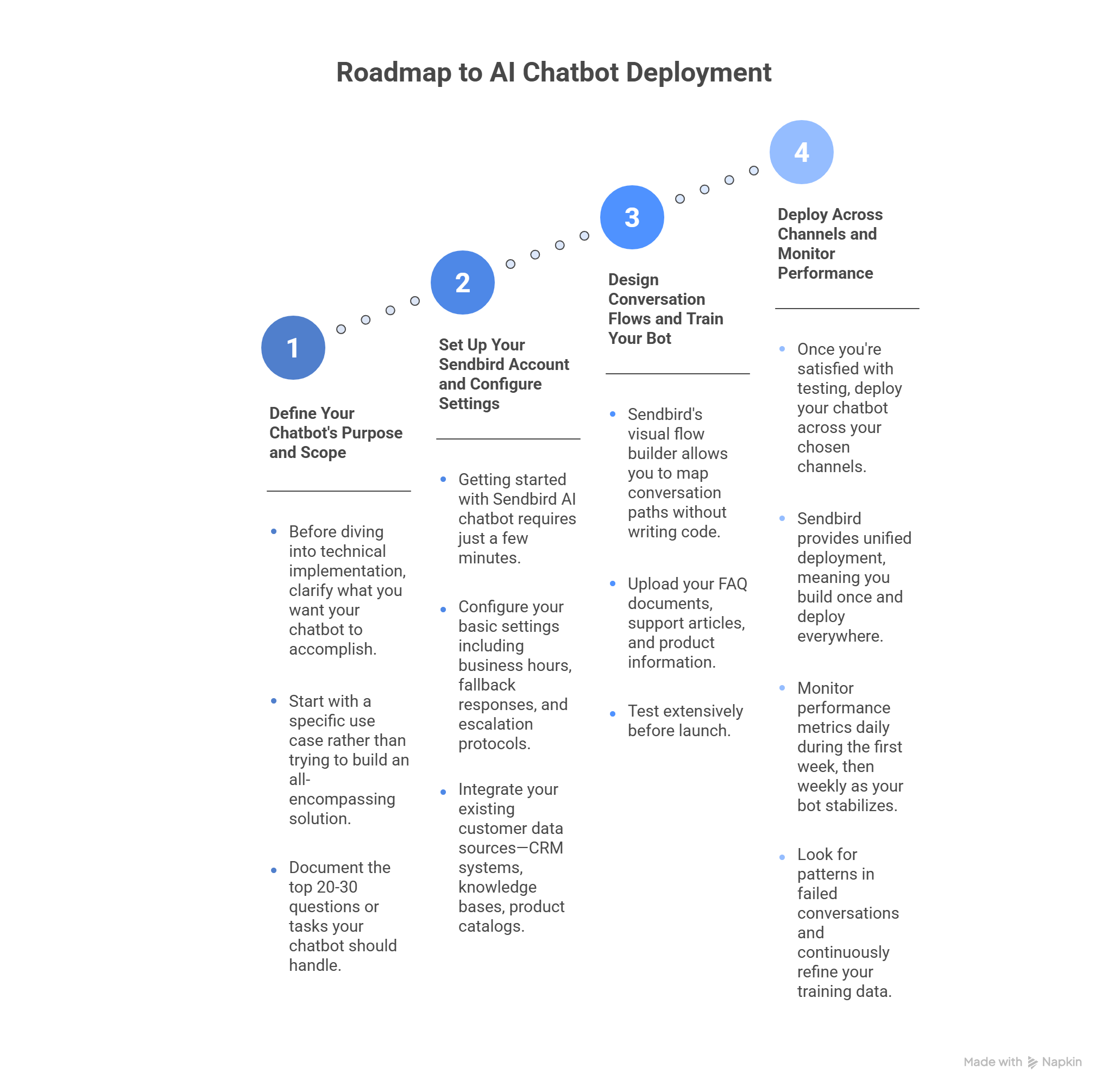
Creating an effective AI chatbot might seem daunting, but Sendbird’s intuitive platform makes the process straightforward. Here’s your roadmap to deployment.
Step 1: Define Your Chatbot’s Purpose and Scope
Before diving into technical implementation, clarify what you want your chatbot to accomplish. Are you focused on customer support, lead generation, product recommendations, or appointment scheduling?
Start with a specific use case rather than trying to build an all-encompassing solution. A focused chatbot that excels at one task outperforms a generalist bot that handles everything mediocrely. Following UX best practices from Nielsen Norman Group can help ensure your chatbot provides genuine value.
Document the top 20-30 questions or tasks your chatbot should handle. This becomes your initial training dataset and helps you measure success post-launch.
Step 2: Set Up Your Sendbird Account and Configure Settings
Getting started with Sendbird AI chatbot requires just a few minutes. Create your account, select your pricing tier based on expected conversation volume, and access the dashboard.
Configure your basic settings including business hours, fallback responses, and escalation protocols. Decide when conversations should transfer to human agents and establish clear handoff procedures.
Integrate your existing customer data sources—CRM systems, knowledge bases, product catalogues—to give your chatbot access to the information it needs to provide accurate responses.
Step 3: Design Conversation Flows and Train Your Bot
Sendbird’s visual flow builder allows you to map conversation paths without writing code. Create decision trees that guide users towards resolution while maintaining natural, conversational language following Google’s conversational design principles.
Upload your FAQ documents, support articles, and product information. Sendbird’s AI automatically processes this content to understand your business domain and generate appropriate responses.
Test extensively before launch. Simulate various customer scenarios, including edge cases and difficult questions. Refine your bot’s responses based on these test conversations.
Step 4: Deploy Across Channels and Monitor Performance
Once you’re satisfied with testing, deploy your chatbot across your chosen channels—website, mobile app, Facebook Messenger, WhatsApp, or other platforms.
Sendbird provides unified deployment, meaning you build once and deploy everywhere. Your chatbot maintains consistent functionality and personality across all touchpoints.
Monitor performance metrics daily during the first week, then weekly as your bot stabilises. Look for patterns in failed conversations and continuously refine your training data.
Best Practices for Optimal Performance
Successful chatbot implementations follow these proven practices:
- Set clear expectations: Let users know they’re interacting with AI and what it can help with, following responsible AI principles
- Provide easy escalation: Always offer a path to human support when needed
- Use conversational language: Avoid robotic, overly formal responses
- Iterate based on data: Review conversation logs weekly and update responses
- Maintain brand voice: Ensure your chatbot reflects your company’s personality and values
Overcoming Common Sendbird AI Chatbot Challenges
While AI chatbots offer tremendous benefits, implementation isn’t without challenges. Understanding potential obstacles and their solutions ensures smoother deployment.
Challenge 1: Managing User Expectations
Users sometimes expect chatbots to understand complex, ambiguous queries with human-level comprehension. When the bot fails to meet these expectations, frustration follows.
Solution: Be transparent about your chatbot’s capabilities from the first interaction. Use opening messages that clearly state what the bot can help with. Implement confidence thresholds—if the bot isn’t certain about a query, it should acknowledge uncertainty and offer alternatives or human escalation.
Challenge 2: Handling Complex or Unique Queries
No matter how well-trained, your Sendbird AI chatbot will encounter questions outside its knowledge base. How you handle these moments determines overall user satisfaction.
Solution: Design graceful failure responses that maintain user trust. Instead of generic “I don’t understand” messages, provide helpful alternatives: “I’m not sure about that specific question, but I can help you with [related topics], or I can connect you with a team member who specialises in this area.”
Log all unhandled queries and review them weekly. These represent opportunities to expand your bot’s capabilities and address genuine customer needs.
Challenge 3: Maintaining Conversation Context
Users expect chatbots to remember previous statements within a conversation. Context loss creates frustrating experiences where users must repeat information.
Solution: Sendbird’s platform includes built-in context management, but you must design flows that leverage this capability. Structure conversations to reference previous exchanges and maintain state throughout multi-turn interactions.
Challenge 4: Balancing Automation with Human Touch
Over-automation can make customers feel like they’re navigating an impersonal maze. Under-automation defeats the purpose of implementing AI.
Solution: Identify which interactions truly benefit from human involvement—typically complex problem-solving, emotional situations, or high-value sales opportunities. Route these conversations to human agents while letting AI handle routine, transactional queries.
Implement sentiment analysis to detect frustration or dissatisfaction, automatically escalating these conversations before they deteriorate further.
Conclusion: Transform Your Customer Engagement Today
The Sendbird AI chatbot represents more than just a technological upgrade—it’s a fundamental reimagining of how businesses connect with their customers. By providing instant, personalised, and intelligent responses at scale, you’re not just meeting customer expectations; you’re exceeding them.
We’ve explored how AI chatbots reduce operational costs while improving service quality, walked through the step-by-step implementation process, and addressed common challenges you might face. The path forward is clear: businesses that embrace conversational AI will outpace competitors still relying on traditional support models.
The beauty of Sendbird’s platform lies in its accessibility. You don’t need a team of AI specialists or months of development time. With the right strategy and Sendbird’s powerful tools, you can deploy an intelligent chatbot in minutes and start seeing results immediately.
Remember that chatbot implementation is an iterative process. Your first deployment won’t be perfect, and that’s okay. The key is launching, learning from real user interactions, and continuously improving based on data and feedback.
As we move further into 2025, AI chatbots will become increasingly sophisticated, handling more complex tasks and providing even more value. By starting now, you’re positioning your business at the forefront of this transformation.
Ready to revolutionise your customer engagement strategy? Don’t navigate this journey alone. The experts at The Crunch specialise in implementing AI chatbot solutions that drive real business results. Schedule your free consultation today and discover how a customised Sendbird AI chatbot can transform your customer experience and accelerate your growth.
The future of customer engagement is conversational, intelligent, and available 24/7. The question isn’t whether to implement AI chatbots—it’s how quickly you can get started.
Frequently Asked Questions (FAQ)
1. What is the Sendbird AI Chatbot?
2. How do I integrate the Sendbird AI Chatbot into my app or website?
3. What are the main benefits of using the Sendbird AI Chatbot?
4. How does the Sendbird AI Chatbot compare to other chatbot solutions?
5. Is the Sendbird AI Chatbot secure and compliant with data privacy standards?
6. How much does the Sendbird AI Chatbot cost?
7. Can I customise the Sendbird AI Chatbot’s responses and behaviour?
8. What kind of support and resources are available for Sendbird AI Chatbot users?
9. Do I need coding experience to set up the Sendbird AI Chatbot?
10. Can the Sendbird AI Chatbot handle multiple languages?
11. How do I get started with the Sendbird AI Chatbot?
12. What are some common use cases for the Sendbird AI Chatbot?