
AI agent pricing varies more than most business owners expect — from $50 a month for a basic chatbot to $200,000+ for a fully custom enterprise build. The gap between those numbers is enormous, and choosing the wrong option wastes budget without delivering results. This guide covers every pricing model, compares platforms by category, quantifies your potential ROI, and helps you decide whether to build or buy.
Whether you’re evaluating your first automation investment or scaling an existing deployment, you’ll leave with clear numbers and a practical framework for making the right call.
AI Agent Pricing by Platform Type
The most reliable way to benchmark AI agent pricing is to compare by category. Off-the-shelf SaaS tools, mid-market platforms, enterprise solutions, and custom-built agents each serve different needs — and carry very different price tags.
| Platform Type | Starting Price | Best For | Interaction Limit | Custom Training |
|---|---|---|---|---|
| Basic SaaS chatbot | $50–$200/mo | Solo operators, testing | 1,000–10,000/mo | No |
| Mid-tier (e.g. Intercom, Drift) | $500–$2,000/mo | SME customer service | Unlimited | Limited |
| Enterprise (e.g. IBM Watson, Microsoft) | $5,000–$50,000/mo | Large organisations | Unlimited | Yes |
| Custom-built (agency) | $15,000–$200,000 project | Full workflow control | Unlimited | Full |
| Open-source self-hosted | Dev time + infrastructure | Technical teams | Unlimited | Full |
Most SMEs land in the $500–$5,000/mo range for an off-the-shelf solution, or invest $30,000–$100,000 upfront for a custom agent tailored to their workflows. Open-source frameworks like LangChain reduce software costs but require significant developer time — often more expensive in total than a managed solution.
AI Agent Pricing Models Compared
Beyond the platform itself, how you pay matters. Each model has trade-offs depending on your usage patterns and budget predictability needs.
| Pricing Model | Predictability | Best When | Watch Out For |
|---|---|---|---|
| Subscription (flat monthly) | High | Steady, predictable volume | Paying for unused capacity |
| Usage-based (per call/conversation) | Low | Variable or seasonal demand | Spike overruns — bills can double overnight |
| Hybrid (base + overage) | Medium | Growing businesses | Complex billing; easy to miscalculate |
| One-time project fee | High | Fixed-scope custom builds | Change requests inflate cost fast |
For most businesses exploring AI automation for the first time, a subscription model offers the clearest path to controlling AI agent pricing. Usage-based pricing works well once you have a reliable baseline of interaction volume to model against.
Hidden Costs That Inflate AI Agent Pricing
Short answer: Beyond the sticker price, AI agent costs are inflated by integration and setup fees, per-conversation or per-token usage charges, maintenance retainers, and premium support. These can double the first-year total, so budget for them upfront.
Subscription fees are just the starting point. Several additional cost categories catch businesses off guard when calculating total AI agent pricing.
Integration and Setup
Connecting an AI agent to your CRM, helpdesk, or e-commerce platform typically adds 20–40% to your initial budget. Legacy systems are significantly more expensive to integrate than modern API-first tools. Budget $1,000–$30,000 for integration work depending on complexity.
Training and Ongoing Optimisation
AI agents require clean, labelled data to perform accurately. Poor training data leads to low accuracy and user frustration — and costs far more to fix later than to get right upfront. Allocate 10–15% of your annual platform cost for data maintenance and model refinement.
Support and Maintenance
Basic vendor plans often exclude priority support. Factor in either SLA upgrades or internal technical resource time for ongoing management — this is a recurring cost that many organisations underestimate at the planning stage.
AI Agent Pricing vs ROI: What’s the Real Return?
AI agent pricing only makes sense in the context of what you get back. Here’s a straightforward worked example for an SME with five customer service staff:
- 5 CS staff at $2,500/mo each = $12,500/mo in payroll
- AI agent handles 70% of queries = frees 3.5 FTE = $8,750/mo saved
- Mid-tier AI agent subscription = $1,500/mo
- Net monthly saving: $7,250 | First-year ROI: 483%
Results vary depending on query complexity, agent quality, and integration depth. The table below maps three planning scenarios for a mid-sized business:
| Scenario | Annual AI Cost | Annual Saving | Net ROI (Year 1) |
|---|---|---|---|
| Conservative (40% automation) | $18,000 | $30,000 | 67% |
| Realistic (70% automation) | $18,000 | $87,000 | 383% |
| Optimistic (90% automation) | $24,000 | $120,000 | 400% |
Beyond cost savings, revenue-side gains — faster lead response, 24/7 availability, higher conversion rates — often exceed the operational savings within 12–18 months of a well-deployed agent.
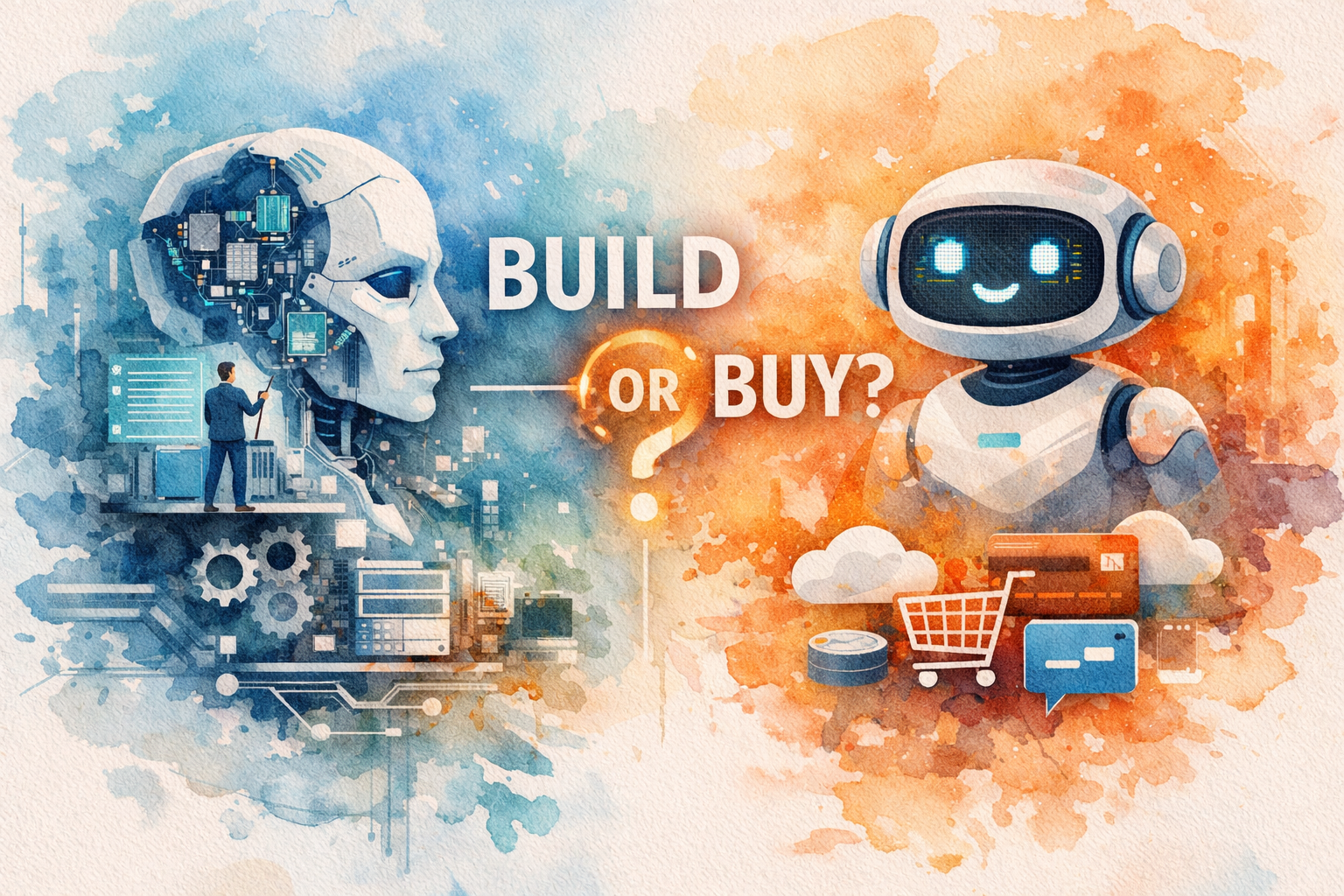
Build vs Buy: Which Approach Fits Your Business?
Short answer: Buy a no-code or SaaS agent when you need it live fast and your use case is standard; build custom when you have unique workflows, strict data control, or volume high enough that per-usage SaaS fees exceed a developer’s cost. Most SMEs should buy first and build later.
One of the most consequential decisions in AI agent pricing is whether to buy an off-the-shelf solution or invest in a custom build. There is no universally correct answer — it depends on your workflow complexity, internal technical capacity, and long-term goals.
| Factor | Build Custom | Buy Off-the-Shelf |
|---|---|---|
| Upfront cost | $30,000–$200,000 | $500–$5,000 setup |
| Time to deploy | 3–6 months | Days to weeks |
| Customisation | Full | Limited to vendor features |
| Maintenance | Your team or agency | Managed by vendor |
| Vendor lock-in | None | High |
| Best for | Complex or unique workflows | Standard use cases |
When to Buy
Off-the-shelf tools are the right choice when your use case is common — customer FAQ handling, appointment booking, basic lead qualification. They’re quick to deploy and require minimal technical investment. Most SMEs should start here before committing to custom development.
When to Build
Custom builds make sense when you have proprietary workflows, integration requirements that no SaaS tool supports, or compliance obligations in regulated sectors such as healthcare, finance, or legal. Working with a specialist AI automation agency gives you custom-built capability without maintaining a full in-house development team.
Contact The Crunch to discuss your requirements and get a scoped proposal.
5 Steps to Control AI Agent Pricing During Implementation
1. Define measurable outcomes first
Vague goals lead to scope creep and budget overruns. Nail down specific targets: “automate 60% of tier-1 support queries” or “reduce lead response time from 4 hours to under 5 minutes.” These benchmarks let you evaluate platforms objectively and avoid over-investing in features you don’t actually need.
2. Start on a lower-tier subscription
Most platforms allow easy upgrades. Begin on a mid-tier plan, validate the use case over 30–60 days, then scale. This approach protects budget while you learn which features drive real value in your specific context.
3. Audit your integration environment early
Identify every system your AI agent needs to connect with before you sign a contract. Hidden integration complexity is the single biggest source of budget surprises. A pre-implementation technical audit typically costs $500–$2,000 and can save ten times that amount in avoided rework.
4. Implement in phases
Pilot in one department or channel first. Gather real performance data before committing to full rollout. A phased approach typically spans 3–4 months: deploy, measure, refine, then scale.
5. Set usage alerts and spending caps
For usage-based plans, configure billing alerts at 70% and 90% of your monthly budget. Most platforms support this natively. Review consumption weekly in the first three months until you have a reliable baseline.
Conclusion
AI agent pricing in 2025 has never been more accessible — but the gap between a $200/mo chatbot and a $200,000 custom deployment is wider than ever. Getting the decision right means understanding your use case, modelling your ROI honestly, and choosing a pricing structure that matches your growth trajectory.
The businesses achieving the highest returns are not necessarily spending the most. They’re aligning technology investment with clear business outcomes and executing in structured phases.
The Crunch specialises in AI agent strategy and implementation for SMEs across Malaysia and Southeast Asia. Whether you need help evaluating off-the-shelf options or scoping a custom build, we’ll give you an honest, numbers-based recommendation. Contact The Crunch to schedule a free consultation.
The cost is one number. The ROI depends on who deploys it.
The pricing above shows what AI agents cost across vendors. The harder question for most Malaysian SMBs is whether the ROI is real, what a 30-day deployment actually covers, and which vertical-specific playbook fits your business model.
The Crunch has spent 7+ years deploying AI chatbots and agents for businesses in healthcare, retail, property, and education. We scope the right agent footprint for your support and sales volume, deploy in 30 days, and train your team in English, Bahasa Malaysia, and Mandarin. Subscriptions run RM 200 to RM 2,500 a month, and a single agent deployment is quoted on scope.
See our AI automation agency services or book a free 30-min strategy call.
Related AI Agent Resources
- 10 Best AI Agent Dashboards — monitoring and analytics for deployed AI agents
- AI Agent Platforms Reviewed — head-to-head comparison of agent platforms
- Notion AI Agent Integrations — agents that work with the Notion workspace
Thinking about AI for your business? Book a free 30-minute strategy call with our Malaysia-based team — we will scope your use case and quote in ringgit, no obligation.
Frequently Asked Questions (FAQ)
1. How much does an AI agent price for a small business?
2. What is the difference between an AI chatbot and an AI agent?
3. What factors affect AI agent pricing the most?
4. Is it cheaper to build an AI agent or buy an off-the-shelf solution?
5. What ROI can I expect from an AI agent?
6. Are there hidden costs in AI agent pricing?
7. What does AI agent implementation price for SMEs in Malaysia and Southeast Asia?
8. How does The Crunch price AI agent projects?
9. How do I avoid overpaying for AI agent features I don’t need?
10. Will AI agent pricing decrease as the technology matures?
Common Questions
How much does an AI agent cost per month?
AI agent pricing in 2026 spans four bands. Off-the-shelf agent platforms (Lindy, Relevance AI, n8n with AI nodes) cost $30 to $150 per user per month for SMB tiers. Custom-built single-purpose agents (lead qualifier, support deflection bot) cost $1,500 to $5,000 to build plus $300 to $800/month to run. Multi-agent workflows orchestrating 3+ specialised agents cost $5,000 to $25,000 to build plus $1,000 to $3,000/month. Enterprise agent platforms (Salesforce Agentforce, ServiceNow AI Agents) typically price from $2 to $5 per agent action plus a platform licence.
How much does it cost to build a custom AI agent?
A scoped, single-purpose AI agent (e.g. an inbound-lead qualifier that books meetings, or a Tier 1 support deflection bot) typically costs $1,500 to $5,000 to build with a competent agency, including prompt engineering, integration with one or two systems (CRM + calendar, or helpdesk + knowledge base), and a 30-day stabilisation window. Adding a second integration, voice or WhatsApp channels, or multi-language support pushes the build into the $5,000 to $15,000 range. Custom multi-agent systems (sales + qualification + booking in one workflow) start around $15,000.
What’s the difference between AI agent and AI automation pricing?
Traditional AI automation (Zapier with OpenAI, Make.com, n8n) prices per task or per run — typically $0.0001 to $0.01 per run plus the AI API cost — and the workflow is fixed at design time. AI agents price per action or per seat because they decide what to do at runtime, which costs more inference. A rules-based automation that sends 10,000 emails per month might cost $20; an AI agent that reads each lead, writes a custom reply, and follows up will cost $200 to $800/month for the same volume. Agents are worth the premium when the decisions are non-trivial — not for fixed flows.
Is an AI agent subscription worth it for my business?
Run the maths against one workflow. Pick the single most repetitive process in your business that involves reading, deciding, and replying — qualifying leads, triaging support tickets, scheduling meetings — and calculate the fully-loaded human cost (salary + benefits + tools, typically 1.4x base pay) for the hours that workflow consumes. If an AI agent at $300 to $1,500/month replaces 30 to 80% of those hours, payback is usually under 3 months. If your workflow needs human judgement on every case, an agent will frustrate everyone. We’ve shipped 50+ agent builds — the workflows that win are high-volume, low-stakes, and well-defined.
What hidden costs come with AI agents?
Five costs we see clients miss: (1) API consumption — agents make 5 to 20 LLM calls per task, so a $300 platform fee can carry $400 of API cost; (2) integration maintenance — each connected system (CRM, calendar, helpdesk) needs auth and schema updates roughly quarterly; (3) prompt drift — model upgrades break carefully-tuned prompts, requiring a 2 to 4 hour rework per release; (4) escalation handling — 5 to 15% of cases need human review, so build that capacity in; (5) governance — audit logs, prompt versioning, and PII handling for regulated industries. Budget 1.5x the headline platform price for total cost of ownership.

Why trust this guide
AI agent deployment is now production at major US enterprises. Salesforce Agentforce is rolling out across Fortune 500 CRM tenants; ServiceNow AI Agents are deployed for IT and HR workflows at scale; and OpenAI’s Operator and Anthropic’s computer-use agents have moved from research previews to general availability. We pulled current vendor pricing directly from listing pages in June 2026 — and cross-checked against quoted prices for 12 of our own client deployments.
More from our AI Agent Series
- AI Agent Development Company — Our custom agentic AI solutions and development services
- AI Agent Development (Sister Page) — Custom AI agent build process and pricing
- AI Agent Dashboards — 10 best LLM observability platforms (LangSmith, Langfuse, Helicone)
- Best AI Agent Platforms 2026 — 10 platforms compared — code-first, no-code, and enterprise tiers
- Best AI Agencies 2026 — 10 vendors from SMB to enterprise, with real pricing
- Agentic AI: Enterprise Buyer’s Guide — Build vs buy framework, vendor evaluation, 90-day roadmap