In today’s data-driven business landscape, organizations are drowning in information but starving for insights. Companies collect massive amounts of customer data daily, yet struggle to transform this raw information into actionable intelligence that drives revenue growth and customer satisfaction.
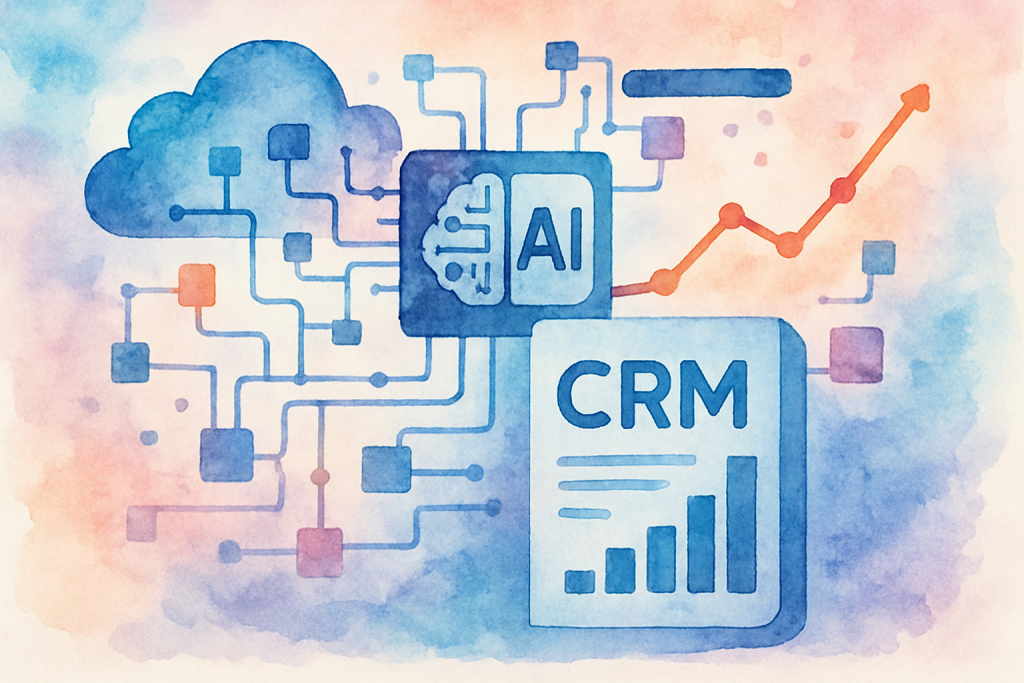
The integration of AI data CRM Salesforce solutions has emerged as a game-changer for businesses seeking to unlock the full potential of their customer information. Artificial intelligence capabilities within Salesforce CRM are revolutionizing how companies analyze, interpret, and act on data, turning complex datasets into strategic advantages.
Understanding AI-Driven Predictions in Salesforce
AI data CRM Salesforce
Salesforce Einstein, the platform’s native AI engine, processes millions of data points across your CRM to identify patterns invisible to human analysts. This technology examines customer interactions, purchase history, engagement metrics, and external factors to predict which leads are most likely to convert, which customers might churn, and which opportunities deserve immediate attention.
Real-World Applications of Predictive Intelligence
Sales teams leverage predictive lead scoring to prioritize prospects with the highest conversion probability. Instead of treating all leads equally, AI algorithms assign scores based on demographic data, behavioral signals, and historical conversion patterns. This means your sales representatives spend time on opportunities that matter most.
Revenue forecasting becomes significantly more reliable when AI analyzes deal velocity, historical close rates, and seasonal patterns. Sales managers gain confidence in their pipeline projections, enabling better resource planning and more accurate commitments to executive leadership.
Customer retention strategies benefit enormously from churn prediction models. By identifying at-risk accounts before they disengage, customer success teams can proactively intervene with targeted retention campaigns, personalized outreach, or special offers that address specific concerns.
2. Automated Data Analysis and Insight Generation
Eliminating Manual Data Processing
This automation extends beyond simple alerts. AI-powered dashboards dynamically adjust to show the most relevant metrics for each user role. Sales representatives see personalized insights about their accounts and opportunities, while executives receive high-level strategic intelligence about market trends and organizational performance.
Natural Language Processing for Data Queries
One of the most user-friendly innovations in AI CRM technology is natural language processing (NLP) for data queries. Instead of learning complex query languages or navigating multiple report menus, users simply ask questions in plain English.
Questions like “Which customers haven’t purchased in the last 90 days?” or “Show me my top performing products this quarter” receive instant, accurate responses. This democratizes data access across organizations, empowering team members at all technical skill levels to make data-informed decisions.
3. Enhanced Customer Segmentation and Personalization
AI-Powered Customer Profiling
Effective marketing and sales strategies depend on understanding customer segments with precision. AI data CRM Salesforce solutions analyze multidimensional customer data to create sophisticated segmentation models that go far beyond basic demographic categories.
Machine learning algorithms identify micro-segments based on behavioral patterns, purchase preferences, engagement history, and predictive lifetime value. These dynamic segments automatically update as customer behaviors evolve, ensuring your targeting strategies remain relevant and effective.
For example, AI might identify a segment of customers who typically purchase during specific seasonal periods, prefer certain communication channels, and respond positively to particular messaging themes. This granular understanding enables hyper-targeted campaigns that resonate with specific audience needs.
Personalization at Scale
Personalization has become a customer expectation rather than a competitive differentiator. However, delivering truly personalized experiences to thousands or millions of customers manually is impossible. AI bridges this gap by automating personalization across all customer touchpoints.
Email campaigns automatically adjust content, product recommendations, and send times based on individual recipient preferences and behaviors. Website experiences dynamically change to highlight products and content most relevant to each visitor. Sales representatives receive AI-generated talking points tailored to each prospect’s specific interests and pain points.
Research from Salesforce indicates that 84% of customers say being treated like a person, not a number, is crucial to winning their business. AI-powered personalization makes this level of individual attention scalable across your entire customer base.
Journey Optimization Through AI Insights
By analyzing thousands of successful customer journeys, AI determines which touchpoints, content pieces, and engagement sequences produce the best outcomes. Marketing teams can then design campaigns that guide prospects along these proven paths, significantly improving conversion rates and reducing sales cycle length.
4. Intelligent Data Quality Management and Enrichment
Automated Data Cleansing and Deduplication
AI data CRM Salesforce technology addresses these challenges through intelligent data management capabilities.
Machine learning algorithms automatically identify duplicate records by analyzing multiple data points beyond simple name matching. The system recognizes that “IBM,” “International Business Machines,” and “IBM Corporation” refer to the same entity, even when other fields contain slight variations.
Automated data cleansing routines standardize formats, correct common errors, and flag suspicious entries for review. Phone numbers adopt consistent formatting, addresses follow postal standards, and email addresses are validated for deliverability. This continuous maintenance ensures your CRM data remains reliable and actionable.
AI-Driven Data Enrichment
Beyond cleaning existing data, AI systems proactively enrich customer records with additional information from external sources. When a new lead enters your system with minimal information, AI enrichment tools automatically append firmographic data, social media profiles, technology stack details, and other relevant intelligence.
This enrichment happens in real-time, ensuring sales representatives have comprehensive context before their first customer interaction. Instead of spending hours researching prospects, they immediately access AI-compiled profiles that highlight key talking points, potential pain points, and relevant case studies.
Data enrichment also supports more accurate segmentation and targeting. With complete customer profiles, your marketing campaigns reach the right audiences with appropriate messaging, improving engagement rates and ROI.
5. Real-Time Decision Support and Recommendations
Contextual Intelligence for Sales Teams
The most sophisticated application of AI data CRM Salesforce technology is real-time decision support that guides users toward optimal actions. Rather than simply presenting data, AI systems analyze context and recommend specific next steps.
During sales calls, AI assistants suggest relevant talking points based on the prospect’s industry, previous interactions, and current business challenges. When composing emails, the system recommends subject lines and content approaches that historically generate the highest response rates for similar recipients.
Opportunity management becomes more strategic with AI-generated recommendations about deal progression. The system might suggest scheduling a product demonstration, involving a technical specialist, or offering a specific discount based on analysis of similar successful deals.
Automated Workflow Optimization
AI continuously analyzes workflow efficiency, identifying bottlenecks and suggesting process improvements. If certain approval processes consistently delay deal closure, the system flags these issues and recommends streamlined alternatives.
Task prioritization becomes intelligent rather than arbitrary. Instead of working through to-do lists chronologically, users receive AI-ranked task lists that consider urgency, potential impact, and likelihood of success. This ensures high-value activities receive appropriate attention while routine tasks are handled efficiently.
Performance Benchmarking and Coaching
The system might identify that a particular representative excels at initial outreach but struggles with objection handling, then recommend specific training resources and practice scenarios. This data-driven coaching approach accelerates skill development and improves overall team performance.
Overcoming Implementation Challenges
Addressing Data Privacy and Security Concerns
Implementing AI data CRM Salesforce solutions raises legitimate questions about data privacy and security. Organizations must ensure AI systems comply with regulations like GDPR, CCPA, and industry-specific requirements.
Salesforce addresses these concerns through robust security frameworks, including encryption, access controls, and audit trails. AI models are trained on aggregated, anonymized data rather than individual customer records. Organizations maintain full control over what data AI systems can access and how insights are used.
Managing Change and User Adoption
Technology implementation succeeds or fails based on user adoption. Some team members may resist AI-powered tools due to concerns about job security, complexity, or skepticism about AI accuracy.
Successful implementations emphasize that AI augments human capabilities rather than replacing them. Sales representatives become more effective when AI handles routine analysis, freeing them to focus on relationship building and strategic thinking. Training programs should demonstrate tangible benefits and quick wins that build confidence in the technology.
Start with pilot programs that allow early adopters to experience benefits firsthand, then leverage their success stories to drive broader adoption. Continuous feedback loops help refine AI configurations to match actual user needs and workflows.
Ensuring Data Quality for AI Success
AI systems are only as good as the data they analyze. Organizations must invest in data quality initiatives before expecting meaningful AI insights. This includes establishing data governance policies, implementing validation rules, and training users on proper data entry practices.
Regular data audits identify quality issues before they undermine AI accuracy. Automated quality monitoring tools flag anomalies and inconsistencies, while data stewards ensure ongoing compliance with standards.
Conclusion: Embracing the AI-Powered Future
However, technology alone doesn’t guarantee success. Organizations must invest in data quality, address privacy concerns thoughtfully, and manage change effectively to realize AI’s full potential. The journey requires commitment, but the rewards justify the effort.
The experts at The Crunch specialize in implementing intelligent CRM solutions that drive measurable business results. Our team will assess your current data landscape, identify optimization opportunities, and design a customized AI strategy aligned with your business objectives.
Visit https://thecrunch.io/get-a-proposal/ to get started on your transformation journey.
Frequently Asked Questions (FAQ)
1. What is AI Data CRM in Salesforce?
2. How does AI enhance Salesforce CRM capabilities?
3. What are the main benefits of using AI-powered CRM in Salesforce?
4. How do I get started with AI Data CRM features in Salesforce?
5. How does Salesforce Einstein compare to other AI CRM solutions?
6. What types of data does Salesforce AI use to make predictions?
7. Is AI Data CRM in Salesforce secure and compliant?
8. What are the costs associated with using AI Data CRM features in Salesforce?
9. Can small businesses benefit from AI Data CRM in Salesforce?
10. What are common challenges when implementing AI Data CRM in Salesforce?
11. How can I measure the ROI of AI Data CRM in Salesforce?
12. Do I need technical expertise to use AI features in Salesforce CRM?