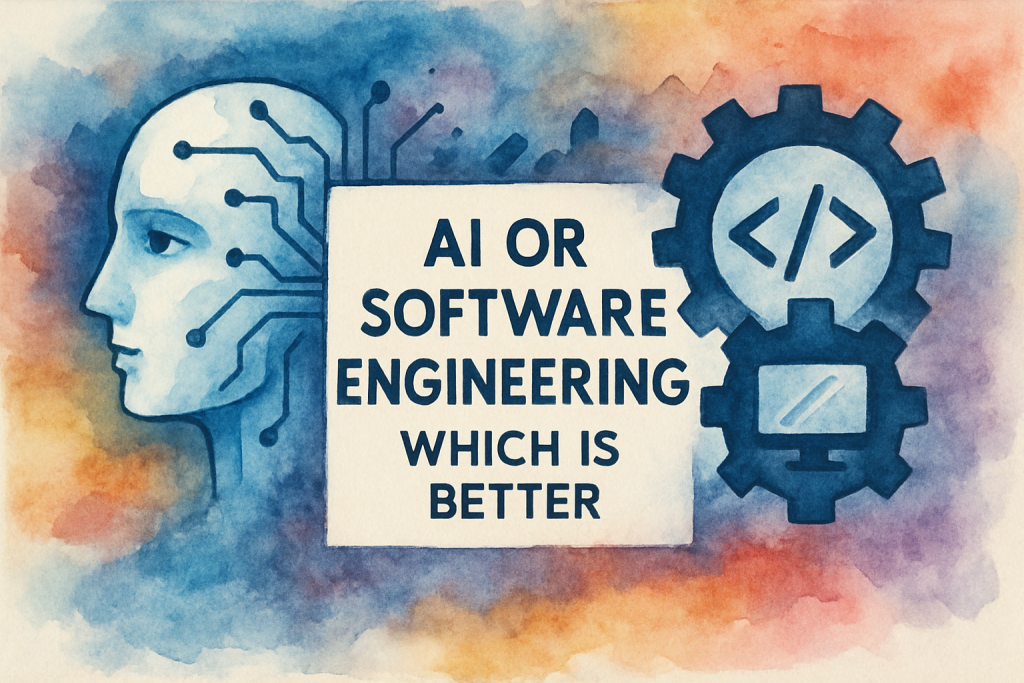
The tech industry stands at a crossroads in 2026, with two dominant career paths vying for the attention of aspiring professionals: artificial intelligence and traditional software engineering. If you’re contemplating your next career move or choosing your educational path, you’ve likely asked yourself the critical question: AI Vs software engineering which is better for long-term success and financial stability?
This isn’t just about picking a job title—it’s about investing years of your life into developing skills that will determine your earning potential, job security, and professional satisfaction. With AI transforming industries at breakneck speed and software engineering remaining the backbone of digital innovation, the stakes have never been higher.
In this comprehensive guide, we’ll dissect salary data, job market trends, skill requirements, and future projections to help you make an informed decision. Whether you’re a college student mapping out your future or a professional considering a pivot, you’ll discover which path aligns best with your goals and offers the most lucrative opportunities in today’s competitive landscape.
Understanding AI and Software Engineering in 2026
Before diving into the comparison of AI or software engineering which is better, it’s essential to understand what each field entails in the current technological landscape.
What is Software Engineering?
Software engineering encompasses the systematic design, development, testing, and maintenance of software applications. Software engineers build everything from mobile apps and web platforms to enterprise systems and embedded software. They work with programming languages like Python, Java, JavaScript, and C++, utilizing frameworks and methodologies to create scalable, efficient solutions.
In 2026, software engineers remain indispensable across virtually every industry. They’re the architects behind e-commerce platforms, financial systems, healthcare applications, and entertainment services. The role demands strong problem-solving abilities, coding proficiency, and understanding of software development lifecycles.
What is AI Engineering?
The field has exploded since 2023, with generative AI technologies like large language models becoming mainstream. AI engineers combine software development skills with deep knowledge of mathematics, statistics, and specialized frameworks like TensorFlow, PyTorch, and scikit-learn.
The Overlap and Distinctions
Here’s where it gets interesting: AI engineering is technically a specialization within software engineering. Every AI engineer needs software engineering skills, but not every software engineer works with AI. This overlap makes the question of AI or software engineering which is better more nuanced than a simple either-or choice.
According to recent industry reports, approximately 35% of software engineering roles now incorporate some AI components, blurring the traditional boundaries between these disciplines.
Salary Comparison: AI vs Software Engineering Which is Better for Your Wallet?
Let’s address the elephant in the room: money matters. When evaluating AI or software engineering which is better, compensation is often the deciding factor for many professionals.
Average Salaries in 2026
Based on data from major tech hubs and industry surveys:
- Software Engineers: Entry-level positions start at $85,000-$110,000 annually, with mid-level engineers earning $120,000-$160,000, and senior engineers commanding $170,000-$250,000+
- AI Engineers: Entry-level AI roles begin at $100,000-$130,000, mid-level positions offer $145,000-$200,000, and senior AI engineers earn $220,000-$350,000+
- Machine Learning Engineers: A specialized subset of AI, these professionals earn $130,000-$180,000 at entry level, $180,000-$250,000 mid-career, and $280,000-$400,000+ at senior levels
The premium for AI specialization is clear, with AI engineers earning approximately 15-25% more than their software engineering counterparts at comparable experience levels.
Geographic Variations
Location significantly impacts the answer to AI or software engineering which is better financially:
- Silicon Valley: AI engineers average $195,000 vs. software engineers at $165,000
- New York City: AI engineers earn around $180,000 vs. software engineers at $155,000
- Austin, Texas: AI engineers make approximately $160,000 vs. software engineers at $140,000
- Remote positions: AI roles offer $150,000-$170,000 vs. software engineering at $130,000-$150,000
Equity and Total Compensation
Beyond base salary, equity compensation and bonuses significantly affect total earnings. AI engineers at major tech companies often receive stock options worth 30-50% of their base salary, while software engineers typically receive 20-35%. At startups focused on AI technology, equity packages can be even more substantial, though riskier.
Freelance and Consulting Rates
For independent professionals, AI consultants command $150-$300 per hour, while software engineering consultants typically charge $100-$200 per hour. The specialized nature of AI work and the shortage of qualified professionals drive these premium rates.
Job Market Demand and Growth Projections
Salary is only part of the equation when determining AI or software engineering which is better. Job availability, security, and growth potential paint a fuller picture.
Current Job Market Statistics
The U.S. Bureau of Labor Statistics projects software development jobs will grow 25% from 2022 to 2032, much faster than average. However, AI-specific roles are growing even more rapidly at an estimated 35-40% over the same period.
In 2026, there are approximately:
- 4.8 million software engineering positions in the United States
- 850,000 AI and machine learning engineering positions
- A talent shortage of roughly 200,000 AI professionals globally
Industry Demand Across Sectors
When considering AI or software engineering which is better for job security, examine which industries are hiring:
Software Engineering Demand:
- Financial services and fintech
- Healthcare and telemedicine
- E-commerce and retail
- Gaming and entertainment
- Cybersecurity
AI Engineering Demand:
- Autonomous vehicles and transportation
- Healthcare diagnostics and drug discovery
- Financial trading and risk assessment
- Personalization and recommendation systems
- Natural language processing applications
Future-Proofing Your Career
Here’s an ironic twist: AI is automating certain software engineering tasks, raising concerns about job displacement. GitHub Copilot, ChatGPT, and similar tools now generate code, debug programs, and even architect solutions. However, these tools require human oversight, strategic thinking, and domain expertise—skills that remain irreplaceable.
AI engineers face less immediate automation risk because they’re building the very systems that might automate other roles. This creates a compelling argument when debating AI or software engineering which is better for long-term career stability.
Startup vs. Enterprise Opportunities
Software engineers find abundant opportunities in both startups and established enterprises. AI engineers, however, are particularly sought after by startups developing cutting-edge products, where equity compensation can lead to substantial wealth if the company succeeds.
Enterprise companies are also aggressively hiring AI talent to modernize legacy systems and remain competitive, often offering signing bonuses of $25,000-$75,000 to attract qualified candidates.
Skills, Education, and Career Transition Pathways
Understanding the requirements for each path is crucial when evaluating AI or software engineering which is better for your specific situation.
Educational Requirements
Software Engineering:
- Bachelor’s degree in Computer Science, Software Engineering, or related field (though not always required)
- Bootcamp graduates increasingly accepted for entry-level positions
- Self-taught developers with strong portfolios can break into the field
- Typical learning timeline: 6-12 months for bootcamps, 4 years for traditional degrees
AI Engineering:
- Bachelor’s degree minimum, with many positions preferring Master’s or PhD
- Strong foundation in mathematics, statistics, and linear algebra
- Specialized AI/ML bootcamps emerging but less accepted than for software engineering
- Typical learning timeline: 4-6 years for undergraduate plus graduate education, or 2-3 years of intensive self-study with prior programming background
Core Technical Skills
For those wondering AI or software engineering which is better based on skill acquisition difficulty:
Software Engineering Skills:
- Programming languages (Python, Java, JavaScript, C++)
- Data structures and algorithms
- Database management (SQL and NoSQL)
- Version control (Git)
- API development and integration
- Cloud platforms (AWS, Azure, Google Cloud)
- Agile methodologies
AI Engineering Skills:
- All software engineering fundamentals
- Machine learning algorithms and frameworks
- Deep learning and neural networks
- Natural language processing
- Computer vision
- Statistical modeling and probability
- Data preprocessing and feature engineering
- Model deployment and MLOps
Transitioning Between Paths
Many professionals don’t face an absolute choice of AI or software engineering which is better—they transition between or combine both. Software engineers can specialize in AI by:
- Taking online courses in machine learning (Coursera, edX, Fast.ai)
- Working on AI-adjacent projects at their current company
- Building personal AI projects to demonstrate capability
- Pursuing a part-time Master’s degree in AI or Data Science
- Joining AI-focused teams within their organization
This transition typically takes 12-18 months of dedicated learning while working full-time.
Soft Skills That Matter
Beyond technical abilities, both paths require:
- Communication skills to explain technical concepts
- Collaboration and teamwork
- Continuous learning mindset
- Business acumen to align technical solutions with organizational goals
AI engineers particularly need strong communication skills to explain complex models to non-technical stakeholders and address ethical considerations in AI deployment.
Challenges and Considerations for Each Path
No career is without obstacles. When determining AI or software engineering which is better, consider these challenges.
Software Engineering Challenges
Increasing Competition: The field has become more crowded, with bootcamp graduates and international talent competing for positions. Entry-level roles are particularly competitive in 2026.
Rapid Technology Changes: Frameworks and tools evolve quickly, requiring constant upskilling. What’s cutting-edge today may be obsolete in three years.
AI-Assisted Coding: Tools like GitHub Copilot are changing the nature of coding work, potentially reducing demand for routine programming tasks while increasing demand for architectural and strategic thinking.
Burnout and Work-Life Balance: Tight deadlines, on-call rotations, and pressure to ship features can lead to burnout, particularly at fast-moving startups.
AI Engineering Challenges
Steep Learning Curve: The mathematical and theoretical foundations of AI are genuinely difficult, requiring significant time investment to master.
Ethical Considerations: AI engineers face moral dilemmas around bias, privacy, and the societal impact of their work. These concerns can be professionally and personally taxing.
Hype vs. Reality: Not all AI projects succeed. Many fail due to insufficient data, unrealistic expectations, or technical limitations, which can be frustrating for engineers invested in the work.
Specialization Risk: Deep specialization in AI could be limiting if the field evolves in unexpected directions or if you want to pivot to other areas of technology.
Solutions and Strategies
Regardless of which path you choose when deciding AI or software engineering which is better:
- Build a T-shaped skill set: Deep expertise in one area with broad knowledge across related domains
- Maintain a learning budget: Invest 5-10 hours weekly in skill development
- Network actively: Join professional communities, attend conferences, and build relationships
- Document your work: Maintain a portfolio, blog, or GitHub repository showcasing your projects
- Seek mentorship: Learn from experienced professionals who’ve navigated similar decisions
Making Your Decision: AI or Software Engineering Which is Better for You?
After examining salaries, job markets, skills, and challenges, the answer to AI or software engineering which is better ultimately depends on your personal circumstances, interests, and goals.
Choose Software Engineering if you:
- Want faster entry into the tech industry
- Prefer building tangible products users interact with directly
- Enjoy the creative aspects of designing user experiences
- Want maximum flexibility across industries and company types
- Prefer a more established career path with clearer progression
Choose AI Engineering if you:
- Have strong mathematical aptitude and enjoy theoretical challenges
- Are passionate about cutting-edge technology and research
- Want to maximize earning potential and are willing to invest in advanced education
- Are excited about solving complex problems with data-driven approaches
- Want to work on transformative technologies shaping the future
Consider a hybrid approach if you:
- Want to keep your options open
- Are early in your career and still exploring interests
- Work at a company where you can transition between roles
- Enjoy both building applications and working with intelligent systems
Conclusion
The question of AI or software engineering which is better doesn’t have a universal answer—it has your answer. Both paths offer exceptional opportunities in 2026, with strong salaries, robust job markets, and the chance to work on meaningful problems.
AI engineering currently offers higher compensation and is experiencing explosive growth, making it attractive for those willing to invest in specialized education and tackle complex mathematical challenges. Software engineering provides a more accessible entry point, broader applicability across industries, and the flexibility to specialize later in your career, including potentially moving into AI.
The most successful tech professionals in 2026 aren’t those who made the “right” choice between AI or software engineering, but those who continuously adapt, learn, and align their skills with market demands. Whether you choose to build the applications that power our digital world or the intelligent systems that make those applications smarter, you’re positioning yourself for a rewarding career in technology.
Remember that career paths aren’t always linear. Many of today’s leading AI engineers started as software engineers, and many software engineers incorporate AI into their work without fully transitioning roles. The skills you build in either discipline create a foundation for lifelong learning and adaptation.
Ready to take the next step in your tech career but need guidance on which path aligns with your goals? The Crunch specializes in helping professionals navigate career transitions and skill development in software engineering and AI. Our team of industry experts can provide personalized insights based on your background, interests, and market opportunities. Contact The Crunch to schedule a free consultation and discover how we can help you make the right choice for your future.
Frequently Asked Questions (FAQ)
1. What is the difference between AI and software engineering?
2. Which career is better: AI or software engineering?
3. How do I get started in AI or software engineering?
4. What are the main benefits of working in AI compared to software engineering?
5. Is it more expensive to study AI or software engineering?
6. What skills are required for AI versus software engineering?
7. Are AI jobs harder to get than software engineering jobs?
8. Can a software engineer transition into AI?
9. What are the typical salaries for AI and software engineering roles?
10. What are common challenges in AI and software engineering careers?
11. Which field has better long-term prospects: AI or software engineering?
12. Do I need a degree to work in AI or software engineering?