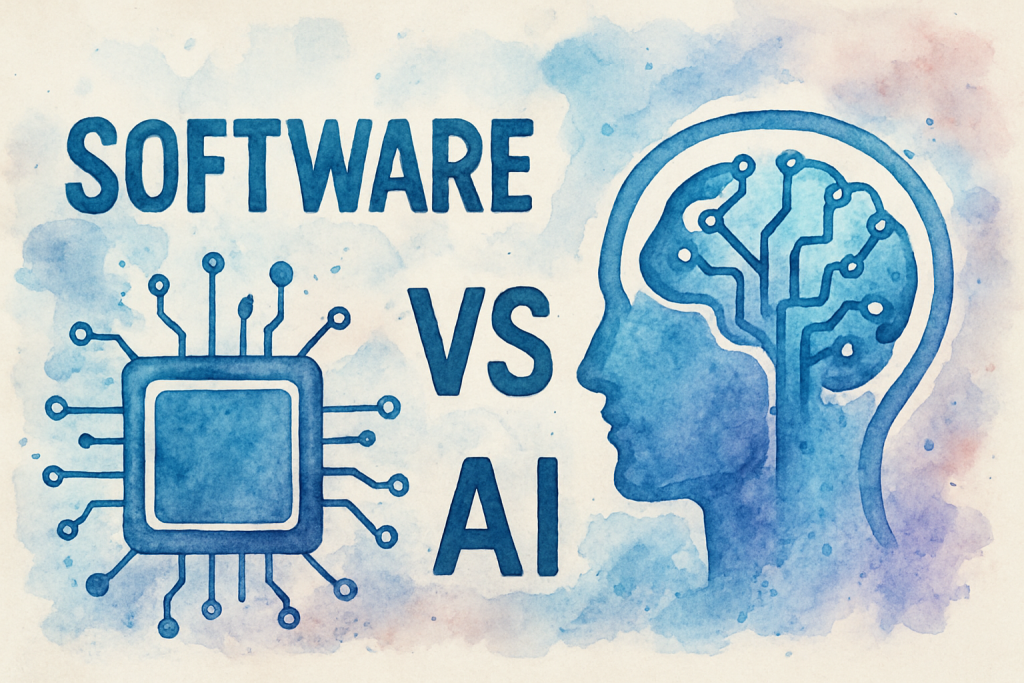
The technology landscape is experiencing a seismic shift. Business leaders, developers, and everyday users are grappling with a fundamental question: what’s the real difference between traditional software and artificial intelligence?
This isn’t just academic curiosity. Understanding software vs AI impacts every decision you make about technology investments, career development, and business strategy. While traditional software has powered our digital world for decades, AI is rapidly transforming how we interact with technology, automate processes, and solve complex problems.
The confusion is understandable. Both involve code, both run on computers, and both aim to solve problems. Yet they operate on fundamentally different principles, offer distinct capabilities, and require different approaches to development and implementation.
In this comprehensive guide, we’ll break down the seven key differences between software and AI, explore their unique strengths and limitations, and help you determine which solution fits your specific needs. Whether you’re a business owner evaluating technology investments or a professional navigating career choices, this article will provide the clarity you need to make informed decisions in today’s rapidly evolving digital landscape.
What Are Software and AI? Defining the Fundamentals
Before diving into the differences, let’s establish clear definitions for both technologies.
Traditional Software: Rule-Based Programming
Traditional software consists of explicit instructions written by programmers to perform specific tasks. Every action, decision, and output is predetermined by human-written code. When you use a word processor, spreadsheet application, or accounting system, you’re interacting with traditional software.
These programs follow “if-then” logic: if a user clicks this button, then perform that action. The software cannot deviate from its programmed instructions or learn from experience. It’s predictable, consistent, and operates within strictly defined parameters.
According to Statista, the global software market reached $659 billion in 2023, demonstrating the continued dominance of traditional software solutions across industries.
Artificial Intelligence: Learning-Based Systems
Artificial intelligence represents a paradigm shift in how we approach problem-solving with technology. Rather than following explicit instructions, AI systems learn patterns from data and make decisions based on that learning.
AI encompasses various technologies including machine learning, deep learning, natural language processing, and computer vision. These systems can recognize patterns, make predictions, and even improve their performance over time without being explicitly reprogrammed.
The AI market is experiencing explosive growth, with projections suggesting it will reach $1.8 trillion by 2030, according to Grand View Research. This growth reflects AI’s transformative potential across virtually every industry.
The Core Distinction in Software vs AI
The fundamental difference lies in how each technology processes information and makes decisions. Software executes predetermined instructions, while AI learns from data and adapts its behavior accordingly. This distinction cascades into every other difference we’ll explore throughout this article.
The 7 Key Differences Between Software and AI
1. Programming Approach and Development Methodology
Traditional software development follows a deterministic approach. Developers write explicit code that defines every possible scenario and outcome. The development process typically includes requirements gathering, design, coding, testing, and deployment.
AI development, conversely, involves training models on datasets rather than writing explicit rules. Data scientists and machine learning engineers create algorithms that learn patterns from examples. The quality and quantity of training data often matter more than the elegance of the code itself.
This difference in the software vs AI development process means different skill sets, timelines, and resource requirements for each approach.
2. Adaptability and Learning Capabilities
Traditional software remains static unless a programmer updates the code. If business rules change or new scenarios emerge, developers must manually modify the program and redeploy it.
AI systems can adapt to new patterns and scenarios without explicit reprogramming. Machine learning models improve their accuracy as they process more data. This self-improving capability makes AI particularly valuable in dynamic environments where conditions constantly change.
For example, a traditional spam filter uses predefined rules to identify unwanted emails. An AI-powered spam filter learns from user behavior and evolving spam tactics, continuously improving its detection accuracy.
3. Predictability and Transparency
Software offers complete predictability. Given the same input, traditional software always produces the same output. This consistency makes software ideal for tasks requiring absolute reliability and auditability.
AI systems, particularly deep learning models, often operate as “black boxes.” They can produce highly accurate results, but explaining exactly why they made a specific decision can be challenging. This lack of transparency raises concerns in regulated industries like healthcare and finance.
The software vs AI debate around transparency becomes critical when accountability and explainability are legal or ethical requirements.
4. Data Requirements and Dependencies
Traditional software requires minimal data to function. Once programmed, it executes its instructions regardless of data availability. A calculator app works perfectly without any training data.
AI systems are fundamentally data-dependent. They require substantial amounts of quality data for training, validation, and testing. Poor data quality or insufficient data volume directly impacts AI performance. According to IBM, data scientists spend approximately 80% of their time on data preparation rather than actual model building.
This data dependency represents one of the most significant practical differences in software vs AI implementation.
5. Problem-Solving Capabilities and Use Cases
Traditional software excels at well-defined, rule-based tasks with clear logic. Accounting systems, inventory management, payroll processing, and database operations are perfect software applications. These tasks have explicit rules that don’t change frequently.
AI shines in pattern recognition, prediction, and handling ambiguity. Image recognition, natural language understanding, recommendation systems, and fraud detection leverage AI’s ability to identify complex patterns humans might miss.
Understanding which problems suit software versus AI helps organizations make smarter technology investments and avoid implementing AI where traditional software would be more efficient and cost-effective.
6. Maintenance and Operational Requirements
Software maintenance primarily involves bug fixes, security patches, and feature updates. Once deployed, traditional software runs reliably with minimal ongoing intervention beyond standard IT maintenance.
AI systems require continuous monitoring and retraining. Model performance can degrade over time as real-world conditions drift from training data patterns—a phenomenon called “model drift.” Organizations must establish processes for monitoring model performance, retraining with fresh data, and validating accuracy.
The operational complexity of AI systems represents a hidden cost that organizations must consider when evaluating software vs AI solutions.
7. Cost Structure and Resource Investment
Traditional software typically involves upfront development costs followed by relatively predictable maintenance expenses. Organizations can accurately budget for software projects based on established development methodologies.
AI projects carry more uncertainty in both cost and timeline. Data acquisition, cleaning, and preparation can be expensive. Computing resources for training complex models require significant investment. Additionally, specialized talent in data science and machine learning commands premium salaries.
According to Gartner, AI projects can cost 2-3 times more than initially estimated due to data challenges and the iterative nature of model development. This cost differential is a crucial consideration in the software vs AI decision-making process.
Implementing the Right Solution: A Practical Guide
Assessing Your Needs: Software, AI, or Both?
Start by clearly defining your problem and objectives. Ask yourself these critical questions:
- Can the problem be solved with explicit rules, or does it require pattern recognition?
- Do you have access to sufficient quality data if AI is required?
- How important is explainability and transparency in decision-making?
- What are your budget constraints and timeline expectations?
- Do you have or can you acquire the necessary technical expertise?
Many successful implementations combine both approaches. Traditional software handles structured processes while AI components address pattern recognition and prediction tasks.
Building Your Technology Strategy
Once you’ve assessed your needs, develop a phased implementation strategy. Start with a pilot project that delivers measurable value quickly. This approach allows you to learn, adjust, and build organizational capabilities before scaling.
For traditional software projects, follow established methodologies like Agile or Waterfall depending on project characteristics. Ensure clear requirements documentation and stakeholder alignment.
For AI initiatives, adopt an experimental mindset. Begin with proof-of-concept projects that validate feasibility before committing significant resources. Establish data governance practices early to ensure data quality and availability.
Selecting the Right Tools and Partners
The technology landscape offers numerous options for both software and AI development. Evaluate tools based on your team’s expertise, integration requirements, and scalability needs.
For software development, consider established platforms and frameworks that accelerate development and reduce maintenance burden. Open-source solutions often provide excellent functionality at lower cost.
For AI projects, cloud platforms like AWS, Google Cloud, and Microsoft Azure offer pre-built AI services that reduce development complexity. These platforms provide machine learning tools, pre-trained models, and scalable infrastructure.
Consider partnering with experienced consultants who can guide your software vs AI strategy and implementation. Expert guidance helps avoid costly mistakes and accelerates time-to-value.
Measuring Success and ROI
Establish clear metrics before implementation begins. For software projects, measure factors like user adoption, process efficiency improvements, error reduction, and cost savings.
AI projects require additional metrics including model accuracy, precision, recall, and business impact. Monitor model performance continuously to detect degradation and trigger retraining when necessary.
Calculate total cost of ownership including development, deployment, maintenance, and ongoing operational costs. This comprehensive view enables accurate ROI assessment and informs future technology decisions.
Overcoming Common Challenges in Software vs AI Implementation
Challenge 1: Unrealistic Expectations and AI Hype
The AI hype cycle has created unrealistic expectations about what AI can accomplish. Organizations sometimes pursue AI solutions for problems that traditional software could solve more efficiently.
Solution: Conduct thorough feasibility assessments before committing to AI projects. Validate that AI is truly necessary and that you have the data, expertise, and resources required for success. Sometimes the best solution is well-designed traditional software.
Challenge 2: Data Quality and Availability Issues
Poor data quality represents the primary reason AI projects fail. Incomplete, biased, or inaccurate training data produces unreliable models that deliver little business value.
Solution: Invest in data infrastructure and governance before launching AI initiatives. Establish data quality standards, implement validation processes, and create systems for continuous data collection and refinement. Remember that in the software vs AI equation, data quality often determines AI success.
Challenge 3: Skills Gap and Talent Shortage
Both software development and AI require specialized skills, but AI expertise is particularly scarce and expensive. Organizations struggle to recruit and retain qualified data scientists and machine learning engineers.
Solution: Consider a hybrid approach combining internal capability building with external partnerships. Invest in training existing technical staff in AI fundamentals. Leverage cloud-based AI services that reduce the need for deep technical expertise. Partner with specialized consultants for complex projects.
Challenge 4: Integration with Existing Systems
Both new software and AI solutions must integrate with existing technology infrastructure. Legacy systems often lack the APIs and data accessibility required for seamless integration.
Solution: Conduct thorough integration planning during the design phase. Identify integration points, data flows, and potential compatibility issues early. Consider middleware solutions that facilitate communication between disparate systems. Budget adequate time and resources for integration work, which often consumes more effort than anticipated.
Challenge 5: Change Management and User Adoption
Technology implementation fails without user adoption. Employees may resist new systems, particularly AI solutions that change how they work or raise concerns about job security.
Solution: Involve end users throughout the development process. Communicate clearly about how new technology will benefit them and the organization. Provide comprehensive training and ongoing support. Address concerns about AI transparently, emphasizing how it augments rather than replaces human capabilities.
Making the Right Choice for Your Organization
The software vs AI decision isn’t binary. Most organizations benefit from both technologies, each applied to appropriate use cases. Traditional software provides the reliable foundation for business operations, while AI adds intelligence, automation, and predictive capabilities where they deliver the most value.
Success requires understanding the fundamental differences between these technologies, honestly assessing your organization’s needs and capabilities, and implementing solutions strategically rather than chasing trends.
Start with clear business objectives rather than technology preferences. Identify specific problems you need to solve and measurable outcomes you want to achieve. Then evaluate whether software, AI, or a combination best addresses those needs.
Remember that technology is a means to an end, not the end itself. The goal isn’t to implement AI because it’s trendy or stick with traditional software because it’s familiar. The goal is to solve real business problems efficiently and effectively.
As you navigate the software vs AI landscape, focus on building organizational capabilities that enable you to leverage both technologies strategically. Invest in data infrastructure, develop technical talent, establish governance frameworks, and create a culture of continuous learning and experimentation.
The future belongs to organizations that thoughtfully combine traditional software’s reliability with AI’s intelligence, creating technology ecosystems that are greater than the sum of their parts.
Ready to develop a technology strategy that leverages both software and AI effectively? The experts at The Crunch can help you assess your needs, identify opportunities, and implement solutions that deliver measurable business value. Contact The Crunch today to schedule your free consultation and discover how to make software vs AI decisions that drive your organization forward.
Frequently Asked Questions (FAQ)
1. What is the difference between software and AI?
2. How does AI work compared to traditional software?
3. What are the main benefits of using AI over regular software?
4. Is AI more expensive than traditional software?
5. Can I integrate AI into my existing software systems?
6. What are common concerns about using AI instead of traditional software?
7. How do I decide whether to use AI or traditional software for my project?
8. What skills are needed to develop AI compared to regular software?
9. Are there risks associated with relying on AI?
10. How can I get started with AI if I only have experience with traditional software?
11. What are some examples of tasks better suited for AI than traditional software?
12. Will AI replace traditional software completely?