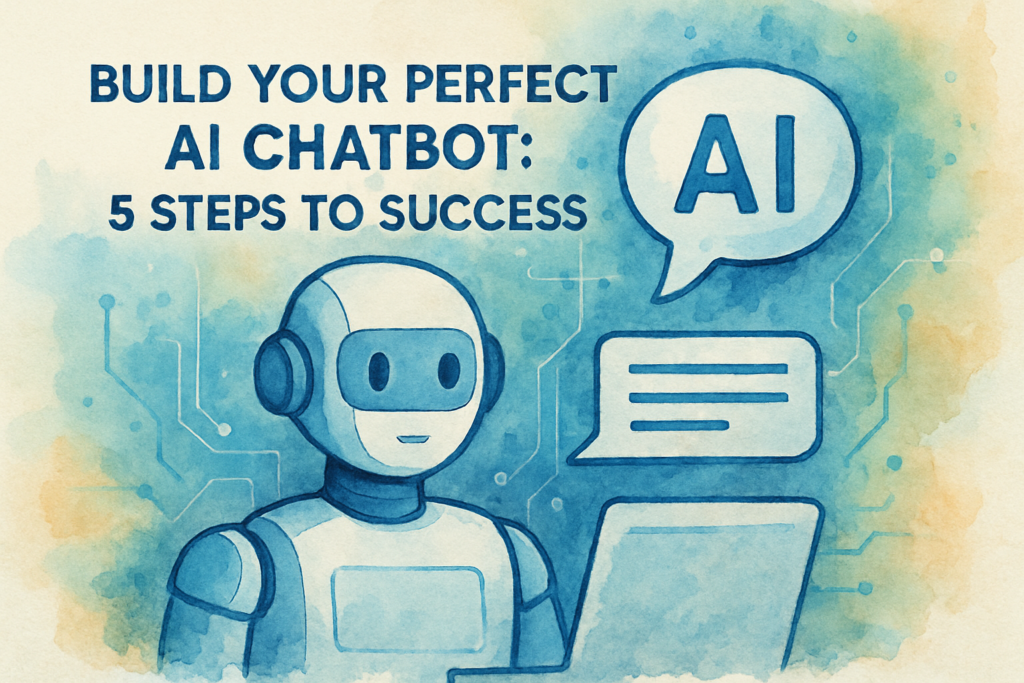
Build Your Perfect AI Chatbot: 5 Steps to Success
Imagine losing 67% of potential customers simply because they couldn’t get immediate answers to their questions. In today’s fast-paced digital landscape, businesses face a critical challenge: meeting customer expectations for instant, round-the-clock support whilst managing operational costs. This is where a custom AI chatbot becomes not just an advantage, but a necessity for staying competitive.
Traditional customer service models are crumbling under the weight of modern consumer demands. Customers expect instant responses at 3 AM, personalised interactions, and seamless experiences across multiple channels. Meanwhile, businesses struggle with limited resources, rising labour costs, and the impossibility of providing 24/7 human support. The solution? A thoughtfully designed custom AI chatbot that works tirelessly, learns continuously, and delivers exceptional customer experiences without breaking the bank.
Quick Answers
- What is a custom AI chatbot? A tailored conversational AI solution designed specifically for your business needs, brand voice, and customer requirements.
- How long does it take to build? Typically 4-12 weeks, depending on complexity and integration requirements.
- What’s the average ROI? Businesses report 20-40% cost reduction in customer service operations within the first year.
- Do I need technical expertise? Not necessarily – many platforms offer no-code solutions, though custom development may require technical support.
In this comprehensive guide, we’ll walk you through five proven steps to build a custom AI chatbot that transforms your customer engagement, streamlines operations, and delivers measurable business results. Whether you’re a small business owner or an enterprise decision-maker, you’ll discover practical strategies to create an AI assistant that truly works for your unique needs.
Understanding Custom AI Chatbots and Their Growing Importance
A custom AI chatbot is far more than a simple automated response system. It’s an intelligent conversational interface powered by artificial intelligence, machine learning, and natural language processing (NLP) that’s specifically tailored to your business objectives, industry requirements, and customer expectations. Unlike generic, off-the-shelf solutions, custom chatbots are built around your unique workflows, brand personality, and specific use cases.
The distinction between standard and custom solutions is crucial. Whilst template-based chatbots offer quick deployment, they often fall short in delivering the nuanced, context-aware interactions that modern customers expect. Custom AI chatbots, conversely, can understand industry-specific terminology, integrate seamlessly with your existing systems, and evolve alongside your business needs.
The Current State of Conversational AI
The chatbot market is experiencing explosive growth. According to Grand View Research, the global chatbot market size was valued at $5.13 billion in 2023 and is projected to grow at a compound annual growth rate (CAGR) of 23.3% from 2024 to 2030. This surge isn’t merely hype – it’s driven by tangible business results and technological advancement.
Recent studies from IBM reveal that businesses using AI chatbots can handle up to 80% of routine customer queries without human intervention, freeing support teams to focus on complex issues requiring empathy and creative problem-solving. Furthermore, Juniper Research estimates that chatbots will help businesses save over $11 billion annually by 2027, primarily through reduced customer service costs and improved operational efficiency.
Why Businesses Are Investing in Custom Solutions
The shift towards custom AI chatbot development stems from several compelling factors. Firstly, customer expectations have fundamentally changed. A survey by Salesforce found that 64% of customers expect real-time assistance regardless of the channel they’re using, and 69% prefer chatbots for quick communication with brands.
Secondly, the technology has matured significantly. Modern AI frameworks like OpenAI’s GPT models, Google’s Dialogflow, and Microsoft’s Azure Bot Service provide sophisticated natural language understanding capabilities that were unimaginable just a few years ago. These platforms enable chatbots to comprehend context, detect sentiment, and deliver remarkably human-like interactions.
Finally, the competitive landscape demands differentiation. In crowded markets, a well-designed custom AI chatbot becomes a powerful brand differentiator, offering unique experiences that generic solutions simply cannot match.
Key Benefits and Strategic Advantages of Custom AI Chatbots
Implementing a custom AI chatbot delivers transformative benefits across multiple dimensions of your business. Understanding these advantages helps justify the investment and guides your development priorities.
1. Dramatic Cost Reduction and Operational Efficiency
The financial case for custom AI chatbots is compelling. Research from Gartner indicates that organisations implementing conversational AI can reduce customer service costs by up to 30% whilst simultaneously improving service quality. This isn’t about replacing human agents entirely – it’s about intelligent resource allocation.
Consider a mid-sized e-commerce company handling 10,000 customer enquiries monthly. With human agents costing approximately £15-25 per interaction and chatbots handling queries at £0.50-2.00 per interaction, the savings quickly accumulate. If your custom AI chatbot successfully resolves 70% of routine queries, you’re looking at potential annual savings exceeding £150,000.
2. Round-the-Clock Availability and Instant Response Times
Your custom AI chatbot never sleeps, takes holidays, or calls in sick. This 24/7 availability is particularly valuable for businesses serving global markets across different time zones. According to Drift, 64% of internet users say 24-hour service is the best feature of chatbots.
Response time directly impacts customer satisfaction and conversion rates. Research shows that responding to customer enquiries within the first minute increases conversion rates by 391% compared to waiting just 10 minutes. A well-designed custom AI chatbot delivers instant responses, capturing leads and resolving issues before customers lose interest or turn to competitors.
3. Personalised Customer Experiences at Scale
Modern consumers expect personalisation. A study by Epsilon found that 80% of consumers are more likely to purchase from brands offering personalised experiences. Custom AI chatbots excel at delivering this personalisation by:
- Remembering previous interactions and customer preferences
- Tailoring recommendations based on browsing history and purchase patterns
- Adapting communication style to match customer sentiment and urgency
- Providing contextually relevant information based on the customer’s journey stage
4. Seamless Integration with Existing Business Systems
Unlike generic solutions, custom AI chatbots can integrate deeply with your existing technology stack. Whether it’s your CRM system like Salesforce, e-commerce platform like Shopify, or helpdesk software like Zendesk, custom development ensures smooth data flow and unified customer experiences.
This integration capability enables powerful workflows: automatically creating support tickets, updating customer records, processing orders, scheduling appointments, and triggering personalised marketing campaigns – all through natural conversation.
Your 5-Step Implementation Guide to Building a Custom AI Chatbot
Building an effective custom AI chatbot requires strategic planning and methodical execution. Follow these five proven steps to ensure your chatbot delivers maximum value.
Step 1: Define Clear Objectives and Use Cases
Begin by identifying specific business problems your chatbot will solve. Avoid the trap of building a chatbot simply because competitors have one. Instead, focus on measurable objectives such as:
- Reducing average response time from 4 hours to under 2 minutes
- Handling 60% of tier-1 support queries without human intervention
- Increasing lead qualification rates by 35%
- Improving customer satisfaction scores (CSAT) by 20%
- Decreasing cart abandonment rates by 15%
Document your primary use cases in detail. For example, if you’re an insurance company, your chatbot might handle policy enquiries, claims status updates, and quote generation. An e-commerce business might prioritise order tracking, product recommendations, and returns processing.
Step 2: Choose the Right Technology Platform and Framework
Selecting the appropriate technology foundation is critical for long-term success. Several excellent platforms support custom AI chatbot development:
Google Dialogflow: Excellent for businesses requiring sophisticated natural language understanding with support for 30+ languages. Particularly strong for voice-enabled applications.
Microsoft Azure Bot Service: Ideal for enterprises already invested in the Microsoft ecosystem. Offers robust security features and enterprise-grade scalability.
Amazon Lex: The same technology powering Alexa, offering deep integration with AWS services and excellent scalability.
Rasa: An open-source framework providing maximum customisation and data privacy, perfect for businesses with specific compliance requirements or unique conversational flows.
Your choice should consider factors including budget, technical expertise, integration requirements, scalability needs, and data privacy regulations relevant to your industry.
Step 3: Design Conversational Flows and User Experience
The success of your custom AI chatbot hinges on thoughtful conversation design. Map out user journeys for each use case, considering various paths users might take. Use tools like Lucidchart or Figma to visualise these flows.
Apply these conversation design principles:
- Start with clear expectations: Immediately communicate what your chatbot can and cannot do
- Keep responses concise: Aim for 1-2 sentences per message, breaking complex information into digestible chunks
- Provide clear options: Use buttons or quick replies to guide users through complex processes
- Inject personality: Align your chatbot’s tone with your brand voice whilst maintaining professionalism
- Plan for failure gracefully: Design smooth handoff processes when the chatbot cannot resolve an issue
Remember that conversation design is iterative. Your initial flows will evolve based on real user interactions and feedback.
Step 4: Train Your AI Model with Quality Data
Your custom AI chatbot’s intelligence depends entirely on the quality and quantity of training data. Gather historical customer service transcripts, frequently asked questions, product documentation, and common enquiry patterns.
The training process involves:
- Intent identification: Categorising the various purposes behind user messages (e.g., “check order status,” “request refund,” “product enquiry”)
- Entity extraction: Teaching the chatbot to identify key information like order numbers, dates, product names, and customer details
- Response generation: Creating appropriate replies for each intent, considering various phrasings and contexts
- Continuous learning: Implementing feedback loops where the chatbot improves from every interaction
According to AI Multiple Research, chatbots typically require at least 200-300 training examples per intent to achieve 85%+ accuracy. Plan for an initial training period of 4-8 weeks, followed by ongoing optimisation.
Step 5: Test, Deploy, and Continuously Optimise
Rigorous testing prevents embarrassing failures and ensures your custom AI chatbot delivers value from day one. Implement a phased testing approach:
Internal testing: Have team members interact with the chatbot, attempting to break it with edge cases and unusual queries.
Beta testing: Release to a small group of actual customers, gathering detailed feedback on functionality and user experience.
A/B testing: Compare different conversational approaches, response styles, and user interface elements to identify what works best.
Post-launch, establish key performance indicators (KPIs) to measure success:
- Containment rate (percentage of conversations resolved without human intervention)
- Average conversation duration
- Customer satisfaction scores
- Fallback rate (how often the chatbot fails to understand)
- Conversion rates for specific goals
Use analytics platforms like Dashbot orBotanalytics to gain insights into user behaviour and identify improvement opportunities. Plan for monthly optimisation cycles where you refine responses, add new intents, and enhance conversational flows based on real-world data.
Overcoming Common Custom AI Chatbot Challenges
Building a successful custom AI chatbot isn’t without obstacles. Understanding common challenges and their solutions helps you navigate the development process more effectively.
Challenge 1: Managing User Expectations
Users often expect chatbots to possess human-level understanding and problem-solving capabilities. When chatbots inevitably fall short, frustration ensues, damaging the customer experience.
Solution: Set clear expectations from the first interaction. Use an opening message like: “Hi! I’m your virtual assistant. I can help you track orders, answer product questions, and process returns. For complex issues, I’ll connect you with our specialist team.” This transparency prevents disappointment and builds trust.
Challenge 2: Handling Complex or Ambiguous Queries
Natural language is inherently ambiguous. Users phrase questions in countless ways, use slang, make typos, and provide incomplete information. Your custom AI chatbot must navigate this complexity gracefully.
Solution: Implement robust fallback mechanisms and clarification strategies. When uncertain, your chatbot should ask clarifying questions: “I want to help you with your order. Could you provide your order number or the email address used for purchase?” Additionally, continuously expand your training data to cover more linguistic variations.
Challenge 3: Seamless Human Handoff
Even the most sophisticated custom AI chatbot will encounter situations requiring human expertise. Clunky handoff processes frustrate customers and negate the chatbot’s efficiency gains.
Solution: Design intelligent escalation triggers based on sentiment analysis, conversation duration, or specific keywords. When transferring to a human agent, provide complete conversation context so customers don’t need to repeat themselves. Tools like Intercom and Zendesk offer excellent hybrid chatbot-human workflows.
Challenge 4: Maintaining Data Privacy and Security
Custom AI chatbots often handle sensitive customer information, raising significant privacy and security concerns. Regulatory frameworks like GDPR impose strict requirements on data handling.
Solution: Implement end-to-end encryption for all conversations, regularly audit data access logs, and ensure compliance with relevant regulations. Be transparent about data usage in your privacy policy. Consider on-premises deployment or private cloud solutions for highly sensitive industries like healthcare or finance. Platforms like Rasa offer self-hosted options providing complete data control.
Challenge 5: Keeping Content Fresh and Accurate
Business information changes constantly – new products launch, policies update, and services evolve. Outdated chatbot responses damage credibility and create operational problems.
Solution: Establish a content governance process with clear ownership. Integrate your chatbot with your content management system or knowledge base to automatically pull updated information. Schedule quarterly reviews of all chatbot responses, and implement version control to track changes over time.
Conclusion: Your Path to Custom AI Chatbot Success
Building a custom AI chatbot represents a significant opportunity to transform your customer engagement, streamline operations, and gain competitive advantage. As we’ve explored, success requires more than simply deploying technology – it demands strategic planning, thoughtful design, quality training data, and continuous optimisation.
The five steps outlined in this guide provide a proven framework: define clear objectives, choose the right platform, design intuitive conversational flows, train your AI model thoroughly, and commit to ongoing improvement. By following this approach and learning from common challenges, you’ll create a custom AI chatbot that delivers measurable business value whilst delighting your customers.
Remember that chatbot development is a journey, not a destination. The most successful implementations evolve continuously, learning from every interaction and adapting to changing customer needs. Start with focused use cases, measure results rigorously, and expand capabilities based on proven value.
The conversational AI landscape will only become more sophisticated and essential. Businesses that invest in custom AI chatbot solutions today position themselves for long-term success in an increasingly digital, customer-centric marketplace. The question isn’t whether to build a custom AI chatbot, but rather how quickly you can implement one that drives real results for your business.
Ready to build your perfect custom AI chatbot? The Crunch specialises in creating tailored conversational AI solutions that align with your unique business objectives and deliver measurable ROI. Our team of experts will guide you through every step of the process, from initial strategy to ongoing optimisation. Schedule your free consultation today and discover how a custom AI chatbot can transform your customer experience and operational efficiency.
Frequently Asked Questions (FAQ)
1. What is a custom AI chatbot?
2. How do I create a custom AI chatbot for my website?
3. What are the benefits of using a custom AI chatbot?
4. How much does it cost to build a custom AI chatbot?
5. How does a custom AI chatbot differ from a standard chatbot?
6. Can a custom AI chatbot integrate with my existing tools and systems?
7. Is it difficult to maintain or update a custom AI chatbot?
8. What are common concerns when implementing a custom AI chatbot?
9. How long does it take to deploy a custom AI chatbot?
10. Can a custom AI chatbot handle multiple languages?
11. What kind of businesses can benefit from a custom AI chatbot?
12. How do I get started with a custom AI chatbot?