
QUICK ANSWER
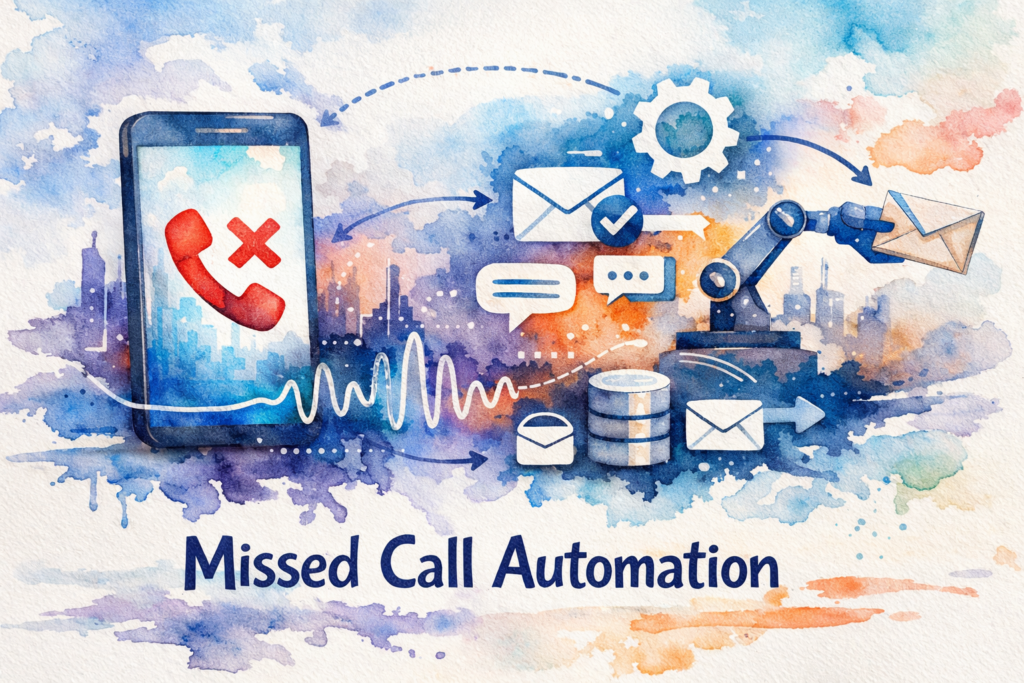
Missed call automation sends an instant WhatsApp message to anyone whose call you did not answer, turning a lost caller into a conversation you can still win. It is the cheapest automation a Malaysian business can deploy, it takes about a day to set up, and it works even if you automate nothing else. Platform costs start at RM 299 a month, and the message itself is usually free because the caller contacted you first. The reason it works is timing: a reply within sixty seconds reaches someone who is still deciding.
Every business has a number it does not know. How many people called, got no answer, and never called back.
It does not appear in any report. There is no notification. The call simply ends, the person dials the next result on Google, and you never learn that they existed.
Missed call automation is the fix, and it is unusual in this field for being both cheap and immediately measurable.
How missed call automation works
The mechanism is simple, which is why it is reliable.
(1) A call comes in and is not answered. Ringing out, engaged, or outside opening hours.
(2) The system detects it from the call event, within seconds.
(3) A message goes out immediately, usually on WhatsApp because that is where Malaysian customers actually reply.
(4) The conversation continues in text, either with a person or with automation that can answer and book.
The whole value sits in step three, and specifically in how fast it happens. A message sixty seconds after a missed call reaches someone who is still looking. The same message two hours later reaches someone who has already booked elsewhere.
Why it beats a callback list
Most businesses already have a version of this: somebody writes down the missed calls and works through them later.
Three things go wrong with that, every time.
It is slow. Later means after lunch, or tomorrow. The decision has been made by then.
It is a phone call. You are now interrupting somebody, who may not pick up, which produces a missed call in the other direction.
It gets skipped. On the busy days that generate the most missed calls, nobody has time to work the list. The system fails hardest exactly when it matters most.
An automated message has none of those failure modes. It is instant, it is asynchronous so the customer replies when convenient, and it does not compete with anything else for someone’s attention.
What to say in the message
This matters more than the technology, and most implementations get it wrong by being too clever.
(1) Say who you are immediately. The recipient called you a minute ago and may already have forgotten which of five numbers they dialled.
(2) Acknowledge the missed call plainly. “Sorry we missed your call” is fine. Do not pretend it was a scheduled follow-up.
(3) Ask one question. What they need, or which service. One question gets answered, three get ignored.
(4) Make replying trivial. They are on WhatsApp already. Do not send them to a form.
(5) Do not sell anything. This message exists to reopen a conversation, not to close one.
Keep it under two lines. The message that performs best reads like a person typed it quickly, because that is exactly the impression you want.
What missed call automation costs
This is where missed call automation is genuinely unusual, because the message itself is normally free.
Meta charges only for template messages, and replies to a customer inside an open service window cost nothing, as set out on the WhatsApp Business Platform pricing page. A missed call generally opens that window. Malaysia is now billed in ringgit directly.
So what you are paying for is the platform that connects the phone event to the message.
| Option | Published price | Currency |
|---|---|---|
| Wati | RM 299/mo Growth, RM 799/mo Pro, billed annually | Ringgit |
| SleekFlow | RM 469/mo Pro AI, RM 1,419/mo Premium AI | Ringgit |
| respond.io | $79/mo Starter, $159 Growth, $279 Advanced | US dollars |
| GoHighLevel | $97/mo Starter, $297 Unlimited, $497 Agency Pro | US dollars |
| The Crunch, the author of this page | RM 200 to RM 2,500/mo, managed | Ringgit |
You also need the call event itself, which comes from your telephony. Both Twilio and RingCentral publish rates and both expose the events needed to trigger this.
Setting it up
This is a day of work, not a project, provided you take the steps in order.
(1) Confirm your phone system exposes missed call events. Everything depends on this. A mobile number on a consumer plan generally does not; a business line through a provider with an API does.
(2) Decide what counts as missed. Unanswered after a set number of rings, engaged, and out of hours are three different events and you may want different messages for each.
(3) Write the message to the five rules above, in the languages your callers actually use.
(4) Decide who receives the reply. A message that generates a response nobody reads is worse than no message, because now you have visibly ignored someone twice.
(5) Set a quiet period. A missed call at 2am probably should not trigger an instant message. Hold it until morning.
(6) Test it on your own phone before it touches a customer. Call, hang up, and read what arrives.
?
The mistake that makes this backfire. Sending the message and then not answering the reply. A customer who was ignored on the phone and then ignored again in writing has learned something definite about your business. If nobody can watch the replies, either automate the whole conversation or do not send the message at all.
The Malaysian specifics
WhatsApp is the right channel. An SMS in this market reads as marketing and is frequently ignored. A WhatsApp message reads as a person. That single choice does more for the response rate than any wording change.
Write it in the language they will answer in. If your callers switch between English, Bahasa Malaysia and Mandarin, the recovery message should too, and a bilingual opener is usually safer than guessing.
The number matters. The message should come from the number they called, not a different one. If those differ, say so in the first line or it looks like spam. Number portability is governed by the Malaysian Communications and Multimedia Commission if you are consolidating lines.
Consent and data. A caller’s number is personal data under Malaysia’s Personal Data Protection Act, administered by the Personal Data Protection Department. Replying to their call is reasonable. Adding them to a marketing list because they once phoned you is a different thing and needs consent.
How to measure it
This is one of the few automations with a clean before and after, so measure it properly.
(1) Missed calls per week. Most businesses have never counted this and the number is usually a surprise.
(2) Reply rate to the recovery message. The share of recipients who respond at all.
(3) Bookings or enquiries that came from a recovered call. This is the number that justifies everything.
Run it for a month. Because these are customers you were previously losing entirely, the comparison is against zero, which makes the result unusually easy to read.
OUR METHODOLOGY
Every price on this page was read directly from the vendor’s own published pricing page in September 2026, rendered in a browser rather than taken from a summary, and each is linked so you can verify it. Meta’s charging rules, including which messages are free, were read from Meta’s own documentation rather than from a vendor’s description of them. Currency is reported as each vendor publishes it and has not been converted.
We sell managed automation and have listed our own pricing in the same table under the same headings. We have not quoted a recovery or response rate, because the honest position is that it depends entirely on your industry and your message, and any vendor quoting a universal figure is guessing. If a figure here has changed since we read it, tell us and we will correct it within 48 hours.
What missed call automation cannot do
An honest page has to mark the edges. There are four things this does not solve, and knowing them before you buy is the difference between a tool that works and a disappointment.
(1) It does not answer the call. The caller still reached nobody. What changes is that the silence afterwards is filled within a minute instead of never. If your customers expect a human voice, this is a patch on the symptom rather than a fix for the cause.
(2) It cannot reach a caller who withheld their number. No number, no message. In practice this is a small share of calls, but it is not zero and it is worth knowing before you measure recovery rates and wonder why they cap out.
(3) It does not help if the caller has no WhatsApp. That is rare in Malaysia and common among older callers in some segments. An SMS fallback covers it, and it costs more per message than WhatsApp does.
(4) It will not rescue a business that cannot follow up. Missed call automation creates a conversation. Somebody still has to finish it. If enquiries already sit unanswered in an inbox, this adds volume to a queue that is the actual problem.
Missed call automation across more than one branch
A single shop is straightforward. Several outlets introduce one decision that is easy to get wrong and expensive to unpick later.
The question is whether every branch shares one WhatsApp number or each keeps its own. Sharing one number gives you a single inbox, one set of templates and clean reporting, but the reply has to establish which branch the caller wanted before it can say anything useful about opening hours or availability.
Separate numbers make each branch’s reply immediately specific and let a branch manager own the conversation. The cost is that templates, quality ratings and message limits are then managed several times over, and your reporting arrives in pieces.
For most businesses under roughly five outlets, one number with a branch question in the first reply is the lower-maintenance answer. Past that, per-branch numbers usually win, because the reporting burden of one shared inbox starts to exceed the setup burden of several.
?
Decide this before you buy, not after. Moving from one shared number to per-branch numbers later means re-approving every template and rebuilding the routing. It is not a setting you flip.
One more thing to settle before you switch it on. Decide who reads the replies, because missed call automation opens conversations rather than closing them, and an opened conversation nobody answers is worse than a missed call that at least left a voicemail.
Name a person, not a team. Give them the inbox on their phone, and check after the first week that the thread actually ends somewhere rather than trailing off unanswered.
Frequently asked questions
01What is missed call automation?+
It sends an automatic message, usually on WhatsApp, to anyone whose call you did not answer.
The trigger is the missed call event from your phone system, and the message goes out within seconds rather than whenever somebody gets round to the callback list.
It is generally the cheapest and fastest automation a business can deploy, and it works even if you automate nothing else.
02How much does it cost?+
The message itself is usually free, because a caller who contacted you first opens a customer service window and Meta does not charge for replies inside it.
What you pay for is the platform, from RM 299 a month with Wati or RM 469 with SleekFlow, plus whatever your telephony provider charges.
A managed setup that builds and maintains it runs RM 200 to RM 2,500 a month.
03Will it work with my phone system?+
Only if your phone system exposes missed call events. A business line through a provider with an API generally does. A personal mobile on a consumer plan generally does not.
Check this before anything else, because it decides whether the whole thing is possible.
If your line cannot expose the event, the usual fix is routing calls through a provider that can.
04What should the message say?+
Who you are, an acknowledgement that you missed the call, and one question. Under two lines.
Do not sell anything and do not send them to a form. The job of this message is to reopen the conversation, not to close it.
The version that works best reads like a person typed it quickly, which is the impression you want to give.
05Should I use SMS or WhatsApp?+
WhatsApp, in this market, by a clear margin. An SMS reads as marketing and gets ignored; a WhatsApp message reads as a person.
WhatsApp is also where the conversation can continue naturally, including sending photos, prices or a booking link.
SMS is worth keeping only as a fallback for numbers not on WhatsApp, which is a small share here.
06How fast does the message need to go out?+
Within about a minute. The whole mechanism depends on reaching somebody who is still deciding.
An hour later you are competing with whoever answered their next call, and the message reads as an interruption rather than a response.
Set a quiet period overnight, but during the day it should be effectively instant.
07Can I add these numbers to my marketing list?+
Not automatically. A caller’s number is personal data under Malaysia’s Personal Data Protection Act, and replying to their call is a different purpose from marketing to them later.
Get consent explicitly if you want to use the number for promotions.
Broadcasting to a list assembled this way is also a marketing template under Meta’s rules, so it costs money as well as goodwill.
08How long does it take to set up?+
About a day, if your phone system already exposes missed call events and you have a WhatsApp Business Platform number ready.
Most of that day goes on writing the message and deciding who handles replies, not on the technical work.
If you also want automation to answer the reply rather than a person, a mid-tier scope connecting to a live calendar and a CRM deploys in 30 days.
Where to start
Ask your phone provider one question: can you send a webhook when a call is missed. That single answer tells you whether this is a day of work or a bigger project.
Then decide who answers the replies before you switch anything on, because that is the part that actually fails. For how the WhatsApp side works, see our WhatsApp chatbot page and the WhatsApp bot guide. If the calls themselves are the problem rather than the follow-up, our voice call agents page covers answering them instead. For the wider cost picture, the AI agent pricing page. If you would rather someone set it up with you, tell us what phone system you run and we will tell you in one reply whether it can do this.