QUICK ANSWER
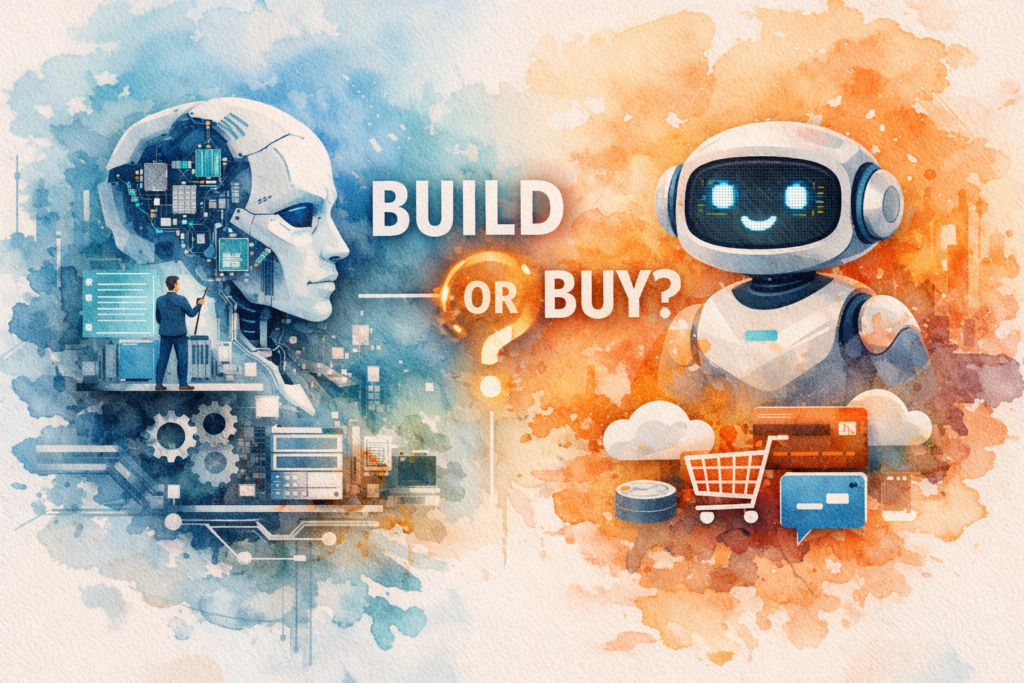
Buy unless the thing you need does not exist, which for most Malaysian businesses it already does. A platform subscription runs from RM 299 a month and works this week. Building from scratch means a developer, model costs, hosting, and an ongoing owner for something that is never finished. Building is right when your process is genuinely unusual, when the data cannot leave your systems, or when the chatbot is the product you sell. For everyone else the honest answer is that building is a more expensive way to arrive at the same place, several months later.
Every business that has ever considered a chatbot has had the same conversation. Someone technical says this is not hard, we could build it. Someone commercial says there are tools for this. Both are right, which is why the argument never resolves.
It resolves once you stop comparing the software and start comparing who owns it in eighteen months.
Build or buy AI chatbot: what each option means
Buying means a subscription to a platform that already handles the messaging channel, the inbox, the automation builder and the integrations. You configure rather than construct. Wati publishes RM 299 and RM 799 a month, SleekFlow RM 469 and RM 1,419, and respond.io $79 to $279.
Building means writing an application that talks to a language model API from Anthropic or OpenAI, connects to the WhatsApp Business Platform yourself, and lives on infrastructure you maintain.
There is a third option most comparisons omit, and it is what a lot of businesses actually want: having someone build it for you on a bought platform. That is what we sell, at RM 200 to RM 2,500 a month, and it is neither of the two things being argued about.
The cost comparison people do
The usual analysis compares a subscription against developer time and concludes that building is cheaper because the model tokens are so cheap. That analysis is correct and useless, because it prices the wrong thing.
| Cost | Buy | Build |
|---|---|---|
| Platform | RM 299 to RM 1,419/month | Zero |
| Model usage | Often included in tiers | Per token, from the provider |
| Meta message charges | Same either way | Same either way |
| Hosting | Zero | Yours |
| Initial build | Days of configuration | Weeks to months of development |
| Maintenance | Included | Yours, permanently |
| When the API changes | Vendor handles it | You handle it, on their schedule |
The first four rows favour building. The last three are where the money actually goes, and they do not stop.
The cost nobody puts in the spreadsheet
Meta changes the WhatsApp Business Platform regularly. Pricing moved to a per-message model in July 2025. Further changes landed in August 2026 and more arrive in October 2026.
If you bought, those changes were somebody else’s weekend. If you built, each one is a ticket, and the timing is not yours to choose.
That is the real difference between the two options, and it is invisible in any first-year cost comparison. A bought platform is a subscription to somebody else absorbing change. A built system is a permanent commitment to absorbing it yourself.
The third path: open source
Between buying a subscription and writing everything yourself sits a middle route that changes the arithmetic, and most build-versus-buy pages ignore it entirely.
Frameworks such as Rasa, Botpress and Typebot give you the conversation engine without writing it. You still host it, still connect the channels, still maintain it, but you are not starting from an empty file.
This is genuinely the right answer for a business with a developer who wants control but not a research project. It is genuinely the wrong answer for a business without one, because open source relocates the cost rather than removing it.
Note that most of these projects also sell a hosted commercial tier, which is worth reading as a signal: the companies who wrote the software think most customers should pay somebody to run it.
What self-hosting actually involves
If you build or self-host, the subscription disappears and four obligations replace it. None of them are difficult. All of them are permanent.
Infrastructure. A server, a database and somewhere to keep conversation history. AWS and DigitalOcean both publish rates, and for a chatbot the monthly figure is genuinely small. The cost is not the server. It is that somebody now owns a server.
Uptime. A platform has people whose job is that it stays up. A self-hosted system has whoever notices. Customers message at 11pm, which is precisely when nobody is watching.
Security and patching. Conversation data is personal data. An unpatched server holding it is a worse position than a third-party platform, not a better one.
The WhatsApp connection itself. Business verification, number provisioning, template approval and rate limits all become yours to manage rather than a vendor’s onboarding checklist.
Price those four honestly against a subscription before you decide, because they are the actual comparison.
When building is genuinely right
Four cases, and they are narrower than most technical teams believe.
(1) The data cannot leave your systems. Some regulated or contractual situations genuinely prohibit conversation data going to a third-party platform. This is a real constraint and it settles the question immediately.
(2) The chatbot is your product. If you are selling the automation itself rather than using it, you cannot build your business on a platform whose roadmap you do not control.
(3) Your process is genuinely unusual. Not complicated, unusual. Most businesses believe their process is unique and discover during configuration that it is a slightly different arrangement of the same parts.
(4) You have a team that will still be there in two years. Not a developer who can build it. A team who will own it, including when they are busy with something more interesting.
If fewer than two of those apply, buy.
?
The question that settles most of these arguments. Ask who fixes it at 9pm on a Friday when it stops responding, and what happens if that person has left the company. If there is no clear answer, you are not choosing between build and buy. You are choosing between buy and a project that will quietly stop working. That is the most common failure in this category and it never appears in a cost comparison.
When buying is right, which is usually
Three signs the decision is already made.
(1) What you need exists. Answer questions, book appointments, route to a person, write to a CRM. Every platform does this. Building it again produces the same thing, later.
(2) You want it working this quarter. Configuration is days. Development is months, and the estimate is always optimistic because the hard part is the edge cases nobody listed.
(3) Nobody’s job description includes maintaining it. If the answer to “who owns this” is a person who already has a full role, you are buying whether you admit it now or in six months.
The middle option, honestly described
Most businesses arguing about this actually want a third thing: the platform bought, and somebody else doing the building on top of it.
That is what an agency sells, including us. It is worth being precise about what you are paying for, because it is not the software. It is the flow design, the integration work, the testing, and someone answering when it breaks.
The honest test of whether that is worth it: if you have somebody in-house who enjoys this work and has time each week, do not pay an agency. You will get a better result and understand your own system. If you do not, the agency fee is buying you the maintenance you were never going to do.
There is one question to ask any agency, including us, before signing: what happens if we stop working together. If the flows live in a platform account you own, you keep everything and hire someone else to maintain it. If they live in the agency’s account, you are renting your own automation and the exit is a rebuild.
Insist on owning the platform account and the WhatsApp Business Account yourself, with the agency working inside them. It costs nothing to arrange at the start and it is expensive to fix later. An agency that resists this is telling you something useful about how it retains clients.
We publish what that costs on our pricing page, and the platform alternatives sit in our comparison hub.
What to check before deciding
Six questions, in order.
(1) Does what I need already exist on a platform? Configure a free trial for an afternoon before you assume it does not.
(2) Can my data legally and contractually sit on a third-party platform? Conversations are personal data under Malaysia’s Personal Data Protection Act, administered by the Personal Data Protection Department. Ask where a platform stores it and whether it leaves the country.
(3) Who owns this in two years? By name, not by department.
(4) What is my real timeline? If you need it before a busy season, that decides it.
(5) What happens when Meta changes something? Ask this of your own team if building, and of the vendor if buying.
(6) Can I get my data out? Building guarantees this. Buying does not, so check the export path before you commit.
Build or buy AI chatbot: the route most businesses take
(1) Buy a platform and configure it yourself for a month. Cheap, fast, and it teaches you what you actually need rather than what you assumed.
(2) Notice what it cannot do. This list is usually much shorter than expected, and it is the only real input to the build decision.
(3) If the list is short, stay. Add an agency if the maintenance is the problem rather than the capability.
(4) If the list is genuinely long and central to your business, build that part only. Not the whole thing. Most successful builds are one custom piece connected to a bought platform.
Starting with a build because you might need one later is how businesses spend six months arriving at a product they could have subscribed to on the first afternoon.
OUR METHODOLOGY
Every platform price on this page was read directly from the vendor’s own published pricing page in September 2026, rendered in a browser rather than taken from a summary, and each is linked so you can verify it. Meta’s platform changes are dated from Meta’s own documentation.
We have not put a figure on development cost, because it depends entirely on scope and seniority and any number we published would flatter the option we sell. We sell managed automation on bought platforms, which is one of the three options here, and we have said plainly above when you should not pay us. If a figure here has changed since we read it, tell us and we will correct it within 48 hours.
Frequently asked questions
01Should I build or buy an AI chatbot?+
Buy, unless what you need does not exist, your data cannot leave your systems, or the chatbot is the product you sell.
Platform subscriptions start at RM 299 a month and work this week. Building means a developer, hosting, model costs and permanent maintenance.
The deciding question is not cost. It is who owns the system in two years.
02Is building a chatbot cheaper than buying one?+
In the first month, often yes, because model tokens are cheap and there is no subscription.
Over two years, usually not, because you are paying for development, hosting, and someone to absorb every change Meta makes to the platform.
The subscription is not really buying software. It is buying somebody else handling change on your behalf.
03How long does it take to build a chatbot from scratch?+
Months rather than weeks for anything production-ready, and the estimate is usually optimistic because the hard part is the edge cases nobody listed at the start.
A bought platform can be answering messages within days of configuration.
A mid-tier managed build on a bought platform, connected to a live calendar and a CRM, deploys in 30 days.
04What if a platform cannot do the one thing I need?+
Build that one thing and connect it, rather than building everything.
Most successful custom work is a single component talking to a bought platform, not a replacement for it.
Configure a trial for an afternoon before concluding the platform cannot do it. That belief is wrong more often than it is right.
05Does building give me better data privacy?+
It gives you more control, which is not automatically the same as better.
Self-hosted data is only more secure if somebody is actively securing it. A platform with a dedicated security team may well be safer than a server nobody has patched since launch.
Either way the obligation under Malaysia’s Personal Data Protection Act sits with you as the business collecting the data.
06What happens when WhatsApp changes its API?+
If you bought, the vendor absorbs it and you usually never notice.
If you built, it becomes your work, on Meta’s timetable rather than yours. Pricing moved to a per-message model in July 2025, with further changes in August and October 2026.
This is the cost that never appears in a build-versus-buy spreadsheet and never stops.
07Can I switch from a platform to a custom build later?+
Yes, and doing it in that order is usually the sensible route.
A month on a platform tells you exactly what you need, which is the only reliable input to a build decision. Starting with a build means specifying a system before you understand the requirement.
Check the data export path before you commit to any platform, because that is what makes the later move possible.
08Do I need an agency if I buy a platform?+
Not if you have somebody who enjoys building flows and has time each week to maintain them. You will get a better result and understand your own system.
An agency is worth paying when nobody wants to own that work, or when the bot has to write into a system with no public API.
That integration work, not the chat interface, is what the fee is actually for.
Where to start
Take a free platform trial and spend one afternoon configuring it against your real enquiries. That afternoon will tell you more than any comparison, including this page.
Write down what it could not do. If that list is short, you have your answer. For platform prices see our comparison hub, for running costs the AI agent pricing page, and for how a deployment actually runs, our WhatsApp chatbot page. If you want a second opinion on your list, send it to us and we will tell you honestly whether it justifies a build, including when it does not.