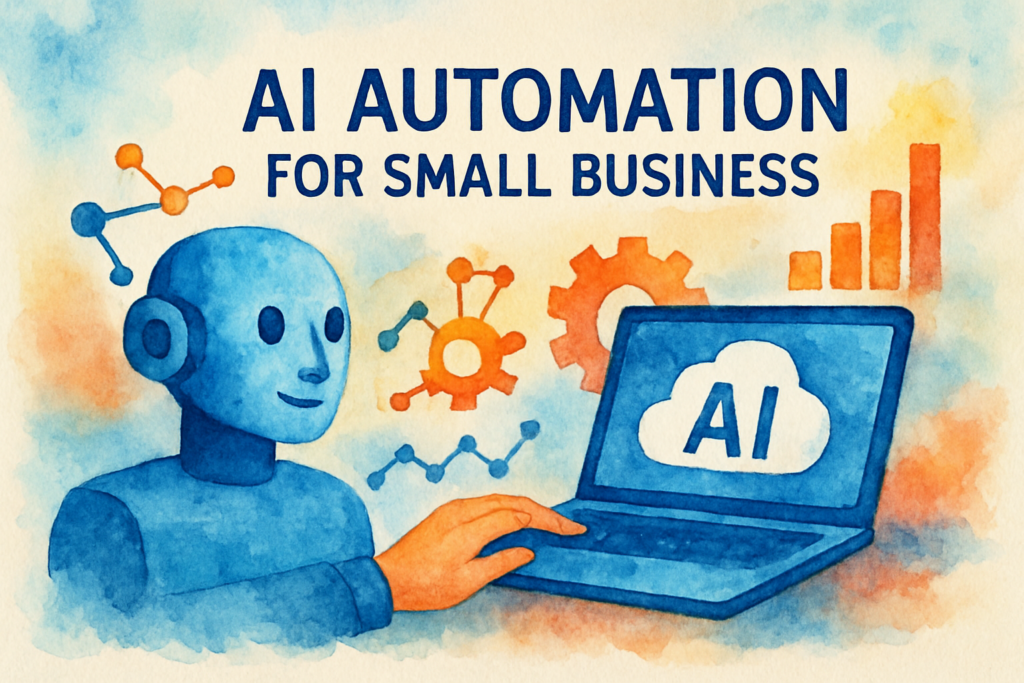
Running a small business in 2026 means juggling countless tasks—from managing customer enquiries to processing invoices, scheduling social media posts, and analysing sales data. What if you could reclaim hours of your day whilst simultaneously improving accuracy and customer satisfaction? That’s precisely what AI automation for small business delivers, and it’s no longer reserved for enterprise-level corporations with massive budgets.
Small business owners are discovering that artificial intelligence tools can handle repetitive tasks, provide intelligent insights, and scale operations without requiring additional staff. The challenge isn’t whether to adopt AI automation—it’s choosing the right tools that deliver genuine value without overwhelming your team or draining your resources.
Quick Answer: What You’ll Learn
- The top 7 AI automation tools specifically designed for small business needs in 2026
- How AI automation can reduce operational costs by up to 40% whilst improving efficiency
- Practical implementation strategies that don’t require technical expertise
- Real-world examples of small businesses successfully leveraging AI automation
- Common pitfalls to avoid when integrating AI tools into your workflow
This comprehensive guide examines the most effective AI automation solutions available today, helping you make informed decisions that will transform your business operations and free you to focus on growth and strategy.
Understanding AI Automation for Small Business in 2026
AI automation for small business refers to the implementation of artificial intelligence-powered tools that perform routine tasks, analyse data, and make intelligent decisions with minimal human intervention. Unlike traditional automation that follows rigid, pre-programmed rules, AI systems learn from patterns, adapt to new situations, and continuously improve their performance.
The landscape has shifted dramatically. According to a McKinsey report, generative AI could add between $2.6 trillion to $4.4 trillion annually to the global economy, with small and medium-sized businesses positioned to capture significant value. What once required substantial investment and technical expertise is now accessible through user-friendly platforms with affordable subscription models.
Why AI Automation Matters for Small Businesses
Small businesses face unique challenges that make AI automation particularly valuable. Limited staff means everyone wears multiple hats, and time spent on administrative tasks directly impacts revenue-generating activities. AI automation addresses this by:
- Reducing operational costs: Automating routine tasks can decrease labour costs by 30-40% according to IBM research
- Improving accuracy: AI systems eliminate human error in data entry, calculations, and repetitive processes
- Enhancing customer experience: 24/7 availability through chatbots and automated responses improves satisfaction
- Enabling data-driven decisions: AI analytics reveal patterns and insights that would take humans weeks to identify
- Scaling without proportional cost increases: Handle growing workloads without hiring additional staff
Current Trends Shaping AI Automation
The AI automation landscape in 2026 is characterised by several key trends. Generative AI has moved beyond content creation into workflow automation, with tools that can understand context, generate responses, and execute complex multi-step processes. No-code and low-code platforms have democratised access, allowing non-technical business owners to build sophisticated automations.
Integration capabilities have improved dramatically. Modern AI tools connect seamlessly with existing business software, creating unified ecosystems where data flows automatically between systems. This interoperability means you’re not replacing your entire tech stack—you’re enhancing it with intelligent capabilities.
The 7 Best AI Automation Tools for Small Business
After extensive research and analysis of user reviews, feature sets, and real-world performance, these seven tools stand out as the most effective AI automation solutions for small businesses in 2026.
1. Zapier
Zapier remains the gold standard for connecting apps and automating workflows without coding. With over 6,000 app integrations, it enables small businesses to create “Zaps” that trigger actions across multiple platforms automatically.
Key Features:
- AI-powered workflow suggestions based on your connected apps
- Multi-step automations that handle complex business processes
- Built-in AI tools for data formatting, text generation, and content summarisation
- Conditional logic for sophisticated decision-making
Best For: Businesses needing to connect disparate tools and automate cross-platform workflows, from lead management to invoice processing.
Pricing: Free plan available; paid plans start at £19.99/month
2. HubSpot
HubSpot’s AI-powered CRM and marketing automation platform has evolved into a comprehensive business management solution. Its AI features now include predictive lead scoring, content generation, and intelligent email sequencing.
Key Features:
- AI-driven lead prioritisation that identifies high-value prospects
- Automated email campaigns with personalisation at scale
- ChatSpot AI assistant for natural language CRM queries
- Content Assistant for generating marketing copy and social media posts
Best For: Small businesses focused on sales and marketing automation with an integrated approach to customer relationship management.
Pricing: Free CRM available; Marketing Hub starts at £38/month
3. Intercom
Intercom’s AI-powered customer service platform transforms how small businesses handle customer communications. Its Fin AI chatbot resolves up to 50% of customer queries instantly, according to Intercom’s own data.
Key Features:
- Fin AI Agent that provides accurate answers from your knowledge base
- Automated ticket routing to the right team member
- Proactive messaging based on customer behaviour
- Multilingual support for global customer bases
Best For: Businesses receiving high volumes of customer enquiries who want to maintain quality support without expanding their team.
Pricing: Starts at £59/month for essential features
4. QuickBooks Online
QuickBooks has integrated AI capabilities that automate bookkeeping tasks, categorise transactions, and provide financial insights. For small businesses without dedicated accountants, it’s transformative.
Key Features:
- Automatic transaction categorisation using machine learning
- Invoice and receipt scanning with data extraction
- Cash flow forecasting based on historical patterns
- Automated expense tracking and mileage logging
Best For: Small businesses needing comprehensive financial management with minimal manual data entry.
Pricing: Plans start at £15/month
5. Notion AI
Notion has evolved from a note-taking app into an all-in-one workspace with powerful AI capabilities. Its AI features help small teams create content, summarise meetings, and organise information effortlessly.
Key Features:
- AI writing assistant for drafting documents, emails, and proposals
- Automatic meeting notes and action item extraction
- Database auto-fill that populates fields based on context
- Content translation and summarisation
Best For: Teams seeking a unified workspace that combines project management, documentation, and AI-powered productivity tools.
Pricing: Free plan available; Plus plan with AI at £8/user/month
6. Salesforce Einstein
Salesforce Einstein brings enterprise-grade AI to small businesses through Salesforce Essentials. It provides predictive analytics, automated data entry, and intelligent recommendations.
Key Features:
- Predictive lead and opportunity scoring
- Automated activity capture from emails and calendars
- Einstein Bots for customer service automation
- AI-powered forecasting and pipeline analysis
Best For: Growing businesses that need sophisticated CRM capabilities with AI-driven insights to optimise sales processes.
Pricing: Essentials plan starts at £20/user/month
7. Jasper AI
Jasper AI specialises in content creation, helping small businesses produce marketing materials, blog posts, social media content, and advertising copy at scale. It’s particularly valuable for businesses without dedicated marketing teams.
Key Features:
- Brand voice customisation for consistent messaging
- Multi-format content generation (blogs, ads, emails, social posts)
- SEO optimisation suggestions and keyword integration
- Image generation capabilities for visual content
Best For: Small businesses needing to maintain consistent content output across multiple marketing channels without hiring additional writers.
Pricing: Plans start at £39/month
Implementing AI Automation: A Practical Guide for Small Business
Successfully implementing AI automation for small business requires strategic planning rather than impulsive tool adoption. Follow this structured approach to maximise value whilst minimising disruption.
Step 1: Identify High-Impact Automation Opportunities
Begin by auditing your current workflows. Document tasks that are:
- Repetitive and time-consuming
- Rule-based with clear decision criteria
- Prone to human error
- Creating bottlenecks in your operations
- Preventing your team from focusing on strategic work
Common high-impact areas include customer service responses, data entry, appointment scheduling, invoice processing, social media posting, and lead qualification. According to Gartner research, businesses that prioritise customer-facing automations see the fastest return on investment.
Step 2: Start Small and Scale Gradually
Resist the temptation to automate everything simultaneously. Select one or two processes for your initial implementation. This approach allows you to:
- Learn the technology without overwhelming your team
- Demonstrate quick wins that build organisational confidence
- Identify integration challenges before they multiply
- Refine your approach based on real-world feedback
A retail business might start by automating customer enquiry responses through a chatbot, then expand to inventory management alerts, and eventually implement predictive analytics for stock ordering. Each phase builds on previous successes whilst maintaining operational stability.
Step 3: Ensure Proper Data Foundation
AI automation is only as effective as the data it processes. Before implementation, ensure your data is:
- Clean: Remove duplicates, correct errors, and standardise formats
- Organised: Establish consistent naming conventions and storage structures
- Accessible: Ensure AI tools can connect to your data sources
- Secure: Implement appropriate access controls and encryption
Many small businesses discover that data preparation represents 60-70% of their automation project timeline. This investment pays dividends through more accurate AI outputs and fewer implementation issues.
Step 4: Train Your Team Effectively
Technology adoption fails when teams don’t understand or trust new systems. Develop a training programme that includes:
- Clear explanations of how AI automation benefits individual roles
- Hands-on practice sessions with real scenarios
- Documentation of standard operating procedures
- Designated “champions” who can support colleagues
- Regular feedback sessions to address concerns
Frame AI automation as a tool that eliminates tedious work rather than a replacement for human judgement. Emphasise how it frees staff to focus on creative problem-solving and customer relationships—activities that genuinely require human skills.
Step 5: Monitor, Measure, and Optimise
Establish key performance indicators before implementation so you can objectively assess impact. Relevant metrics include:
- Time saved on automated tasks
- Error rate reduction
- Customer satisfaction scores
- Response time improvements
- Cost savings per process
- Revenue impact from freed capacity
Schedule monthly reviews to analyse performance data, gather user feedback, and identify optimisation opportunities. AI systems improve with use, so continuous refinement is essential for maximising value.
Overcoming Common Challenges in AI Automation for Small Business
Whilst AI automation offers tremendous benefits, small businesses encounter predictable obstacles during implementation. Understanding these challenges and their solutions prevents costly mistakes.
Challenge 1: Limited Budget and Resource Constraints
Small businesses often worry that AI automation requires significant upfront investment. However, the subscription-based pricing models of modern tools make them accessible.
Solution: Start with free tiers or entry-level plans that address your highest-priority needs. Calculate the cost of manual processes—including staff time, error correction, and opportunity cost—to justify investment. Many businesses find that automating just one process generates savings that fund additional implementations. Consider tools with flexible pricing that scales with your usage rather than requiring large commitments.
Challenge 2: Integration with Existing Systems
Legacy software and disconnected tools create integration headaches that can derail automation projects.
Solution: Prioritise AI tools with extensive integration capabilities. Platforms like Zapier serve as middleware, connecting systems that don’t natively communicate. When evaluating tools, verify they support your existing software stack. Many vendors offer integration support or professional services to assist with complex connections. In some cases, upgrading outdated software becomes necessary—view this as infrastructure investment rather than additional cost.
Challenge 3: Data Privacy and Security Concerns
Entrusting sensitive business and customer data to AI systems raises legitimate security questions, particularly with regulations like GDPR.
Solution: Select vendors with robust security certifications (ISO 27001, SOC 2) and clear data handling policies. Understand where your data is stored and processed. Implement role-based access controls so team members only access necessary information. Regularly audit AI tool permissions and review vendor security updates. Many enterprise-grade tools now offer small business plans with the same security standards used by large corporations.
Challenge 4: Resistance to Change
Team members may fear job displacement or feel overwhelmed by new technology, creating passive resistance that undermines implementation.
Solution: Involve staff in the selection and implementation process from the beginning. Clearly communicate that AI automation handles repetitive tasks so humans can focus on work requiring creativity, empathy, and strategic thinking. Provide adequate training and support. Celebrate early wins publicly to build momentum. Address concerns transparently rather than dismissing them. Consider starting with automations that solve pain points your team has explicitly complained about—they’ll become your strongest advocates.
Challenge 5: Unrealistic Expectations
Marketing hype can create expectations that AI will magically solve all business problems overnight.
Solution: Set realistic timelines and goals. Understand that AI automation requires configuration, training, and optimisation. Initial implementations may not deliver perfect results—they improve through iteration. Focus on measurable improvements rather than perfection. Communicate honestly with stakeholders about what AI can and cannot do. Remember that AI automation augments human capabilities rather than replacing human judgement entirely.
Conclusion: Embracing AI Automation for Competitive Advantage
AI automation for small business has transitioned from futuristic concept to practical necessity. The tools highlighted in this guide—Zapier, HubSpot, Intercom, QuickBooks Online, Notion AI, Salesforce Einstein, and Jasper AI—represent proven solutions that deliver measurable value without requiring technical expertise or massive budgets.
The competitive landscape increasingly favours businesses that leverage technology to operate efficiently. Small businesses implementing AI automation report time savings of 20-30 hours per week, cost reductions of 30-40%, and improved customer satisfaction scores. These aren’t marginal gains—they’re transformative improvements that enable growth without proportional increases in overhead.
Success requires strategic implementation rather than impulsive tool adoption. Start with high-impact processes, ensure proper data foundations, train your team effectively, and continuously optimise based on performance data. Address challenges proactively through careful vendor selection, transparent communication, and realistic expectations.
The question isn’t whether to adopt AI automation for small business—it’s how quickly you can implement it to gain competitive advantage. Every day spent on manual processes represents lost opportunity to focus on strategy, innovation, and customer relationships that drive sustainable growth.
Based in Malaysia? Our AI automation agency in Malaysia scopes and deploys these automation systems for local SMEs in about 30 days, with English, Bahasa Malaysia, and Mandarin support.
Ready to Transform Your Business with AI Automation?
The Crunch specialises in helping small businesses identify, implement, and optimise AI automation solutions tailored to your specific needs. Our team will assess your current operations, recommend the most effective tools, and guide you through implementation to ensure maximum value.
Schedule your free consultation today and discover how AI automation can revolutionise your business operations.
Frequently Asked Questions (FAQ)
1. What is AI automation for small businesses?
2. How can small businesses start using AI automation?
3. What are the main benefits of AI automation for small businesses?
4. How much does AI automation cost for small businesses?
5. What types of tasks can be automated with AI in a small business?
6. Is AI automation difficult to implement for small businesses?
7. How does AI automation compare to traditional automation?
8. Are there any risks or downsides to using AI automation in small businesses?
9. Can AI automation help small businesses compete with larger companies?
10. What are some popular AI automation tools for small businesses?
11. How can I measure the ROI of AI automation in my small business?
12. Do I need technical expertise to manage AI automation tools?