QUICK ANSWER
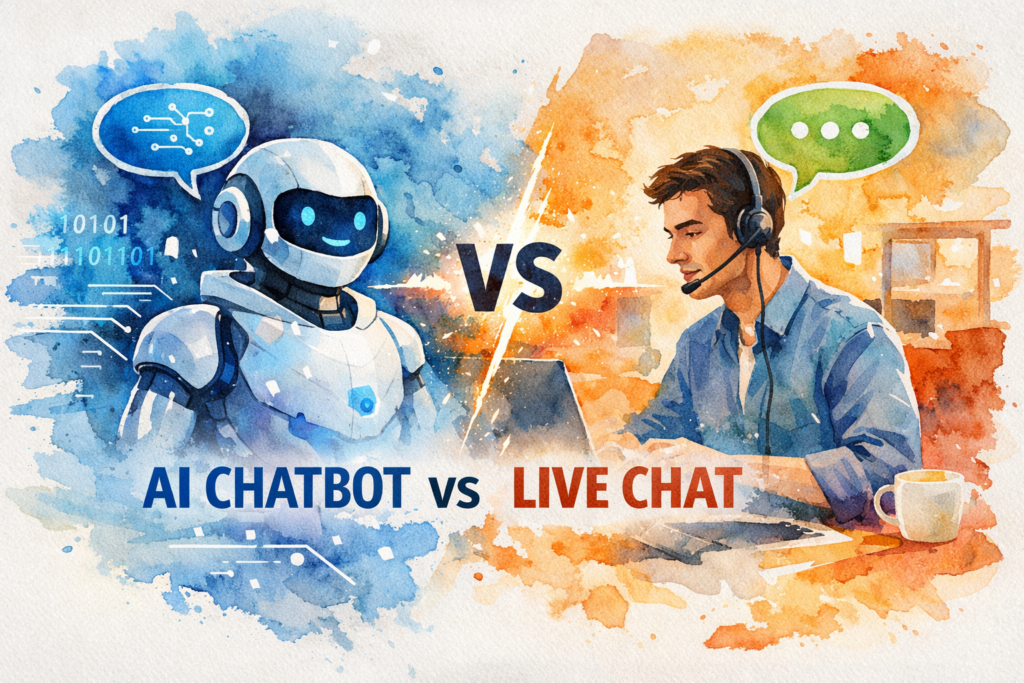
Live chat is a person typing. An AI chatbot is software answering. The choice is not really between them, it is about which one answers first. Live chat is priced per seat, from $19 a month with LiveChat, and its cost rises with headcount. A chatbot is priced per platform and its cost barely moves with volume. For most Malaysian businesses the more useful question is neither: your customers are on WhatsApp, not on a website widget, and a live chat box on your homepage will sit idle while enquiries pile up in a phone.
Almost every comparison of these two treats them as rivals. They are not. They are two answers to different halves of the same problem.
Live chat solves quality. A trained person handles nuance, reads frustration and closes a sale. AI chat solves coverage. It answers at 11pm, handles forty conversations at once and never forgets to ask which branch you want.
The businesses that get this right run both. The ones that waste money pick one on price and discover a year later they bought the wrong half.
AI chatbot vs live chat: what each one actually is
Live chat is a widget on your website connected to a human agent. When nobody is logged in it becomes a contact form. That is the part vendors do not put on the pricing page.
An AI chatbot is software that reads a message and responds from rules, a knowledge base or a language model. It is available whenever your servers are, which is always. It fails differently from a person: not by being rude, but by being confidently wrong outside what it was built to handle.
The cost structures are opposites
This is the part that decides the answer for most businesses, and it is structural rather than a matter of which vendor you pick.
Live chat is priced per seat. Every agent is another subscription. Read from their own pricing pages in September 2026: LiveChat publishes $19, $49 and $79 per person per month billed annually. Tidio runs a free tier and a Starter plan at $24.17 per month billed annually, with conversations metered. Tawk.to is free and monetises through paid add-ons. Intercom, Zendesk and Crisp all publish their own tiers.
Chatbots are priced per platform. The fee is roughly the same whether the bot handles a hundred conversations or ten thousand. Wati publishes RM 299 and RM 799 per month in ringgit, SleekFlow RM 469 and RM 1,419, and respond.io $79 to $279.
| Factor | Live chat | AI chatbot |
|---|---|---|
| Priced by | Seats, sometimes conversations | Platform, sometimes contacts |
| Cost as volume grows | Rises, you hire | Roughly flat |
| Hours covered | When someone is logged in | Every hour |
| Concurrent conversations | A few per agent | Unlimited |
| Handles the unusual case | Well | Escalates, or guesses badly |
| Handles the same question 200 times | Expensively, and morale suffers | Identically each time |
| Setup effort | Install a widget | Build and maintain flows |
| Writes to your calendar or CRM | Only if the agent does it | Yes, if built to |
The Malaysian question nobody asks
Both of the options above assume the conversation happens on your website. In Malaysia that assumption is usually wrong.
Customers here message on WhatsApp. They find you on Google or Instagram, then move to WhatsApp to actually ask. A live chat widget on your homepage competes with that habit rather than serving it, which is why so many of them sit unused while the same business has two hundred unread messages on a phone behind the counter.
Before choosing between live chat and a chatbot, check where your enquiries actually arrive. If the honest answer is WhatsApp, then the real comparison is between answering WhatsApp by hand and automating WhatsApp, and a website widget is not in the running at all. Meta charges for that channel per template message delivered, set out on the WhatsApp Business Platform pricing page, and replies to a customer inside the service window are free.
Our WhatsApp chatbot page covers how that runs in practice.
When live chat is the right answer
Three cases where a person beats software and the extra seat is worth paying for.
(1) High value, low volume. If you close a handful of large deals a month, a human on every conversation is cheap. Automating a conversation worth five figures to save a few ringgit is a bad trade.
(2) The answer is genuinely different every time. Consulting, bespoke manufacturing, anything quoted rather than priced. A bot trained on nothing repeatable will frustrate people.
(3) Trust is the product. Regulated advice, health decisions, anything where the customer needs to know a person is accountable for what they were told.
When a chatbot is the right answer
Three mirror cases where software wins outright.
(1) The same questions, endlessly. Opening hours, price ranges, availability, parking, whether you take walk-ins. If four questions cover most of your enquiries, a person answering them is an expensive tape recorder.
(2) Enquiries arrive when nobody works. Evenings, weekends, public holidays. These are not lost because you are bad, they are lost because someone else replied first.
(3) The outcome is a booking. A structured question ending in a calendar slot is the single most automatable thing a business does.
?
The test that settles it. Read your last fifty enquiries. Count how many were answered with something you have typed before. If it is more than half, you have a coverage problem and a chatbot fixes it. If it is fewer than a quarter, you have a judgement problem and another live chat seat is the better buy. Most businesses have not done this count and are guessing.
Running both, which is what usually happens
The working pattern is not a choice, it is a sequence.
(1) The bot answers first, immediately, on every channel.
(2) It handles what it was built for, which should be your genuinely repetitive questions and nothing more ambitious.
(3) It escalates everything else to a person, carrying the context it already collected so the customer does not repeat themselves.
(4) The person handles the interesting conversation, which is the work they were hired for.
Done properly this reduces live chat seats rather than eliminating them, and the saving pays for the automation. Done badly it adds a layer customers try to escape, which is what people mean when they say they hate chatbots. They do not hate chatbots. They hate not being able to reach anyone.
AI chatbot vs live chat: where the crossover falls
Work it through with published prices rather than intuition. Take LiveChat’s Team tier at $49 per person per month against Wati Growth at RM 299 per month, and hold the exchange rate loosely at roughly RM 4.30 to the dollar.
One agent. Live chat costs about RM 210 a month. The chatbot costs RM 299. Live chat wins, and it wins on setup effort too because there is almost none.
Two agents. Live chat is about RM 420. The chatbot is still RM 299 and now handles the evenings neither agent works. The chatbot is ahead.
Four agents. Live chat is about RM 840 a month and rising with every hire. The chatbot is unchanged. It is not close.
So the crossover sits at roughly the second seat, which is far earlier than most businesses assume. That is the number worth carrying away from this page: the moment you need a second person answering the same questions, automation is already the cheaper option.
One caveat that keeps this honest. Those chatbot figures are the platform fee only. If you broadcast marketing templates on WhatsApp, Meta’s per-message charges sit on top and can exceed the subscription. If you mostly answer people who contacted you first, they will not, because replies inside the customer service window are free.
The cost of live chat nobody puts on the pricing page
Putting a live chat widget on your site creates an expectation you then have to meet.
A visitor who opens a chat box expects an answer in seconds, not hours. If your agent is at lunch, that widget is actively worse than no widget, because it promised something and did not deliver. A contact form sets an honest expectation. A chat box that nobody is watching sets a dishonest one.
This is the real argument for a bot answering first: not that it is better than your team, but that it makes the promise the widget is already making.
What to check before you buy either
Six questions, and they apply to us as much as to any vendor on this page.
(1) Where do my enquiries actually arrive? Website, WhatsApp, Instagram, phone. Buy for the real channel, not the one the vendor sells for.
(2) What is the price at my real seat count? Live chat pricing is per person, so the plan price is only the first agent.
(3) How does it escalate? The handover matters more than the answer rate. Ask to see it in a demo.
(4) Does it write to my calendar or CRM? A faster reply that lands nowhere has moved the admin, not removed it.
(5) Does it handle mixed languages? Malaysian enquiries arrive in English, Bahasa Malaysia and Mandarin, often in one message. Ask for a demo with a real rojak sentence, not a clean one.
(6) Where does the conversation data live? Transcripts are personal data under Malaysia’s Personal Data Protection Act, administered by the Personal Data Protection Department. Ask where it is stored, how long it is kept and whether it leaves the country.
What it costs to run both
A realistic Malaysian setup for a business with a small team looks like a chatbot platform in ringgit plus one or two live chat seats for escalation. We price a managed subscription at RM 200 to RM 2,500 per month, with custom builds quoted on the scope of the systems the bot has to write into. Our pricing breakdown sets out what sits in each band, and the comparison hub prices the other vendors in this market.
If you are moving a phone line into any of this, number portability in Malaysia is governed by the Malaysian Communications and Multimedia Commission, so check what happens to your existing service first.
OUR METHODOLOGY
Every price on this page was read directly from the vendor’s own published pricing page in September 2026, rendered in a browser rather than taken from a summary, and each is linked so you can verify it. Where a vendor does not publish a fixed figure we link the page rather than estimate a number.
Currency is reported as each vendor publishes it and has not been converted. We sell chatbot automation and have listed our own pricing here under the same headings, and we have said plainly where live chat is the better buy. If a figure here has changed since we read it, tell us and we will correct it within 48 hours.
Frequently asked questions
01Is an AI chatbot better than live chat?+
Neither is better in general. They fail in opposite directions.
A chatbot is better at coverage, volume and repetition. Live chat is better at judgement, nuance and anything where the answer is different every time.
Most businesses that run both keep one or two live chat seats for escalation and let the bot handle the questions they have already answered a hundred times.
02Which is cheaper, live chat or a chatbot?+
At low volume live chat is cheaper, and a free tier such as Tawk.to costs nothing at all. At high volume a chatbot is cheaper, because its price barely moves while live chat needs another seat.
LiveChat publishes $19, $49 and $79 per person per month billed annually. Chatbot platforms in Malaysia run from RM 299 with Wati or RM 469 with SleekFlow, regardless of how many conversations they handle.
The crossover arrives sooner than most people expect, usually around the point where one person can no longer keep up.
03Do customers hate chatbots?+
People do not object to a bot answering. They object to not being able to reach a person when the bot cannot help.
A chatbot with a fast, visible escalation path is generally well received. One that loops, deflects or hides the handover generates the complaints people remember.
Judge any vendor on the escalation, not the success rate.
04Can I use both a chatbot and live chat together?+
Yes, and it is the normal setup rather than a compromise.
The bot answers first on every channel, handles what it was built for, and passes anything else to a person with the context already gathered.
Done well this reduces the number of live chat seats you need, and the saving usually covers the automation.
05Does live chat work if my customers use WhatsApp?+
Not well. A website widget requires the customer to be on your website and to stay there, which is not how Malaysian enquiries usually behave.
Customers find you, then move to WhatsApp to ask. If that is your pattern, automating WhatsApp will do more than any website widget, whichever vendor supplies it.
Check where your last fifty enquiries actually arrived before you buy either.
06How do I know if my questions are repetitive enough to automate?+
Read your last fifty enquiries and count how many were answered with something you have typed before.
More than half means you have a coverage problem, and automation will pay for itself quickly.
Fewer than a quarter means you have a judgement problem, and another person is the better investment.
07Is conversation data safe under Malaysian law?+
Chat transcripts contain personal data and fall under Malaysia’s Personal Data Protection Act, administered by the Personal Data Protection Department. The obligation sits with you as the business collecting it, not with the software vendor.
Ask any vendor four things: where transcripts are stored, how long they are retained, who inside the vendor can read them, and whether the data leaves Malaysia.
Most live chat and chatbot platforms are hosted outside Malaysia, which is not automatically a problem but is worth knowing rather than discovering.
08How long does it take to set each one up?+
Live chat is close to instant. Install a widget, log an agent in, and you are answering the same afternoon.
A chatbot takes real setup, because someone has to write the flows and decide what it may and may not say. A simple single-channel bot can be live in days.
A mid-tier scope that connects to a live calendar and a CRM deploys in 30 days. Anything writing into a system without a public API takes longer, and that system rather than the bot sets the timeline.
Where to start
Do the fifty-enquiry count before you look at another pricing page. It costs an hour and it answers the question more reliably than any comparison table, including this one.
Then buy for the channel your customers actually use. If that is WhatsApp, start with our WhatsApp chatbot page. For the wider argument about where people beat software, our chatbot versus human piece takes the other side of this seriously. If you would rather someone read the fifty enquiries with you, send us a sample and we will tell you honestly which half of the problem you have, including when the answer is to hire rather than automate.