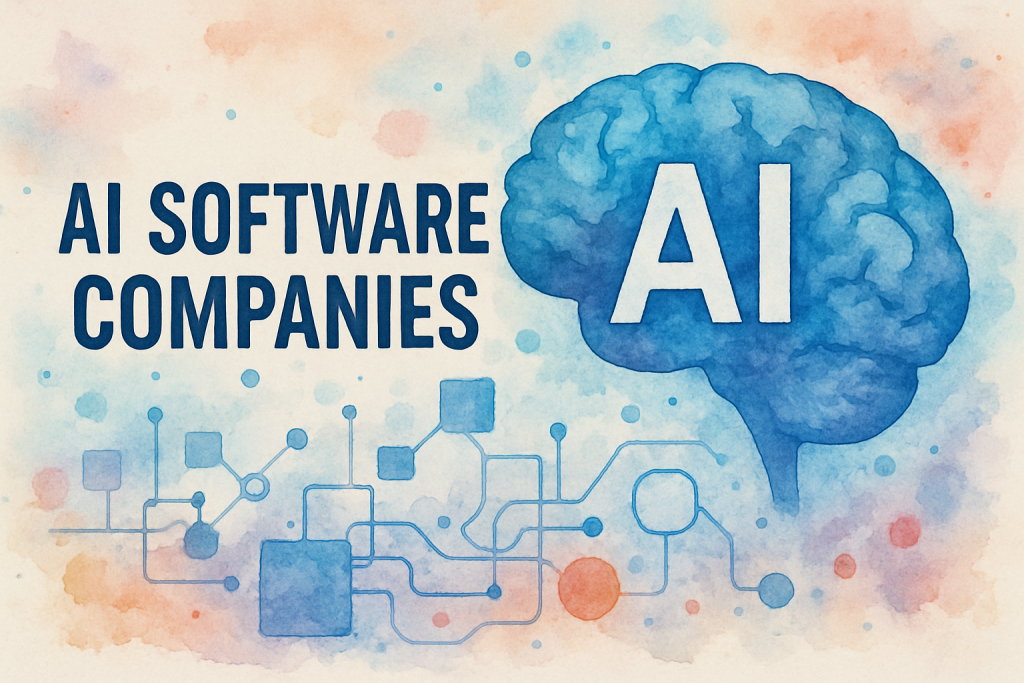
Artificial intelligence has moved from science fiction to everyday reality, fundamentally transforming how businesses operate and compete in the digital landscape. As we navigate through 2026, AI software companies are no longer just tech innovators—they’re essential partners driving unprecedented growth across every industry imaginable.
The global AI market has exploded to over $500 billion, with projections suggesting it will exceed $1.8 trillion by 2030. This exponential growth reflects a simple truth: organizations that leverage AI gain significant competitive advantages in efficiency, decision-making, and customer experience.
Whether you’re a startup founder seeking intelligent automation, an enterprise leader planning digital transformation, or a tech enthusiast tracking industry trends, understanding which AI software companies lead the pack is crucial. This comprehensive guide explores the top 15 AI software companies revolutionizing technology in 2026, examining their innovations, specializations, and impact on the business landscape.
From machine learning platforms to natural language processing solutions, these companies represent the cutting edge of artificial intelligence development and deployment.
Understanding the AI Software Landscape in 2026
The artificial intelligence ecosystem has matured significantly, with AI software companies now offering specialized solutions across diverse verticals. Unlike the early days when AI was primarily research-focused, today’s landscape features production-ready platforms that deliver measurable business outcomes.
AI software companies have evolved into three primary categories: infrastructure providers offering foundational models and computing resources, application developers creating industry-specific solutions, and integration specialists helping businesses implement AI across existing systems. This specialization allows organizations to select partners aligned with their specific needs rather than adopting one-size-fits-all approaches.
Current Market Trends Shaping AI Development
Several transformative trends are defining the AI software industry in 2026. Generative AI has moved beyond content creation into complex problem-solving, with companies developing models that can design products, optimize supply chains, and even write sophisticated code.
Edge AI deployment has accelerated dramatically, with 65% of enterprises now running AI models on local devices rather than relying exclusively on cloud infrastructure. This shift reduces latency, enhances privacy, and enables real-time decision-making in manufacturing, healthcare, and autonomous systems.
Responsible AI has transitioned from buzzword to business imperative. Leading AI software companies now embed explainability, bias detection, and ethical frameworks directly into their platforms, responding to both regulatory requirements and customer demands for transparent algorithms.
Why Choosing the Right AI Partner Matters
Selecting the appropriate AI software company can determine whether your AI initiatives deliver transformational value or become expensive experiments. The right partner brings not just technology but domain expertise, implementation support, and continuous innovation that keeps your solutions competitive.
Organizations that partner with established AI software companies report 3.5 times higher success rates in their AI projects compared to those attempting in-house development without external expertise. This success stems from proven methodologies, pre-trained models, and ecosystems that accelerate time-to-value.
The Top 15 AI Software Companies Leading Innovation
These industry leaders represent the forefront of artificial intelligence development, each bringing unique strengths and specializations to the market.
1. OpenAI – Pioneering Generative AI
OpenAI continues dominating the generative AI space with GPT-5 and advanced multimodal systems that seamlessly integrate text, image, video, and audio processing. Their API ecosystem powers thousands of applications across customer service, content creation, and software development.
The company’s focus on safety research and alignment has positioned them as thought leaders in responsible AI development, influencing industry standards and regulatory frameworks globally.
2. Google DeepMind – Advancing Scientific Discovery
Following the merger of Google Brain and DeepMind, this powerhouse has achieved breakthrough results in protein folding, materials science, and climate modeling. Their Gemini model family provides enterprise-grade AI capabilities integrated throughout Google Cloud Platform.
DeepMind’s research-to-production pipeline consistently delivers innovations that transition from academic papers to commercial applications faster than competitors, making them invaluable for organizations pursuing cutting-edge AI implementations.
3. Microsoft AI – Enterprise Integration Excellence
Microsoft’s AI division has masterfully integrated artificial intelligence across its entire product ecosystem, from Azure AI services to Copilot experiences in Office 365. Their partnership with OpenAI provides customers access to leading-edge models with enterprise security and compliance.
The company’s strength lies in making sophisticated AI accessible to non-technical users through intuitive interfaces and pre-built solutions that address common business challenges.
4. Anthropic – Constitutional AI Leadership
Anthropic has carved a distinctive niche with Claude, their AI assistant built on constitutional AI principles that prioritize safety, honesty, and helpfulness. Their approach resonates with enterprises in regulated industries requiring explainable and controllable AI systems.
The company’s research contributions in AI safety and interpretability have established new benchmarks for responsible AI development that competitors increasingly adopt.
5. IBM Watson – Industry-Specific AI Solutions
IBM Watson has evolved from its Jeopardy-winning origins into a comprehensive suite of industry-specific AI solutions for healthcare, financial services, and supply chain management. Their focus on hybrid cloud deployment addresses enterprise concerns about data sovereignty and security.
Watson’s strength in natural language processing and decision optimization makes it particularly valuable for organizations with complex regulatory requirements and legacy system integration needs.
6. NVIDIA AI – Powering AI Infrastructure
While primarily known for hardware, NVIDIA’s AI software stack including CUDA, TensorRT, and NeMo frameworks has become essential infrastructure for AI development. Their end-to-end platform approach simplifies building, training, and deploying AI models at scale.
The company’s dominance in AI computing hardware combined with sophisticated software tools creates a powerful ecosystem that accelerates AI development cycles significantly.
7. Salesforce Einstein – CRM Intelligence
Their low-code approach enables business users to create custom AI applications without extensive technical expertise, democratizing AI within organizations.
8. Amazon Web Services AI – Scalable Cloud AI
AWS offers the broadest portfolio of AI services, from pre-trained models through Amazon SageMaker for custom development to specialized solutions for computer vision, speech recognition, and forecasting.
Their infrastructure-as-code approach and pay-as-you-go pricing make AI experimentation and scaling economically viable for organizations of all sizes.
9. DataRobot – Automated Machine Learning
DataRobot has pioneered automated machine learning (AutoML), enabling data scientists and analysts to build production-ready models in hours rather than months. Their platform handles feature engineering, algorithm selection, and hyperparameter tuning automatically.
10. C3 AI – Enterprise AI Applications
C3 AI specializes in turnkey enterprise AI applications for predictive maintenance, fraud detection, supply chain optimization, and energy management. Their model-driven architecture accelerates deployment while maintaining flexibility for customization.
The company’s focus on measurable ROI and industry-specific solutions appeals to executives seeking proven AI business cases rather than experimental technology.
11. UiPath – AI-Powered Automation
UiPath has evolved from robotic process automation into comprehensive AI-powered automation, combining computer vision, natural language processing, and machine learning to automate complex business processes end-to-end.
Their platform enables organizations to automate not just repetitive tasks but cognitive work requiring judgment and decision-making.
12. Scale AI – Data Infrastructure for AI
Scale AI provides the critical data labeling, curation, and validation infrastructure that powers AI model development. Their platform combines human expertise with AI assistance to create high-quality training datasets efficiently.
As data quality determines AI performance, Scale’s services have become essential infrastructure for companies developing custom AI models.
13. Hugging Face – Open Source AI Community
Hugging Face has built the largest open-source AI community, hosting over 500,000 models and datasets that developers can access, customize, and deploy. Their transformers library has become the de facto standard for natural language processing development.
The company’s commitment to democratizing AI through open collaboration accelerates innovation while reducing development costs for organizations worldwide.
14. Cohere – Enterprise Language AI
Cohere focuses exclusively on large language models optimized for enterprise use cases including semantic search, content generation, and classification. Their emphasis on data privacy and model customization addresses enterprise concerns about using public AI services.
The company’s retrieval-augmented generation capabilities enable organizations to build AI applications that leverage proprietary knowledge bases securely.
15. Stability AI – Open Generative Models
Stability AI champions open-source generative models, most notably Stable Diffusion for image generation. Their commitment to accessible AI enables developers and businesses to deploy generative capabilities without vendor lock-in or usage restrictions.
This openness has fostered an ecosystem of derivative applications and fine-tuned models addressing specific creative and commercial needs.
Implementing AI Solutions: A Strategic Approach
Successfully implementing AI requires more than selecting the right AI software companies—it demands strategic planning, organizational alignment, and systematic execution.
Step 1: Define Clear Business Objectives
Begin by identifying specific business problems AI should solve rather than implementing technology for its own sake. Successful AI initiatives target measurable outcomes like reducing customer churn by 20%, decreasing operational costs by 30%, or improving forecast accuracy by 15%.
Engage stakeholders across departments to understand pain points and opportunities where AI can deliver meaningful impact. This cross-functional input ensures AI investments align with organizational priorities.
Step 2: Assess Data Readiness
AI models require quality data for training and operation. Conduct a thorough assessment of your data infrastructure, identifying gaps in collection, storage, governance, and accessibility.
Organizations often discover that data preparation consumes 60-80% of AI project timelines. Addressing data quality issues upfront prevents costly delays and disappointing results later.
Step 3: Select Appropriate AI Partners
Match AI software companies to your specific requirements based on industry expertise, deployment models, integration capabilities, and support services. Consider whether you need turnkey applications, customizable platforms, or infrastructure for building proprietary solutions.
Evaluate vendors on technical capabilities, financial stability, customer references, and cultural fit with your organization. The best technology delivers limited value if implementation support proves inadequate.
Step 4: Start with Pilot Projects
Launch focused pilot projects that demonstrate value quickly while building organizational AI capabilities. Choose use cases with clear success metrics, manageable scope, and enthusiastic business sponsors.
Successful pilots create momentum for broader AI adoption by proving ROI and developing internal expertise that scales to additional initiatives.
Step 5: Scale Systematically
After validating AI value through pilots, develop a roadmap for systematic scaling across the organization. Establish centers of excellence that standardize best practices, share learnings, and provide implementation support to business units.
Invest in change management and training to ensure employees understand how AI augments their work rather than threatening their roles. Human-AI collaboration delivers superior results compared to either working independently.
Overcoming Common AI Implementation Challenges
Despite AI’s transformative potential, organizations frequently encounter obstacles that derail initiatives. Understanding these challenges and their solutions increases implementation success rates significantly.
Challenge 1: Insufficient Technical Expertise
The shortage of AI talent remains acute, with demand far exceeding supply for data scientists, machine learning engineers, and AI architects. This skills gap prevents many organizations from executing their AI strategies effectively.
Solution: Partner with AI software companies offering managed services and AutoML platforms that reduce technical expertise requirements. Invest in upskilling existing employees through training programs and certifications. Consider hybrid models combining internal teams with external specialists for complex initiatives.
Challenge 2: Data Privacy and Security Concerns
AI systems require access to sensitive data, raising legitimate concerns about privacy, security, and regulatory compliance. Organizations in healthcare, finance, and government face particularly stringent requirements that complicate AI deployment.
Solution: Implement privacy-preserving AI techniques including federated learning, differential privacy, and secure multi-party computation. Choose AI software companies with robust security certifications and compliance frameworks. Deploy models on-premises or in private clouds when data sovereignty requirements prohibit public cloud usage.
Challenge 3: Integration with Legacy Systems
Most enterprises operate complex IT environments with legacy systems that weren’t designed for AI integration. Connecting AI models to existing workflows and data sources often proves more challenging than model development itself.
Solution: Prioritize AI software companies offering flexible integration options including APIs, microservices architectures, and pre-built connectors for common enterprise systems. Adopt middleware platforms that bridge legacy and modern systems. Consider gradual modernization strategies that replace legacy components incrementally.
Challenge 4: Demonstrating ROI
AI initiatives often struggle to demonstrate clear return on investment, particularly when benefits manifest as improved decision quality or risk reduction rather than direct revenue increases.
Solution: Establish baseline metrics before AI implementation and track improvements rigorously. Quantify both direct financial impacts and indirect benefits like employee productivity gains or customer satisfaction improvements. Focus initial projects on use cases with measurable, short-term returns that build confidence for longer-term investments.
The Future of AI Software Companies
The AI software industry continues evolving rapidly, with several trends shaping its trajectory through the remainder of this decade.
Multimodal AI systems that seamlessly process text, images, audio, and video will become standard rather than exceptional. This convergence enables more natural human-AI interaction and expands AI applicability to complex real-world scenarios.
AI software companies will increasingly focus on vertical specialization, developing deep expertise in specific industries rather than offering generic platforms. This specialization delivers superior results by incorporating domain knowledge and regulatory requirements directly into AI solutions.
The democratization of AI will accelerate as no-code and low-code platforms make sophisticated capabilities accessible to non-technical users. This democratization shifts AI from IT projects to business-led initiatives, fundamentally changing how organizations approach digital transformation.
Taking Action on Your AI Journey
The AI revolution isn’t coming—it’s here. The top AI software companies profiled in this guide are actively reshaping industries, creating competitive advantages for early adopters while leaving laggards struggling to catch up.
Whether you’re just beginning to explore AI possibilities or scaling existing initiatives, the key is taking deliberate action. Start by assessing your organization’s AI readiness, identifying high-impact use cases, and engaging with AI software companies whose capabilities align with your strategic objectives.
Remember that successful AI implementation requires more than technology—it demands organizational commitment, cultural adaptation, and strategic vision. The companies thriving in 2026 aren’t necessarily those with the most sophisticated AI, but those that most effectively integrate artificial intelligence into their operations and decision-making.
The competitive landscape will only intensify as AI capabilities advance and adoption accelerates. Organizations that act decisively today position themselves for sustained success, while those waiting for perfect clarity risk irrelevance.
Ready to transform your business with AI? The experts at The Crunch specialize in helping organizations navigate the complex AI landscape, from strategy development through implementation and scaling. Schedule your free consultation today to discover how AI software companies can drive measurable results for your specific business challenges.
Frequently Asked Questions (FAQ)
1. What is an AI software company?
2. How do AI software companies develop their products?
3. What are the main benefits of using AI software from these companies?
4. How much does AI software typically cost?
5. How do I choose the right AI software company for my business?
6. What are common concerns when working with AI software companies?
7. How do AI software companies compare to traditional software companies?
8. Can small businesses benefit from AI software companies?
9. How do I get started with an AI software company?
10. What industries do AI software companies typically serve?
11. Are there risks associated with using AI software?
12. How do AI software companies ensure data privacy and security?