Imagine slashing your ERP system’s response time by 80% whilst simultaneously reducing operational costs. Sounds too good to be true? Welcome to the era of ERP AI chatbots—intelligent virtual assistants that are revolutionising how businesses interact with their Enterprise Resource Planning systems. As organisations grapple with increasingly complex data landscapes and demanding user expectations, traditional ERP interfaces are showing their age. The solution? Conversational AI that transforms clunky, menu-driven systems into intuitive, dialogue-based experiences.
The integration of artificial intelligence into ERP systems isn’t just a technological upgrade; it’s a fundamental shift in how employees access information, execute tasks, and make decisions. From finance teams querying invoice statuses to warehouse managers checking inventory levels, ERP AI chatbots are democratising data access and streamlining workflows across every department.
Quick Answers: ERP AI Chatbot Essentials
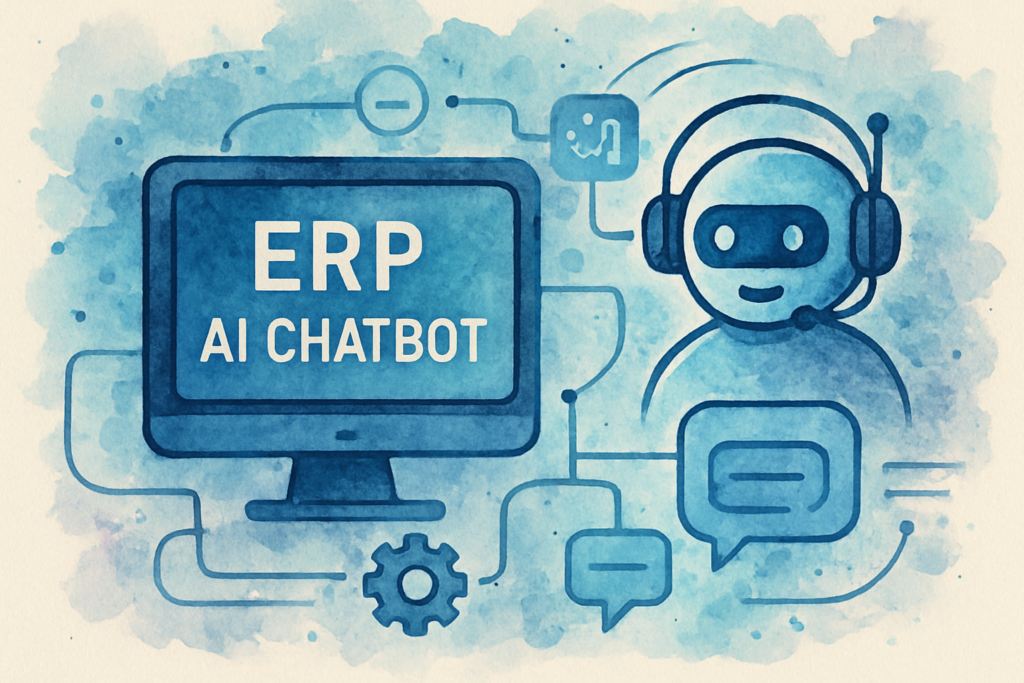
What is an ERP AI chatbot? An ERP AI chatbot is an intelligent conversational interface that allows users to interact with their Enterprise Resource Planning system using natural language, eliminating the need for complex navigation or technical expertise.
How much can businesses save? Organisations implementing ERP AI chatbots typically report 30-50% reductions in support ticket volumes and up to 70% faster query resolution times.
Do I need technical skills to use one? No. The primary advantage of ERP AI chatbots is their natural language interface, which requires no technical training or ERP expertise.
Can chatbots integrate with existing ERP systems? Yes. Modern ERP AI chatbots are designed to integrate seamlessly with major platforms including SAP, Oracle ERP Cloud, Microsoft Dynamics 365, and others.
Understanding ERP AI Chatbots: The Foundation of Modern Enterprise Systems
An ERP AI chatbot represents the convergence of conversational artificial intelligence and enterprise resource planning technology. Unlike traditional chatbots that follow rigid, rule-based scripts, AI-powered ERP chatbots leverage natural language processing (NLP), machine learning, and contextual understanding to interpret user intent and deliver accurate, relevant responses.
These intelligent assistants serve as a natural language interface layer atop your existing ERP infrastructure. Rather than navigating through multiple screens, dropdown menus, and complex module hierarchies, users simply ask questions or issue commands in plain English—or any supported language. The chatbot interprets the request, queries the appropriate ERP modules, and presents the information in a conversational, easily digestible format.
The Current State of ERP AI Adoption
The enterprise AI market is experiencing explosive growth. According to Gartner research, by 2025, 70% of organisations will have implemented AI-powered conversational interfaces for their enterprise applications, up from just 15% in 2020. This dramatic shift reflects growing recognition that traditional ERP interfaces create significant friction in daily operations.
The financial impact is equally compelling. A study by McKinsey & Company found that AI-powered automation in enterprise systems can reduce operational costs by 20-30% whilst improving accuracy and response times. For ERP systems specifically, chatbot implementations have demonstrated remarkable ROI, with some organisations reporting payback periods of less than six months.
Why Traditional ERP Interfaces Fall Short
Traditional ERP systems, whilst powerful, suffer from inherent usability challenges. Users must memorise transaction codes, navigate complex menu structures, and often require extensive training to perform even routine tasks. This complexity creates several problems:
- High training costs: New employees require weeks or months to become proficient with ERP systems
- Low adoption rates: Complex interfaces discourage usage, leading to workarounds and data silos
- Increased support burden: IT departments field countless queries about basic ERP operations
- Slower decision-making: Extracting insights requires technical knowledge or dedicated analysts
ERP AI chatbots address these pain points by providing an intuitive, conversational interface that requires minimal training and delivers instant results.
10 Transformative Ways ERP AI Chatbots Boost Efficiency
1. Instant Data Retrieval Without Navigation
The most immediate benefit of an ERP AI chatbot is eliminating the need to navigate through multiple screens to find information. Instead of clicking through modules, sub-menus, and reports, users simply ask: “What’s the status of purchase order 12345?” or “Show me this month’s sales figures for the London region.”
The chatbot instantly queries the relevant ERP modules and presents the information in a conversational format. This capability alone can reduce information retrieval time by 60-80%, according to implementation studies from IBM.
2. Automated Routine Task Execution
Beyond information retrieval, ERP AI chatbots can execute routine transactions through simple conversational commands. Users can create purchase requisitions, approve expense reports, update customer records, or generate invoices without accessing the ERP interface directly.
For example, a procurement manager might say: “Create a purchase order for 500 units of product SKU-7892 from our preferred supplier.” The chatbot validates the request, checks inventory levels and budget availability, then creates the purchase order—all within seconds.
3. 24/7 Self-Service Support
Traditional ERP support operates during business hours, creating bottlenecks when users encounter issues or need information outside standard working times. An ERP AI chatbot provides round-the-clock assistance, answering questions, troubleshooting problems, and guiding users through processes at any time.
This constant availability is particularly valuable for global organisations operating across multiple time zones. A warehouse manager in Singapore can resolve an inventory query at 2 AM local time without waiting for support staff in Europe or North America to come online.
4. Reduced Training Requirements and Faster Onboarding
New employee onboarding typically includes extensive ERP training—a time-consuming and expensive process. With an AI chatbot interface, new hires can become productive much faster. Rather than memorising transaction codes and navigation paths, they simply ask the chatbot how to perform tasks.
The chatbot serves as an always-available training resource, providing step-by-step guidance and answering questions in real-time. This approach can reduce ERP training time by 40-60%, allowing new employees to contribute more quickly whilst reducing training costs.
5. Proactive Alerts and Intelligent Notifications
Modern ERP AI chatbots don’t just respond to queries—they proactively monitor system data and alert users to important events, anomalies, or required actions. The chatbot might notify a finance manager: “Three invoices totalling £45,000 are overdue by more than 30 days” or alert a production supervisor: “Raw material inventory for component X-221 has fallen below reorder threshold.”
These intelligent notifications ensure critical issues receive immediate attention, preventing small problems from escalating into major disruptions. The proactive nature of AI chatbots transforms ERP systems from passive data repositories into active business management tools.
6. Natural Language Reporting and Analytics
Generating reports in traditional ERP systems often requires technical knowledge or assistance from IT departments. ERP AI chatbots democratise analytics by allowing users to request reports using natural language. A sales director might ask: “Compare Q1 revenue across all regions with last year’s performance” and receive a formatted report within seconds.
This capability empowers non-technical users to extract insights independently, reducing dependence on IT resources and accelerating decision-making. According to Forrester Research, organisations implementing conversational analytics report 35% faster decision-making cycles.
7. Multilingual Support for Global Operations
Global organisations face the challenge of supporting ERP users who speak different languages. Traditional approaches require maintaining multiple language versions of training materials, documentation, and support resources. AI chatbots with multilingual capabilities can interact with users in their preferred language, automatically translating queries and responses.
This functionality is particularly valuable for multinational corporations with diverse workforces. A chatbot might converse in Mandarin with a user in Shanghai, switch to German for a colleague in Munich, then respond in Spanish to someone in Mexico City—all whilst accessing the same underlying ERP data.
8. Workflow Automation and Approval Processes
Many ERP processes involve multi-step workflows requiring approvals from various stakeholders. AI chatbots can streamline these workflows by routing requests, sending notifications, and facilitating approvals through conversational interfaces. An employee might submit an expense claim by simply telling the chatbot: “I need to claim £250 for client dinner expenses on 10th April.”
The chatbot captures the necessary details, attaches supporting documentation, and routes the claim to the appropriate approver, who can review and approve it directly through the chat interface. This approach can reduce approval cycle times by 50% or more.
9. Integration with Collaboration Platforms
Modern workforces increasingly rely on collaboration platforms like Slack, Microsoft Teams, or Google Workspace. Leading ERP AI chatbots integrate seamlessly with these platforms, allowing users to access ERP functionality without leaving their primary work environment.
A project manager working in Teams can query project budgets, check resource availability, or update task statuses directly within the Teams interface. This integration eliminates context switching and keeps users in their flow state, significantly boosting productivity.
10. Continuous Learning and Improvement
Unlike static interfaces, AI-powered chatbots continuously learn from interactions, improving their accuracy and expanding their capabilities over time. Machine learning algorithms analyse conversation patterns, identify common queries, and refine response accuracy. The chatbot becomes more effective the more it’s used, creating a virtuous cycle of improvement.
Advanced implementations incorporate feedback mechanisms, allowing users to rate responses and provide corrections. This feedback trains the AI model, ensuring the chatbot evolves to meet the specific needs of your organisation and industry.
Implementing an ERP AI Chatbot: A Practical Guide
Successfully deploying an ERP AI chatbot requires careful planning and execution. Follow this structured approach to maximise your chances of success:
Step 1: Define Clear Objectives and Use Cases
Begin by identifying specific pain points in your current ERP usage. Which processes consume the most time? Where do users struggle most? What queries generate the highest support ticket volumes? Document these challenges and prioritise use cases based on potential impact and implementation complexity.
Start with high-value, low-complexity use cases to demonstrate quick wins. Common starting points include invoice status queries, leave request submissions, inventory checks, and basic reporting. These foundational capabilities build user confidence and provide a platform for expanding functionality.
Step 2: Choose the Right Technology Platform
Select a chatbot platform that integrates well with your existing ERP system. Major ERP vendors including SAP, Oracle, and Microsoft offer native chatbot solutions, whilst third-party platforms like Workato, UiPath, and ServiceNow provide flexible integration options.
Evaluate platforms based on:
- Native ERP integration capabilities
- Natural language processing accuracy
- Multilingual support requirements
- Scalability and performance
- Security and compliance features
- Customisation and extensibility options
Step 3: Design Conversational Flows
Map out the conversational flows for your priority use cases. Consider how users naturally phrase questions and requests. Design dialogue trees that handle variations in phrasing whilst maintaining context throughout multi-turn conversations.
Involve actual end-users in this design process. Their insights into real-world usage patterns are invaluable for creating intuitive, effective conversational experiences. Conduct user testing with prototypes before full implementation to identify and address usability issues early.
Step 4: Ensure Robust Security and Access Controls
Security is paramount when providing conversational access to ERP data. Implement strong authentication mechanisms, ensuring the chatbot respects existing ERP role-based access controls. Users should only access data and execute transactions they’re authorised to perform through traditional interfaces.
Consider implementing additional security measures such as:
- Multi-factor authentication for sensitive operations
- Audit logging of all chatbot interactions
- Data encryption for conversations and stored information
- Regular security assessments and penetration testing
Step 5: Pilot with a Limited User Group
Rather than organisation-wide deployment, launch your ERP AI chatbot with a pilot group of 20-50 users. Select participants who represent diverse roles and use cases. This controlled rollout allows you to identify issues, gather feedback, and refine the implementation before broader deployment.
Establish clear success metrics for the pilot phase, such as query resolution rates, user satisfaction scores, time savings, and support ticket reduction. Use these metrics to demonstrate value and build momentum for wider adoption.
Step 6: Provide Training and Change Management
Whilst chatbots are intuitive, users still benefit from introduction and guidance. Conduct brief training sessions demonstrating key capabilities and best practices. Create quick reference guides and video tutorials showing common use cases.
Address change management proactively. Some users may resist new technology or prefer familiar interfaces. Communicate the benefits clearly, emphasise that the chatbot complements rather than replaces existing access methods, and celebrate early wins to build enthusiasm.
Step 7: Monitor, Measure, and Iterate
Post-deployment, continuously monitor chatbot performance and user satisfaction. Track metrics including:
- Query resolution rate (percentage of queries successfully answered)
- Average response time
- User satisfaction scores
- Adoption rate across different user groups
- Support ticket volume changes
- Time savings per user
Use these insights to identify improvement opportunities. Regularly review conversation logs to discover new use cases, refine existing responses, and expand the chatbot’s capabilities based on actual user needs.
Overcoming Common ERP AI Chatbot Challenges
Whilst the benefits of ERP AI chatbots are substantial, implementations can face obstacles. Understanding these challenges and their solutions ensures smoother deployment and better outcomes.
Challenge 1: Integration Complexity
Integrating chatbots with legacy ERP systems can be technically challenging, particularly with older, heavily customised implementations. APIs may be limited or non-existent, requiring custom development work.
Solution: Conduct thorough technical assessment before selecting a chatbot platform. Consider middleware solutions that provide pre-built connectors for common ERP systems. For legacy systems, evaluate whether ERP upgrades or modernisation efforts should precede chatbot implementation. Alternatively, start with read-only queries before tackling transactional capabilities.
Challenge 2: Data Quality and Consistency
Chatbots are only as good as the data they access. Inconsistent, incomplete, or inaccurate ERP data leads to poor chatbot responses, eroding user trust.
Solution: Implement data quality initiatives alongside chatbot deployment. Establish data governance policies, clean existing data, and implement validation rules to maintain quality going forward. Configure the chatbot to acknowledge data limitations transparently rather than providing potentially incorrect information.
Challenge 3: Managing User Expectations
Users may expect chatbots to handle any query or task, leading to frustration when encountering limitations. Overpromising capabilities damages adoption and satisfaction.
Solution: Set realistic expectations from the outset. Clearly communicate what the chatbot can and cannot do. Design graceful fallback mechanisms for unsupported queries, offering alternative resources or escalation to human support. Gradually expand capabilities based on user feedback rather than attempting comprehensive functionality immediately.
Challenge 4: Natural Language Understanding Limitations
Despite advances in AI, natural language processing isn’t perfect. Chatbots may misinterpret queries, particularly those involving industry-specific terminology, abbreviations, or complex multi-part requests.
Solution: Invest in training the NLP model with industry-specific terminology and your organisation’s unique vocabulary. Implement confirmation mechanisms for critical transactions, allowing users to review and verify before execution. Provide feedback mechanisms enabling users to correct misunderstandings, which improves the model over time.
Challenge 5: Security and Compliance Concerns
Providing conversational access to sensitive ERP data raises legitimate security and compliance questions, particularly in regulated industries.
Solution: Engage security and compliance teams early in the planning process. Implement robust authentication, authorisation, and audit logging. Ensure the chatbot solution meets relevant regulatory requirements (GDPR, HIPAA, SOX, etc.). Consider deploying on-premises or in private cloud environments for maximum data control. Regular security audits and penetration testing provide ongoing assurance.
The Future of ERP AI Chatbots
The evolution of ERP AI chatbots continues at a rapid pace. Emerging trends point towards even more sophisticated capabilities that will further transform enterprise operations.
Predictive analytics integration will enable chatbots to not just answer questions but anticipate needs. Imagine a chatbot that proactively suggests optimal reorder quantities based on demand forecasting, or alerts finance teams to potential cash flow issues before they materialise.
Voice interfaces are becoming increasingly sophisticated, allowing hands-free ERP interaction. Warehouse workers, field service technicians, and other mobile users will benefit from voice-activated ERP access, keeping their hands free for primary tasks.
Emotional intelligence capabilities are emerging, enabling chatbots to detect user frustration or confusion and adapt their responses accordingly. This human-like interaction quality will further improve user experience and adoption.
Transform Your ERP Experience Today
The integration of AI chatbots into ERP systems represents a fundamental shift in how organisations leverage their enterprise technology investments. By providing intuitive, conversational access to complex systems, ERP AI chatbots democratise data, accelerate processes, and empower users across all skill levels.
The benefits are clear and measurable: reduced training costs, faster information retrieval, improved user satisfaction, and significant operational efficiencies. Organisations that embrace this technology gain competitive advantages through enhanced agility and more effective use of their ERP investments.
Implementation requires thoughtful planning, appropriate technology selection, and attention to change management. However, the return on investment typically materialises quickly, with many organisations achieving payback within months.
Whether you’re struggling with low ERP adoption, high support costs, or simply seeking to extract more value from your enterprise systems, AI chatbots offer a proven path forward. The technology has matured beyond experimental status—it’s now a practical, accessible solution delivering tangible business value.
Ready to transform your ERP experience with intelligent conversational interfaces? The experts at The Crunch specialise in implementing AI-powered solutions that drive real business outcomes. Schedule your free consultation today to discover how an ERP AI chatbot can revolutionise your operations and deliver measurable efficiency gains.
Frequently Asked Questions (FAQ)
1. What is an ERP AI chatbot?
2. How does an ERP AI chatbot work?
3. What are the main benefits of using an ERP AI chatbot?
4. How do I integrate an AI chatbot with my existing ERP system?
5. How does an ERP AI chatbot compare to traditional ERP interfaces?
6. What tasks can an ERP AI chatbot automate?
7. Is my data secure when using an ERP AI chatbot?
8. How much does it cost to implement an ERP AI chatbot?
9. What are common challenges when deploying an ERP AI chatbot?
10. Can an ERP AI chatbot be customized for my business processes?
11. How do I get started with an ERP AI chatbot?
12. What support is available after deploying an ERP AI chatbot?