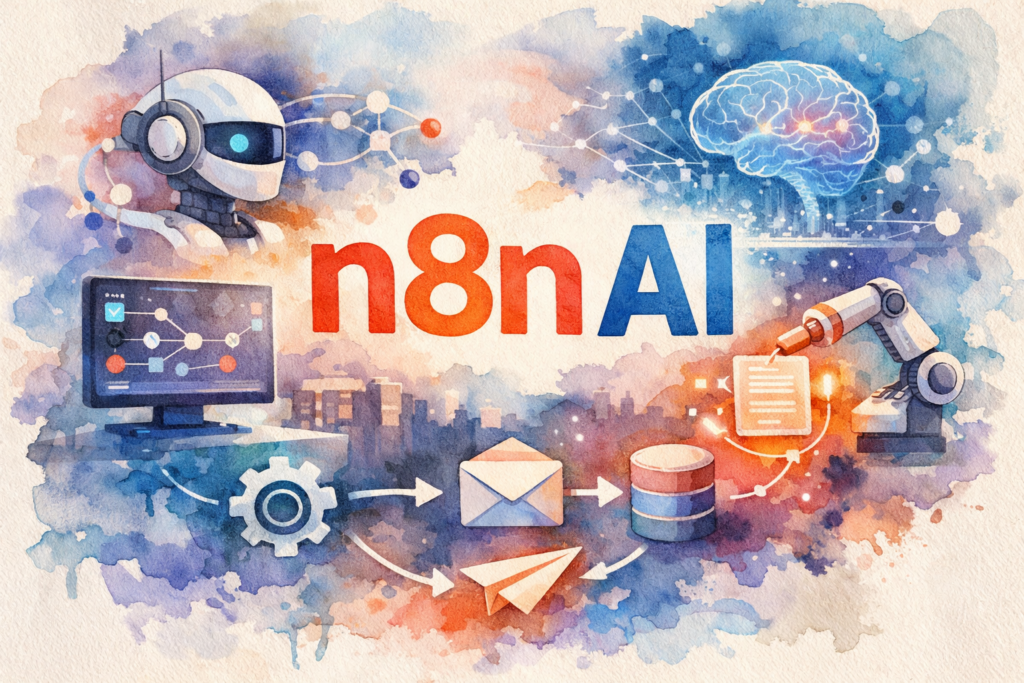
Imagine spending hours each week on repetitive tasks—copying data between applications, sending follow-up emails, or updating spreadsheets. Now imagine reclaiming that time whilst your workflows run themselves, intelligently adapting to your needs. This isn’t science fiction; it’s the reality that n8n AI brings to businesses and individuals seeking smarter automation solutions.
In today’s fast-paced digital landscape, manual processes are the bottleneck holding back productivity and growth. Traditional automation tools often require extensive coding knowledge or expensive enterprise solutions that remain out of reach for many organisations. The challenge isn’t just about automating tasks—it’s about creating intelligent workflows that can think, adapt, and improve over time.
Quick Answer
What is n8n AI? n8n AI is an advanced workflow automation platform that combines traditional automation capabilities with artificial intelligence features. It allows users to create intelligent, self-optimising workflows that can process natural language, make decisions, and integrate with hundreds of applications without extensive coding knowledge.
Key Benefits: Reduces manual work by up to 80%, integrates with 400+ applications, offers AI-powered decision-making, and provides a visual workflow builder that’s accessible to non-technical users.
Whether you’re a small business owner drowning in administrative tasks or an enterprise seeking to streamline complex operations, n8n AI offers a transformative approach to workflow automation. This comprehensive guide explores seven powerful methods to leverage n8n’s AI capabilities, helping you automate faster, smarter, and more efficiently than ever before.
Understanding n8n AI and Its Revolutionary Approach to Automation
n8n represents a paradigm shift in workflow automation technology. Unlike traditional automation platforms that simply connect applications through predefined rules, n8n AI introduces intelligent decision-making capabilities that transform static workflows into dynamic, adaptive systems.
At its core, n8n is an open-source workflow automation tool that enables users to connect various applications, services, and APIs through a visual interface. What sets it apart is its integration of artificial intelligence features that allow workflows to process unstructured data, understand context, and make intelligent decisions without constant human intervention.
The Current State of AI-Powered Automation
The automation market has experienced explosive growth, with research indicating that businesses implementing intelligent automation solutions report productivity increases of 40-60%. According to industry analyses, the global workflow automation market is projected to reach $41.8 billion by 2027, driven largely by AI integration.
What makes n8n AI particularly relevant is its democratisation of advanced automation. Whilst enterprise solutions like UiPath or Blue Prism require significant investment and technical expertise, n8n provides comparable AI capabilities through an accessible, visual interface that technical and non-technical users alike can master.
Why n8n AI Matters for Modern Businesses
The importance of n8n AI extends beyond simple task automation. It addresses three critical business challenges:
- Integration complexity: Modern businesses use an average of 110 different SaaS applications, creating data silos and inefficiencies. n8n AI bridges these gaps seamlessly.
- Resource constraints: Small to medium-sized businesses often lack dedicated IT teams for automation projects. n8n’s visual approach reduces the technical barrier significantly.
- Adaptive intelligence: Static automation breaks when conditions change. AI-powered workflows adapt to variations in data, context, and business rules automatically.
The platform’s open-source nature also means organisations maintain complete control over their data and workflows—a crucial consideration in an era of increasing data privacy regulations and security concerns.
7 Powerful Ways to Leverage n8n AI for Workflow Automation
Implementing n8n AI effectively requires understanding its most impactful use cases. These seven strategies represent proven approaches that deliver immediate value whilst building towards more sophisticated automation ecosystems.
1. Intelligent Email Processing and Response
Email remains the primary communication channel for most businesses, yet managing high volumes of incoming messages consumes countless hours. n8n AI transforms email handling through natural language processing capabilities that can categorise, prioritise, and even draft responses automatically.
By connecting n8n to email services like Gmail or Outlook, you can create workflows that analyse incoming messages, extract key information, and route them to appropriate team members or systems. The AI component understands context, sentiment, and urgency—distinguishing between a routine enquiry and a critical customer issue.
Real-world impact: A marketing agency implemented n8n AI for client communication management, reducing email response time by 73% and freeing up 15 hours per week for strategic work.
2. Data Enrichment and CRM Automation
Customer relationship management systems like Salesforce, HubSpot, or Pipedrive contain valuable data, but keeping records current and complete requires constant manual effort. n8n AI automates data enrichment by pulling information from multiple sources and intelligently updating records.
When a new lead enters your system, n8n workflows can automatically research the company, gather social media profiles, assess company size and industry, and score lead quality—all before a salesperson even sees the record. This intelligent preprocessing ensures your team focuses energy on the most promising opportunities.
3. Content Creation and Social Media Management
Creating consistent, engaging content across multiple platforms challenges even dedicated marketing teams. n8n AI streamlines content workflows by integrating with AI writing tools and social media platforms to generate, schedule, and optimise posts automatically.
By connecting n8n with platforms like LinkedIn, Twitter, and content management systems, you can create workflows that monitor trending topics, generate relevant content suggestions, and even draft posts that match your brand voice. The AI analyses engagement patterns to determine optimal posting times and content formats.
4. Intelligent Document Processing
Processing invoices, contracts, receipts, and other documents typically requires manual data entry—tedious work prone to errors. n8n AI leverages optical character recognition (OCR) and natural language understanding to extract information from documents automatically, regardless of format variations.
These workflows can process incoming documents from email or cloud storage services like Dropbox or Google Drive, extract relevant data points, validate information against existing records, and update accounting or project management systems—all without human intervention.
Practical example: An accounting firm automated invoice processing using n8n AI, reducing processing time from 10 minutes per invoice to under 30 seconds, whilst improving accuracy to 99.2%.
5. Customer Support Automation
Providing responsive customer support across multiple channels strains resources, particularly for growing businesses. n8n AI creates intelligent support workflows that handle routine enquiries, escalate complex issues, and ensure no customer message goes unanswered.
By integrating with support platforms like Zendesk, Intercom, or Slack, n8n workflows can analyse incoming support requests, search knowledge bases for relevant solutions, and either provide automated responses or route tickets to specialists with appropriate context and priority levels.
6. E-commerce Order Processing and Fulfilment
E-commerce operations involve numerous steps between order placement and delivery. n8n AI orchestrates these processes by connecting platforms like Shopify, WooCommerce, or Magento with inventory systems, shipping providers, and accounting software.
Intelligent workflows can detect fraud patterns, optimise shipping methods based on cost and delivery time, generate personalised follow-up communications, and even predict inventory needs based on order patterns—transforming order fulfilment from a reactive process to a proactive, optimised operation.
7. Business Intelligence and Reporting Automation
Data-driven decision-making requires current, accurate information, yet compiling reports from multiple sources consumes significant time. n8n AI automates data collection, analysis, and reporting by connecting to databases, analytics platforms, and business intelligence tools.
Workflows can gather data from sources likeGoogle Analytics, Tableau, or custom databases, apply AI-powered analysis to identify trends and anomalies, and generate comprehensive reports delivered automatically to stakeholders. The AI component can even provide natural language summaries of key findings, making complex data accessible to non-technical decision-makers.
Implementing n8n AI: A Practical Step-by-Step Guide
Successfully deploying n8n AI requires a structured approach that balances ambition with practicality. This implementation framework has proven effective across organisations of varying sizes and technical capabilities.
Step 1: Assess Your Automation Opportunities
Begin by identifying processes that consume disproportionate time relative to their value. Look for tasks characterised by high volume, clear rules, and multiple system interactions. Document current workflows, noting pain points, bottlenecks, and manual handoffs.
Create a prioritisation matrix evaluating potential automation projects based on implementation complexity versus business impact. Quick wins—high-impact, low-complexity projects—should be your initial focus, building momentum and demonstrating value before tackling more ambitious initiatives.
Step 2: Set Up Your n8n Environment
n8n offers flexible deployment options. For initial exploration, the cloud-hosted version provides immediate access without infrastructure concerns. Organisations with specific security or customisation requirements may prefer self-hosted deployment on platforms like AWS, Google Cloud, or DigitalOcean.
The self-hosted approach provides complete data control and unlimited workflow executions, whilst cloud hosting offers simplicity and managed updates. Consider your organisation’s technical capabilities, compliance requirements, and budget when making this decision.
Step 3: Build Your First Workflow
Start with a simple, well-defined process. A common first project involves automating lead capture—when a form submission occurs on your website, n8n creates a contact in your CRM, sends a welcome email, and notifies your sales team.
n8n’s visual workflow builder uses a node-based interface where each node represents an action or decision point. Drag nodes onto the canvas, configure their settings, and connect them to define your workflow logic. The platform includes over 400 pre-built integrations, reducing the need for custom code.
Best practice tip: Test workflows thoroughly using n8n’s execution history and debugging tools before deploying to production. Start with manual triggers, verify each step produces expected results, then switch to automatic triggers once confident in the workflow’s reliability.
Step 4: Integrate AI Capabilities
Once comfortable with basic workflows, incorporate AI features to add intelligence. n8n supports integration with AI services like OpenAI, enabling natural language processing, content generation, and intelligent decision-making within your workflows.
Common AI integrations include sentiment analysis for customer communications, text classification for content routing, data extraction from unstructured sources, and predictive analytics for business forecasting. These capabilities transform reactive workflows into proactive, intelligent systems.
Step 5: Monitor, Optimise, and Scale
Successful automation requires ongoing attention. Monitor workflow execution rates, error frequencies, and processing times. n8n provides detailed execution logs and error notifications, enabling rapid identification and resolution of issues.
As workflows prove their value, expand their scope or create additional automations. Document your workflows thoroughly, including their purpose, dependencies, and maintenance requirements. This documentation proves invaluable as your automation ecosystem grows and team members change.
Overcoming Common n8n AI Implementation Challenges
Whilst n8n AI dramatically simplifies workflow automation, organisations inevitably encounter obstacles during implementation. Understanding these challenges and their solutions accelerates your automation journey.
Challenge 1: Integration Complexity with Legacy Systems
Many organisations rely on older systems lacking modern APIs or integration capabilities. This creates barriers when attempting to include these systems in automated workflows.
Solution: n8n supports multiple integration methods beyond standard APIs, including webhooks, database connections, and even web scraping for systems without programmatic access. For particularly challenging integrations, consider implementing middleware solutions or gradually migrating to more integration-friendly alternatives.
Challenge 2: Managing Workflow Complexity
As automation ambitions grow, workflows can become unwieldy, with dozens of nodes and complex conditional logic that becomes difficult to maintain and troubleshoot.
Solution: Adopt modular workflow design principles. Break complex processes into smaller, focused workflows that can be chained together. Use n8n’s sub-workflow functionality to create reusable components. Document decision logic clearly and implement consistent naming conventions for nodes and variables.
Challenge 3: Ensuring Data Security and Compliance
Automated workflows often process sensitive information, raising concerns about data security, privacy regulations, and compliance requirements.
Solution: Implement security best practices including encrypted credential storage, role-based access controls, and audit logging. For highly sensitive data, consider self-hosted deployment with network isolation. Regular security reviews and compliance audits should be part of your automation governance framework.
Challenge 4: Handling Errors and Edge Cases
Real-world data is messy. Workflows designed for ideal conditions often fail when encountering unexpected inputs, system unavailability, or data format variations.
Solution: Build robust error handling into every workflow. Use n8n’s error workflow functionality to catch and manage failures gracefully. Implement retry logic for transient failures, validation checks for data quality, and notification systems to alert administrators of persistent issues. Design workflows to fail safely, ensuring partial failures don’t corrupt data or leave processes in inconsistent states.
Conclusion: Transform Your Business with n8n AI
The journey from manual, time-consuming processes to intelligent, automated workflows represents more than operational improvement—it’s a fundamental transformation in how organisations operate and compete. n8n AI provides the tools, flexibility, and intelligence needed to make this transformation accessible to businesses of all sizes.
Throughout this guide, we’ve explored seven powerful automation strategies, from intelligent email processing to comprehensive business intelligence reporting. We’ve examined practical implementation steps that move you from concept to production quickly, and addressed common challenges that might otherwise derail your automation initiatives.
The benefits extend beyond time savings. Organisations implementing n8n AI report improved accuracy, enhanced customer experiences, better resource allocation, and increased employee satisfaction as team members shift from repetitive tasks to strategic, creative work. These improvements compound over time, creating competitive advantages that become increasingly difficult for competitors to match.
The automation landscape continues evolving rapidly, with AI capabilities becoming more sophisticated and accessible. Early adopters of platforms like n8n AI position themselves to capitalise on these advances, building automation expertise and infrastructure that will serve them for years to come.
Whether you’re just beginning your automation journey or seeking to enhance existing capabilities, the time to act is now. Start small, focus on delivering value quickly, and build momentum through demonstrated success. Your future self—and your team—will thank you for the hours reclaimed and the possibilities unlocked.
Ready to Transform Your Workflows?
Don’t navigate the automation journey alone. Our team of experts at The Crunch specialises in implementing n8n AI solutions tailored to your unique business needs.
Schedule your free consultation today and discover how n8n AI can revolutionise your operations.
Frequently Asked Questions (FAQ)
1. What is n8n AI?
2. How does n8n AI work?
3. How do I get started with n8n AI?
4. What are the benefits of using n8n AI?
5. Is n8n AI free to use?
6. How does n8n AI compare to other AI automation tools?
7. What AI models or providers can I use with n8n AI?
8. Are there any limitations or concerns with using n8n AI?
9. Can I use n8n AI without coding experience?
10. What are some common use cases for n8n AI?
11. How secure is n8n AI for handling sensitive data?
12. Does n8n AI support custom AI models?